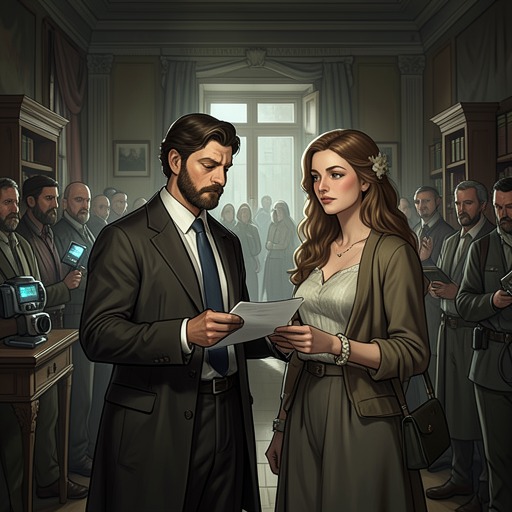
Shen Tang and the Original Shen Tang
I’m Very Happy After Marrying the CEO Husband According to the AgreementShen Tang and the Original Shen Tang are revealed as two manifestations of the same identity across different worlds and narrative layers. What first appears to be transmigration into another person’s life becomes a more complicated reunion: Shen Tang discovers that the orphan she has been observing and the original Shen Tang whose body carried the novel’s suffering are, in a profound sense, herself. This revelation transforms her relationship with the original character from substitution into recovered selfhood, while also forcing her to reconsider responsibility, memory, and the boundaries between fictional existence and lived reality.
Two Lives Linked Across Worlds
Shen Tang initially understands herself as someone who has entered the world of a novel and taken the place of the original Shen Tang. The original character’s life, as seen in Shen Tang’s dream, is marked by humiliation, wrongdoing, and a terrible death. After that death, the original Shen Tang’s soul leaves her body, travels to another world, and discovers the truth: she has been only a character in a novel, created to be shamed and subjected to the author’s control. The discovery destroys her sense of reality because it reveals that even her suffering and choices have been governed by an external narrative power.
The story then presents a second beginning. The original Shen Tang becomes the Shen Tang of another world, an orphan who mysteriously appears at the door of an orphanage. Shen Tang later watches this life unfold from the position of a bystander, experiencing it as both familiar and different. The two lives therefore form a repeated cycle rather than a simple replacement: one Shen Tang suffers inside the novel, dies, crosses into another world, and begins again as an orphan, while the present Shen Tang lives that later existence and gradually recognizes its connection to the earlier one.
The Revelation of the Original Self
The decisive conversation occurs when Shen Tang asks Master Zang where the original Shen Tang went. His answer is that she is far away yet directly before Shen Tang’s eyes. The reply does not identify a separate destination or another surviving body. Instead, it directs Shen Tang toward the conclusion that the original Shen Tang is present in her own existence. Shen Tang herself wonders whether she is the Shen Tang from that world and whether the two are actually the same person; Master Zang confirms that she already has the answer within her.
The revelation is deliberately indirect. Shen Tang is not given a technical explanation that separates souls, bodies, timelines, or textual identities into neat categories. She must infer the truth from the recurrence of her life and from the inexplicable correspondence between the two versions of herself. The ambiguity is central to the relation: the original Shen Tang is both an earlier self and a seemingly distinct person, both someone Shen Tang watches and someone whose history she inherits.
Body, Memory, and the Experience of Watching
The relationship is defined as much by bodily separation as by spiritual continuity. In one return to the real world, Shen Tang sees her unmoving body lying in a hospital room with tubes inserted into it and notices that it has lost weight. She attempts repeatedly to enter and reunite with that body but cannot integrate into it. This scene makes her identity unstable on several levels: consciousness is mobile, the body is inaccessible, and the self cannot be reduced to either physical presence or mental continuity alone.
The later dream gives this instability a narrative form. Shen Tang stands like a spectator at the edge of the original Shen Tang’s entire life, seeing it unfold in a flash while the original consciousness remains clear but unable to control the body. The arrangement reverses ordinary experience. Shen Tang is the one who can see but does not act, while the original Shen Tang is the one who possesses consciousness but lacks bodily agency. Their relation thus begins as a divided subjectivity: one self is split between witness and victim, memory and embodiment, awareness and control.
Orphanhood and the Recovered Explanation
The connection between the two identities also explains a biographical mystery that Shen Tang had previously treated as an absence without an answer. She remembers that Dean Mum once said she had been found with a bag embroidered with the Shen character, which led to her being named Shen. No one knows whether she was deliberately abandoned or simply lost, and no one ever came searching for her; there were not even missing-person notices connected with her disappearance.
Shen Tang has long been past the age of needing parents, and the revelation does not produce a sentimental restoration of family life. Instead, it gives her orphanhood an ontological explanation: she was not originally from this world, so there was no ordinary family in it capable of finding her. She even fears that biological parents might resemble the cruel figures associated with Shen Lan’s history, concluding that having no such parents could be preferable. The original Shen Tang’s cross-world passage therefore explains not only where Shen Tang came from, but why her lack of origins had remained absolute.
Recognition, Shame, and Narrative Significance
Once Shen Tang understands that she is the original Shen Tang and that the original Shen Tang is herself, she also has to face the conduct of her earlier life. She feels embarrassed when remembering what she did to Gu Huaian in the past life, although she is relieved that Gu Huaian does not know about it. The response is neither total rejection of the original character nor uncomplicated self-forgiveness. Shen Tang recognizes continuity strongly enough to feel accountable, yet still experiences the former life as something she watched from outside and as a version of herself shaped by forces beyond her control.
The relation consequently turns the novel’s transmigration premise into an inquiry about identity rather than a permanent division between a modern heroine and a disposable fictional counterpart. The original Shen Tang is not merely the body that Shen Tang occupies, a failed predecessor, or a convenient plot device. She is the buried history through which Shen Tang comes to understand her own orphanhood, her past-life suffering, and the instability of the world she inhabits. Their reunion collapses the distinction between replacement and return: Shen Tang has not simply escaped another woman’s fate; she has inherited, witnessed, and ultimately reclaimed the life that once seemed to belong to someone else.