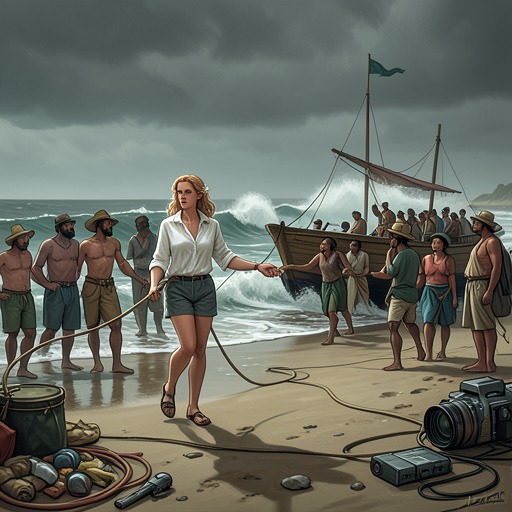
Storm-Stranding and Rescue on 13 Days on the Island
I’m Very Happy After Marrying the CEO Husband According to the AgreementStorm-Stranding and Rescue on 13 Days on the Island is the major environmental crisis of 13 Days on the Island, transforming a controlled survival-production exercise into a genuine emergency. Shen Tang recognizes the coming weather change before the storm arrives, tries to protect separated participants, and ultimately becomes one of those left in danger when rain and wind cut the island off from outside assistance. The crisis also changes the emotional and practical stakes between Shen Tang and Gu Huaian: rescue is no longer an abstract gesture, but a dangerous expedition undertaken because her safety can no longer be left to the program team.
Causes and Background
The event begins on a large, nearly empty island selected for 13 Days on the Island. Shen Tang initially suspects that the production team has exaggerated the island’s isolation and lack of resources, but discovers that the description is accurate: the territory is expansive and contains almost nothing usable. That setting makes weather decisive. With little infrastructure and limited shelter, the participants depend on the program’s equipment, staff, cameras, and eventual access by sea.
The cast is already dispersed when Shen Tang notices the atmospheric shift. Looking at the sky with knitted brows, she warns that the weather is about to change. Soon after the group sets out, the sky darkens. Rather than treating the warning as a private inconvenience, Shen Tang looks toward the aerial camera and asks the director to guide them toward He Yuan and Ao Ziping, because the two men may be in danger if the storm arrives. Her first response is therefore protective and collective: she attempts to reconnect the separated contestants before the island becomes inaccessible.
The production’s logistical assumptions collapse faster than the participants can respond. Before Shen Tang’s group can leave the woods, heavy rain is already falling. At the campsite, Zhou Hao and Huo Yingying face the same breakdown from another direction: the wind and rain render the tent shelter useless. The event is thus not confined to one stranded subgroup. The island’s size, the separation of the cast, the absence of substantial shelter, and the worsening weather combine to turn ordinary filming conditions into a life-threatening predicament.
The Storm and the Stranding
The rain begins before the participants can reach safety, while the campsite is battered by wind. The tent, which should serve as the most immediate production shelter, cannot withstand the conditions. At the same time, staff report that the storm makes it inconvenient or impossible to go out to sea. That decision has a crucial consequence: the normal rescue route is closed precisely when the participants most need it. The island becomes physically and narratively sealed off, and the production team can no longer treat the danger as a problem that can be solved by routine transport.
The crisis is intensified by another hazard encountered during the same period. Zhou Hao suffers a sharp injury to the neck and gives a muffled grunt. Shen Tang examines the wound and states that it is not poisonous, then searches the surrounding area and finds a snake nest deeper in the vegetation, filled with small snakes moving densely together. The discovery turns the storm-stranding into a layered survival emergency: flooding rain and failed shelter are accompanied by the immediate possibility of further animal danger. Shen Tang’s practical knowledge and composure prevent the injury from escalating into panic, but the snake nest confirms how little control the contestants possess over the island environment.
The production’s public-facing format creates a striking contrast with the physical reality. The event is being observed through cameras, yet observation does not equal protection. Shen Tang can appeal to the director through the aerial camera, but the staff cannot immediately reach the isolated participants, and the sea route is suspended by the weather. The show’s promise of a visible, managed survival experience gives way to an actual dependence on terrain, shelter, communication, and rescue capacity. Shen Tang even recalls that the book’s plot only briefly mentioned that this reality show became popular without explaining why, suggesting that the storm may be the unrecorded mechanism behind the program’s later fame.
Gu Huaian’s Rescue Operation
While the storm isolates Shen Tang, Gu Huaian returns home to an unexpected quiet and learns that the situation has become abnormal. He Uncle says that rescue personnel have already been contacted and that the program team should send someone over, interpreting Shen Tang’s condition as panic while the response is still being organized. The initial plan remains institutional and procedural: contact rescuers, wait for the production team, and assume that the emergency can be contained through established channels.
Gu Huaian does not remain a passive observer of that plan. Several luxury cars pull over, and he asks for the locator belonging to the live-streaming device. The request is concrete and technically focused. Rather than relying on vague reports or public images, he seeks the participants’ actual positions. Once he obtains several locations, Gu Huaian and his group board a boat and set out. The rescue therefore proceeds in spite of the sea conditions that had made ordinary travel inconvenient, converting his concern into a direct physical intervention.
Shen Tang has never imagined that Gu Huaian would come. His arrival consequently carries more than logistical value. It reverses the isolation imposed by the storm and demonstrates that the person outside the program structure most willing to act is Gu Huaian. His subordinates later help the participants leave: everyone packs belongings, cleans up the trash, and follows them. Even in an emergency, the departure is not represented as simple flight; the contestants recover their possessions and clear the site before being escorted away, preserving a measure of order amid the collapse of the planned production.
Consequences and Significance
The storm changes the meaning of survival in 13 Days on the Island. Before the weather turns, the cast can still treat scarcity, campsites, games, food, and filming as components of a reality-show format. Once the tents fail, the rain becomes torrential, the island groups are separated, a snake nest is discovered, and sea travel is halted, the program’s artificial boundaries cease to protect anyone. Nature becomes an active force rather than a scenic backdrop, while production technology provides location data without guaranteeing immediate safety.
For Shen Tang, the event reinforces her role as a participant who notices danger early and acts for others before securing her own position. She warns the group about the weather, asks the director to locate He Yuan and Ao Ziping, assesses Zhou Hao’s injury, and investigates the surrounding threat instead of surrendering to fear. Her constant professional smile elsewhere in the entertainment world contrasts with the crisis behavior seen here: the public performer who can endure hostile comments without showing distress is also the practical survivor who responds to danger through observation and action.
For Gu Huaian, the rescue marks a decisive escalation in his connection to Shen Tang. He uses the live-streaming device’s locator, gathers multiple positions, takes a boat to the island, and personally brings the stranded group out. The rescue is therefore both an emergency response and a relationship-changing action. It makes his commitment visible through risk and labor rather than through publicity, while the storm supplies the pressure that ordinary social circumstances had previously kept hidden.
The event also explains why the reality show can become unexpectedly prominent even though its original plot summary offers no clear reason. A storm that traps contestants, defeats their shelter, interrupts sea travel, exposes a snake nest, and necessitates an outside rescue contains the dramatic value of a full disaster narrative. The show’s popularity is not merely the result of celebrity pairing or manufactured publicity; it is also tied to the moment when staged hardship becomes uncontrolled danger and the participants’ survival depends on real decisions made under pressure.