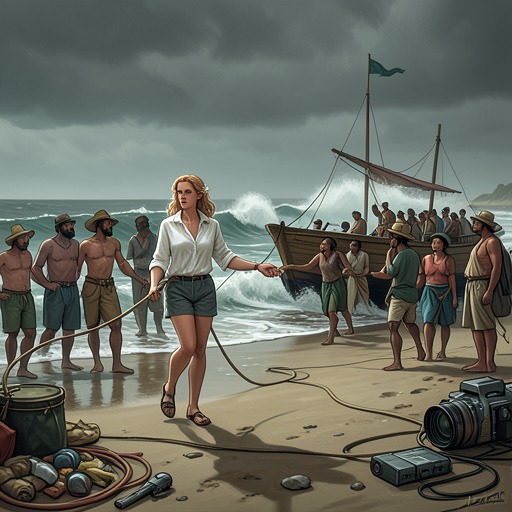
Survival Resource Pack
I’m Very Happy After Marrying the CEO Husband According to the AgreementThe survival resource packs are the central material system of the island survival show. They contain the supplies that make the guests’ thirteen-day ordeal possible, but they are not handed over at the beginning: the program team scatters them across the island, turning food, water, shelter, and clothing into rewards that must be found, carried, rationed, and shared. Their importance lies in the tension they create between a television premise and a real physical emergency.## Definition and Distribution At the start of the challenge, the director requires every guest to surrender luggage and mobile phones, allowing each person to keep only three things. When the guests protest that survival for thirteen days would be impossible with so little, the director explains that resource packs are available on the island, although the guests must locate them themselves. The packs therefore replace ordinary personal baggage with a controlled and uncertain supply network: the participants lose the security of possessions while remaining dependent on objects placed by the production itself.
The island initially appears almost completely empty. Shen Tang discovers that the program team’s description was accurate: there is no ordinary infrastructure for eating, drinking, or even basic bodily needs. Against this blank landscape, a resource pack is not merely a prop or prize. It is one of the few material interruptions in an environment described as having practically nothing, and its scarcity gives every discovery immediate practical and narrative weight.## Contents and Immediate Uses When Ao Ziping and Huo Yingying return with a pack, it contains water, compressed biscuits, instant noodles, and a sleeping bag. The contents establish the pack’s basic logic. Water and food address immediate bodily survival; the sleeping bag provides protection and rest. Yet the single sleeping bag also exposes the limits built into the system. The male guests gallantly leave it to the women, while the men gather large leaves and sleep directly on the ground. The pack thus supplies relief without eliminating inequality, forcing the group to decide who receives the most effective form of shelter.
The packs also contain extra clothing. After heavy rain, the guests carry whatever they can salvage while evacuating toward a dry cave. He Yuan notes that the cave already contains dry branches, and the group uses a campfire there; once they change into dry clothes from the packs and warm themselves, they can finally relax. In this sequence, the packs connect several stages of survival: they provide clothing against exposure, food and water against hunger and thirst, sleeping equipment for rest, and materials that can be moved into a safer shelter when the original campsite becomes untenable.## Collective Survival and Material Burden The packs are valuable precisely because they are difficult to transport. During the evacuation, Zhao Zhe is already exhausted while supporting the injured Zhou Hao, and Huo Yingying can barely walk straight while carrying two packs. Shen Tang carries pots on her head and two packs on her back before taking Huo Yingying’s load as well, explaining that she is stronger. The supplies therefore become a test of physical capacity and mutual obligation. They preserve the group’s chances of survival, but their weight also increases the danger of moving through rain and unstable conditions.
Once the group reaches the cave, the supplies become the basis for rationing. Shen Tang estimates that the remaining food and water can last two or three days if everyone is prudent, while also reassuring the others that the production team will send rescuers. The packs make this calculation possible, but they do not make the situation safe. They turn an abstract promise of survival into a measurable question of quantities, duration, and restraint. The object’s presence stabilizes the group only by reminding everyone how quickly its contents can run out.
At night, after arranging shifts to keep watch, the guests take sleeping bags from the packs and attempt to rest. The following morning, with the rain still falling and morale declining, Shen Tang removes food from a pack and distributes it to everyone. Her action reinforces the emerging leadership structure: the others increasingly look to her because she is both the most popular participant and the calmest under pressure. The resource packs consequently help redistribute authority. Whoever controls access to food, shelter, or useful equipment can influence the group, but Shen Tang uses that practical position to feed everyone rather than to hoard supplies.## Material Agency and Narrative Function The packs participate directly in the show’s unfolding events. They determine where the guests search, what they can carry, how long they can remain in a location, and whether they can withstand rain, injury, and exhaustion. Their contents also interact with the island’s nonhuman environment. The guests must search a landscape that contains hazards such as a snake’s nest, while the packs provide only limited protection and endurance. Later agricultural scenes recall a different relation to material provision: in the south, spring corn is being harvested and autumn corn will be planted afterward, placing the immediate scarcity of survival-show food beside the slower cycles of cultivation and harvest.
This contrast gives the packs a broader significance. On the island, food and equipment are packaged, hidden, and consumed under the pressure of spectacle. In the farming setting, food production unfolds through seasonal labor: spring corn is harvested, and autumn corn will be planted after it. The packs compress the chain of survival into portable objects, while agriculture makes that chain visible across months. Both settings show that apparent self-sufficiency depends on material systems, labor, and environments that the guests cannot simply command.
The packs also sharpen the show’s irony. The production team presents the island as an organized challenge, but the guests experience the consequences of an environment with no basic facilities, prolonged rain, injuries, and dangerous animals. Even when a pack is found, it offers only partial control. Its single sleeping bag creates a social decision; its weight complicates rescue; its food and water impose a timetable; and its clothing becomes essential only after the weather turns threatening. The packs are therefore neither passive background objects nor magical solutions. They are active constraints within the survival assemblage, converting the program’s rules into bodily labor and group ethics.
As recurring objects, the survival resource packs embody the unstable boundary between entertainment and genuine vulnerability. They make the island challenge possible, but they also reveal how thin the margin is between a managed television experiment and an emergency. Shen Tang’s strength, composure, and willingness to distribute provisions give the packs their humane function, while the island’s emptiness, rain, wildlife, and scarcity prevent them from becoming a guarantee. Their decisive narrative role is to make survival concrete: thirteen days are reduced to water, compressed biscuits, instant noodles, clothing, sleeping bags, carrying capacity, and the question of whether a group will share what little it has.