White Moonlight
I’m Very Happy After Marrying the CEO Husband According to the AgreementWhite Moonlight is the story’s name for an apparently irreplaceable former love, but its decisive function is less to identify a confirmed romance than to organize Shen Tang’s fear of being only a substitute. The concept enters through rumor and indirect testimony: Shen Tang hears that Gu Huaian has a White Moonlight and immediately treats that supposed woman as the “official” person whose return would force an “imitation product” like herself to give way. The phrase therefore turns uncertainty into an emotional hierarchy, placing an absent woman above Shen Tang before Gu Huaian has confirmed that the relationship exists at all.
The Rumor and Shen Tang’s Insecurity
Shen Tang’s first response is investigative rather than openly romantic. She explains that she only wanted information from Gu Huaian’s White Moonlight after hearing about her, insisting that she has no other intentions. Yet her language reveals the deeper wound beneath the denial: she imagines the White Moonlight as the original and herself as a replacement, someone who should retreat once the supposedly authentic beloved returns. The concept thus exposes Shen Tang’s precarious understanding of her place beside Gu Huaian. It is not merely a label for another woman; it is a verdict on Shen Tang’s legitimacy.
When Shen Tang later asks whether Gu Huaian went to receive his White Moonlight after seeing Miao Miao’s WeChat timeline, her outward composure conceals acute anxiety. The question is prompted by a social-media post announcing the woman’s return, and Shen Tang worries that even asking may make her seem intrusive. This detail gives the concept a distinctly modern mechanism: a few words and banquet photographs on WeChat can create an entire romantic narrative before the people involved speak directly. The White Moonlight is first encountered as a mediated image, not as a personal history.
Gu Huaian’s Denial
Gu Huaian answers Shen Tang’s suspicion with a terse assertion that there is no one. His denial is important because it directly contradicts the premise on which Shen Tang has built her unease. The exchange does not immediately erase the rumor; instead, it creates a gap between what Shen Tang has heard, what she sees online, and what Gu Huaian says. The concept consequently operates through absence. The more emphatically the supposed beloved is discussed, the less securely she exists as a confirmed romantic fact.
Gu Huaian’s response also reveals the asymmetry between the two characters’ positions. Shen Tang is forced into explanation because she fears that her questions expose jealousy or ulterior motives, while Gu Huaian can reject the premise in a few words. His bluntness frustrates the elaborate emotional logic Shen Tang has constructed around the rumor. The White Moonlight becomes a test of communication: indirect evidence encourages fantasy, whereas direct speech appears to dissolve it, at least temporarily.
The Return of the Supposed Beloved
The rumor gains apparent substance when Shen Tang opens photographs from a banquet and sees a beautiful, innocent-looking woman standing among the guests. Shen Tang identifies her as the person represented by Gu Huaian’s White Moonlight and admits that the woman is indeed striking. This visual confirmation deepens the misunderstanding because the image seems to validate the story that Gu Huaian has been longing for someone absent. Beauty, social presence, and the announcement of her return combine to make the White Moonlight appear real even though Gu Huaian has denied having one.
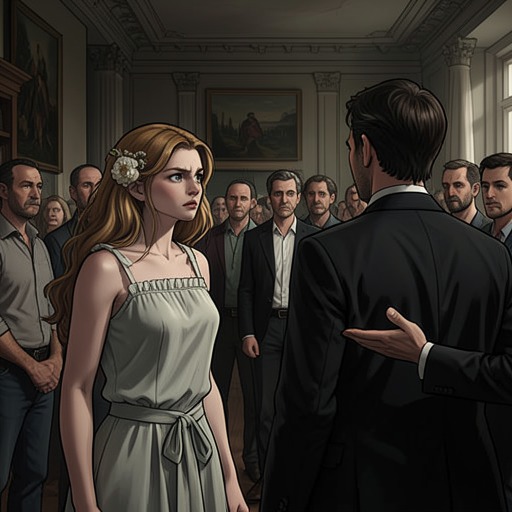
The woman’s later arrival at Shen Tang’s room gives the concept a physical form. Shen Tang expects Gu Huaian but finds Lotus Sis instead, carrying a lunch box. The scene is charged by the contradiction between Gu Huaian’s claim that he is not close to her and her unexplained presence in a private, caring-looking circumstance. Her faint smile and greeting do not settle the relationship; they make the ambiguity more concrete. The White Moonlight has crossed from a rumor on a timeline into a person standing before Shen Tang, yet the central question remains unresolved: whether this woman is truly Gu Huaian’s lost love or merely someone whom others have placed in that role.
Zhou Qinglian and Competing Narratives
The concept is further complicated by Zhou Qinglian’s account of why she is present. When Gu Huaian questions her, she says that Uncle Gu allowed her to come. Her shy smile, the attention of people around them, and her attempt to seize Gu Huaian’s clothing—followed by his avoidance—create a public performance of intimacy without confirming mutual affection. Her behavior supplies the kind of scene that can be read as evidence of a former attachment, while Gu Huaian’s physical withdrawal points in the opposite direction.
Zhou Qinglian’s appearance also connects the White Moonlight rumor to Gu Jinan’s plans against Shen Tang. Gu Huaian remembers surveillance in which Gu Jinan said she wanted to deal with Shen Tang, although he is unsure how much of the recording is true. Zhou Qinglian’s explanation that Uncle Gu sent her therefore cannot be treated as a simple romantic reunion. The White Moonlight may be a sentimental label, but the circumstances surrounding her return include family intervention, surveillance, public scrutiny, and possible hostility toward Shen Tang. The concept’s apparent romance is consequently entangled with power and strategy.
Narrative Function and Significance
White Moonlight functions as a false or unstable romantic premise that drives Shen Tang toward jealousy, self-displacement, and direct confrontation. It embodies the danger of allowing a relationship to be defined by hearsay: a social-media message becomes a supposed history, a photograph becomes proof of emotional importance, and a woman’s presence becomes confirmation of a triangle that Gu Huaian rejects. Each new piece of information seems to clarify the situation while introducing another contradiction.
At the same time, the concept measures the transformation of Shen Tang and Gu Huaian’s relationship from contractual uncertainty toward emotional accountability. Shen Tang’s fear is not simply that Gu Huaian loves another woman; it is that her own place beside him is provisional and replaceable. Gu Huaian’s denial challenges that fear, but the surrounding appearances prevent reassurance from arriving easily. White Moonlight therefore marks the distance between public romantic mythology and private relational truth. Its power comes from what it makes Shen Tang believe before the facts can catch up.