Chuck Carr
I'd Like to Apologize to Every Teacher I Ever HadChuck Carr is a veteran mathematics educator at Northeast High School whose authority comes from thirty-six years of teaching and whose exacting conduct exposes the contradiction at the center of the school’s reform culture. He treats teaching as a life’s work, insists that standardized testing rules be followed without exception, and resists the idea that professional care can be reduced to improvisation or good intentions. At the same time, his gruffness conceals a durable commitment to the institution and its students: when retirement approaches, he changes his mind and stays for one more year, saying that perhaps he will finally get it right.
Identity and Professional Ethos
Chuck Carr is introduced as the head of the Math Department, a large, sturdy man with white hair arranged along a precise part. His usual movement through the halls is marked by resignation, but on the morning of the practice PSSA he becomes visibly energized as he distributes testing materials, directs teachers to calculators, and organizes everything students might need. The contrast is revealing. The test is not merely another administrative task to him; it is serious business because the school’s institutional future has been attached to its results.
Carr’s seriousness also governs his first encounter with Tony Danza. Early in the school year, he enters Danza’s classroom, sits down, and asks whether the new teacher has come to teach or merely to act the part. He presses further, demanding to know whether teaching is a chosen responsibility undertaken to make a difference or simply another acting job. When Danza says that he is frightened but intends to make a difference, Carr asks the more practical and ominous question of whether he will return the following year. Carr’s concern is not theatrical performance but endurance: a teacher must understand that the work continues beyond the first burst of purpose.
Carr then states the principle that defines him: teaching is his life’s work, as it is for many of the educators at Northeast High School, and even a teacher who remains for only two weeks, two months, or two years must keep that fact in mind. His wish of luck to Danza is restrained rather than sentimental, but it functions as both warning and acknowledgment. Carr recognizes the difficulty of the profession while insisting that difficulty does not excuse superficial commitment.
The PSSA and the Limits of Good Intentions
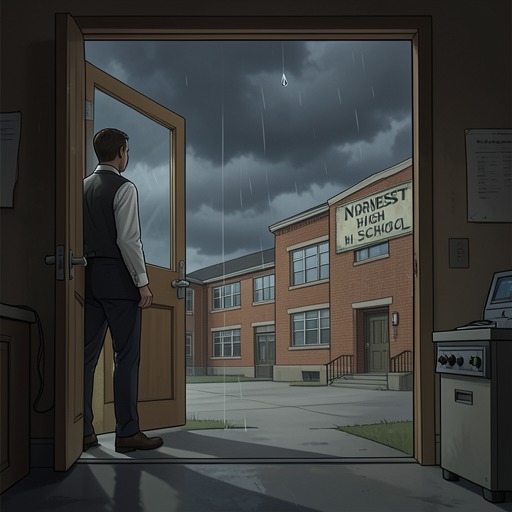
Carr’s role becomes most consequential during the practice administration of the Pennsylvania System of School Assessment. Northeast High School has failed to meet its Adequate Yearly Progress target, and the prospect of becoming a Renaissance School places every employee’s job at risk. The Pennsylvania System of School Assessment measures junior students’ proficiency in reading, writing, mathematics, and science, yet its results are used to judge the school as a whole. Carr therefore operates within a system in which one testing day carries consequences far beyond the classroom.
At first, the examination room appears to be proceeding well. Attendance is good, students remain engaged, and most complete each section. Two boys still have mathematics problems left when they finish the English section, and Tony Danza decides to let them return to the unfinished work. The decision is motivated by care: he believes that additional effort might help the school meet its target. Carr sees the same gesture differently. He demands to know whether Danza is trying to sabotage the results and warns that, if this were the real PSSA and someone reported the violation, the entire test could be nullified. He takes the calculators from Danza and storms back to his office.
The confrontation distinguishes classroom helpfulness from standardized-test administration. Danza’s instinct is to use discretion for the benefit of two students; Carr’s responsibility is to protect the validity of an examination whose rules leave no room for such discretion. His anger is therefore not simply personal strictness. It is the local enforcement of a high-stakes policy in which procedural irregularity can endanger the school’s standing, its staff, and its students. Carr’s severity shows how accountability systems convert a veteran teacher into a guardian of compliance.
The later results deepen the irony of Carr’s position. After the real PSSAs, Northeast High School improves in every category except writing but still fails to meet its Adequate Yearly Progress target. The school becomes an Empowerment School, moves closer to Renaissance School status, and receives more professional-development meetings, district auditor walk-throughs, student assessments, and pressure to perform. Parents are notified that they may transfer their children elsewhere. Carr’s insistence on exact procedure has protected the test from being invalidated, but accurate procedure cannot guarantee that the institutional measure will fairly represent learning or relieve the school’s pressure.
Relationship with Tony Danza
Carr’s relationship with Tony Danza begins as a test of authenticity. He does not accept Danza’s celebrity background as evidence of teaching ability, nor does he allow enthusiasm to substitute for professional seriousness. By asking whether Danza is truly a teacher or merely performing one, Carr places him under the same moral scrutiny that the school’s policies place on its staff. Danza’s fear, uncertainty, and promise to try are not enough to earn automatic approval; they must be proved through sustained work.
The PSSA incident provides the relationship’s sharpest conflict. Danza approaches the test as a teacher who wants students to gain every possible point, while Carr approaches it as an administrator of a regulated assessment. Carr’s rebuke is humiliating, but it also teaches Danza that good intentions can produce unacceptable consequences when the rules governing the assessment are strict. Their shared work later gives them the title of “PSSA partner,” and the relationship becomes a durable professional reference point for Danza’s understanding of testing and accountability.
Carr’s influence extends beyond the single confrontation. Danza comes to share Carr’s doubts about the testing regime after Northeast High School fails its target despite measurable gains. The school’s scores may even be affected by students in the designated region who do not attend Northeast, a problem Linda Carroll alludes to when she argues that the process credits the school for children outside its enrollment. Carr’s skepticism thus becomes part of Danza’s broader education critique: the veteran teacher’s rules protect an assessment process whose categories and consequences may still be unfair.
Retirement Reconsidered
At the end of the school year, Danza hears that Carr has filed papers to retire. The possibility feels consequential because Carr represents one of the experienced educators whose knowledge, discipline, and institutional memory have helped sustain Northeast High School. When Danza encounters him leaving the office, Carr is carrying books and appears unwilling to linger. Asked whether the rumor is true, he answers that he has changed his mind.
Danza follows him through the corridor and asks what that means. Carr replies, “One more year.” Asked how long he has taught, he answers, “Thirty-six.” Danza cannot imagine why someone with such a long career would remain, but Carr looks down the empty corridor, sighs, and explains, “Maybe next year I’ll get it right.” The remark transforms his earlier severity. The man who demanded perfect testing procedure is not claiming mastery; he is confessing that the work remains unfinished.
Carr’s decision is both modest and immense. He does not announce a solution to Northeast High School’s problems, and the narrative does not promise that one additional year will resolve them. Instead, his return expresses the veteran teacher’s refusal to treat education as completed simply because a career has lasted decades. His standard is demanding precisely because he applies it to himself: after thirty-six years, he still sees room to improve.
Legacy and Narrative Significance
Carr’s importance grows after Tony Danza leaves Northeast High School. Budget cuts place teachers with fewer than three years of seniority at risk, while frustration, economic necessity, and institutional pressure drive many educators from the profession. Carr is among the veterans who retire the following year, alongside Lynn Dixon and more than twenty others. Although they have earned their pensions and rest, their departure represents a colossal loss to the school.
For Danza, Carr belongs to the group of experienced professionals who made his first year possible by setting him straight. His influence is therefore practical as well as symbolic. Carr demonstrates that public-school teaching requires more than classroom instruction: it demands rule-bound administration, judgment under pressure, endurance across decades, and a willingness to continue despite inadequate measures of success. His presence also complicates the book’s criticism of the blame game. The teachers at Northeast High School are not portrayed primarily as indifferent failures but as educators working under extraordinary demands, often becoming discouraged and overwhelmed while still carrying responsibility for teaching, counseling, comforting, coaching, inspiring, documenting, and evaluating.
Carr ultimately stands for a form of professional dedication that cannot be captured by the school’s annual score. He enforces the rules of the PSSA because he understands their stakes, yet his final act is not bureaucratic compliance but renewed service. “Maybe next year I’ll get it right” leaves him without a triumphant resolution, but that unresolved humility is his decisive legacy: education remains an unfinished practice, and commitment means returning to the work even when the system offers little guarantee that the work will be recognized fairly.