Education as social justice
I'd Like to Apologize to Every Teacher I Ever HadEducation as social justice is the book’s central conception of teaching as more than the delivery of content or the enforcement of school rules. It links learning to equal opportunity, asks students to examine the forces that limit or enable their lives, and treats the classroom as a place where students can become active participants in their own education and in the work of making society fairer.
Definition and Educational Aim
Education as social justice emerges from the recognition that students do not enter school with equal protection, resources, security, or opportunity. The narrator connects the idea directly to the recurring question of how people respond when they are denied a fair chance to succeed. The theme begins with the study of Of Mice and Men and returns throughout the year, resonating with students who are repeatedly reminded by the surrounding culture that they are disadvantaged. It also has personal force for Tony Danza, who acknowledges that without extraordinary luck he might not have received a comparable chance himself.
The concept therefore rejects a narrow model in which students are treated as passive recipients of instruction. David Cohn explains that a teacher cannot learn on a student’s behalf: students must at least become interested in learning, and the teacher’s task is to involve them in their own education rather than win a popularity contest. This distinction gives social justice an everyday classroom meaning. Participation is not decorative; it is a way of giving students intellectual agency while recognizing that their disengagement may reflect circumstances more complicated than simple unwillingness to work.
Classroom Practice and Student Voice
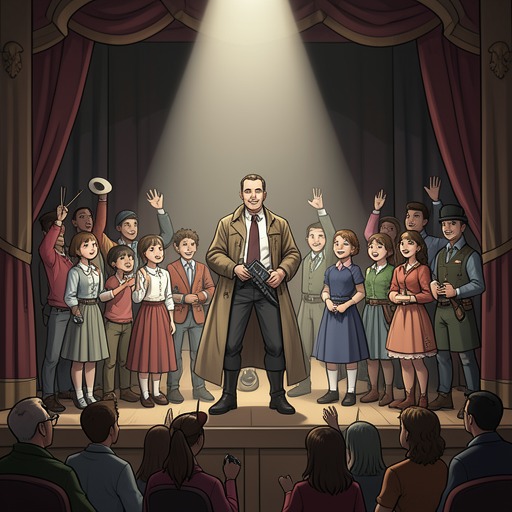
The narrator turns social justice into practice by building lessons around dialogue, experience, disagreement, and performance. In the creation-myth lesson, students are asked to explain creation and natural phenomena through gods, goddesses, or spirit forces, then work in pairs and perform their myths before the class. The assignment makes students producers of knowledge rather than merely readers of an approved text. Eric Choi and Ben-Kyle’s “The Magic Button Myth,” performed with a paper button marked “DO NOT PUSH,” demonstrates how an apparently playful project can give a shy student a public occasion to create and receive praise.
A similar shift occurs during the debate over the Northeast High School uniform policy. When students begin arguing about the policy, Tony Danza abandons the planned physical-fitness prompt and asks them to explain their views. The class responds with unusual energy and conviction, and he organizes the discussion as a debate because students retain ideas through active exchange. Charmaine argues for personal freedom, White Nick asks whether distracting clothing should matter, Al G comments on clothing he finds both appealing and extreme, and Paige challenges the gendered judgment that some girls dress like sluts. Their disagreement does not produce a simple consensus, but it makes power, expression, social judgment, and institutional control visible as subjects worthy of thought.
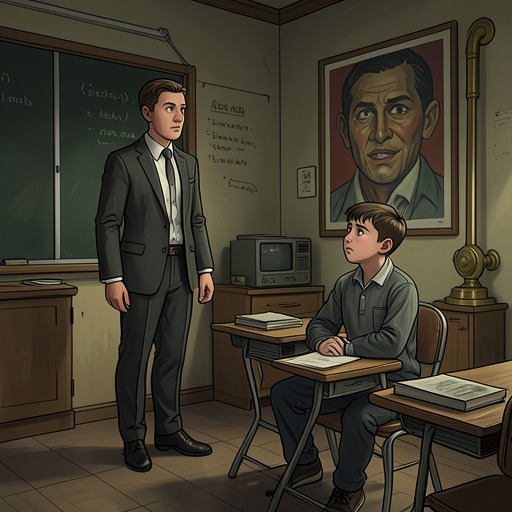
The Student Teacher program extends that experiment in shared authority. Concerned that his strongest students are being underserved while he manages classmates who refuse to participate, Tony Danza gives Monte an entire period to design a lesson, assignments, and standards. Monte prepares a demanding worksheet based on the trial in To Kill a Mockingbird and analyzes the characters’ qualities and interactions. The class does not automatically respect his authority: Matt wanders, Chloe and Katerina talk, Erik Choi sits upside down, and Eric Lopez writes a love note to Ileana. Yet the failed lesson exposes the difficulty of transforming formal authority into genuine participation and allows a student to experience, rather than merely criticize, the work of teaching.
Social Difference, Conflict, and Fairness
The book presents social justice as inseparable from the racial and cultural conflicts that structure school life. Matt’s repeated fights intensify after a friend is attacked and Matt is subsequently beaten by four African-American students. His father describes school problems and interprets the violence as confirmation that Matt’s complaints about Northeast High School are justified. Tony Danza resists that conclusion, warning him not to tell Matt that he is right and describing the girls’ language and behavior as a cultural form of communication rather than proof that the school or its students are inherently what Matt fears. The exchange reveals both the need to address violence and the danger of turning a painful incident into a racialized story about an entire community.
The tension becomes concrete when Matt’s parents encounter a group of Black girls in a crowded corridor after a counseling meeting. The girls’ crude language and racial epithets provoke Matt’s father, who confronts them; insults directed at the parents quickly become a screaming match. The incident makes clear how easily attempts to impose one group’s standards of respectable speech can become another confrontation over race, authority, and belonging. Tony Danza’s response is imperfect and compressed into the language of culture, but his intervention seeks to prevent Matt’s anger from becoming a settled theory of racial difference.
The uniform debate exposes another version of unequal treatment. Paige objects to being punished because of the way other girls dress, while Charmaine invokes freedom of expression and complains that the policy will eliminate a form of personal choice. The discussion shows that rules presented as neutral can be experienced differently according to gender, fashion, family resources, and assumptions about which bodies are distracting or respectable. Education as social justice requires those experiences to be heard rather than allowing the policy’s official language to end the argument.
Poetry, History, and Action
Tony Danza makes the connection between literature and justice explicit through poetry and popular music. A lesson on Coolio’s “Gangsta’s Paradise” leads students to consider why a gangsta believes that disrespect must be answered with death and whether dignity can instead be secured through achievement and socially valued work. Katerina interprets the song’s recognition of emptiness as an argument that killing accomplishes nothing. The class then argues for and against these ideas, converting lyrics associated with violence and honor into a discussion of self-respect, opportunity, and social alternatives.
A video by Figureheads broadens the lesson by invoking Harriet Tubman, Rosa Parks, Harriet Beecher Stowe, and Uncle Tom’s Cabin. Its lyrics ask students what they know about social justice and recall those who fought and suffered for basic rights such as suffrage, before urging them to rise up and lead. Tony Danza uses the song to teach two linked obligations: individuals must make their own opportunities, and society must work toward greater justice. The lesson does not leave social justice as an abstract historical label. It gives the concept a contemporary address, one that Nakiya adopts as a recurring greeting: “What you know about social justice?”
This method also depends on recognizing the personal histories beneath visible classroom behavior. While students practice poems for a contest, Tony Danza discovers that Paige has chosen a poem about a deadbeat, missing father. The discovery does not excuse her moodiness or lack of effort, but it gives him a clue about how to work with her. Understanding what is happening in a student’s life becomes part of teaching because academic behavior cannot be separated neatly from bereavement, family absence, insecurity, or the search for recognition.
Institutional Limits and Significance
The book contrasts this participatory ideal with the institutional pressures that make equitable education difficult. Lynn Dixon’s administrative announcements include deadlines, grade-entry procedures, seminars, planning requirements, technology instruction, and mandated graphic organizers. Tony Danza realizes that teachers are besieged by work outside the classroom, a burden rarely acknowledged when politicians and media figures discuss cutting education costs. The school’s public language may celebrate participation and achievement, while its daily organization consumes the time and energy needed to create either.
Discipline policy exposes an even sharper gap between formal rules and lived practice. Northeast High School posts behavior codes governing uniforms, hoodies, iPods, running, and shouting, and a Philadelphia police station is present on campus. Yet policies are not consistently enforced. Teachers may spend valuable class time involving the dean’s office over an unremoved hoodie or earbud, and students learn to test the limits because they know that many rules have no dependable consequence. The resulting disorder is not simply an individual failure of student character; it reflects an institution whose rules, enforcement mechanisms, and classroom priorities do not align.
Standardized accountability produces a comparable contradiction. After the real Pennsylvania System of School Assessment examinations, Northeast High School improves in every category except writing but still fails to meet its Adequate Yearly Progress target. The school is renamed an Empowerment School, moves closer to Renaissance School status, and receives more professional-development meetings, district walk-throughs, assessments, and pressure to perform. Parents are notified that they may transfer their children. Linda Carroll argues that Northeast has made adequate progress as far as she is concerned, while noting that the school is credited with students in its designated region who do not even attend it. The measurement system thus converts structural complexity into institutional blame and responds to failure with intensified scrutiny, even as teachers find that humiliation and surveillance can make enjoyable, effective teaching harder.
Education as social justice ultimately names a tension rather than a finished program. Its practical promise lies in letting students debate real rules, connect texts and music to lived disadvantage, create and perform their own ideas, and exercise authority in the classroom. Its difficulty lies in the unequal conditions students bring with them and in school systems that often measure justice through compliance, scores, and administrative visibility. The concept gives the book its governing ethical question: what kind of education can help students claim a future while also teaching them to recognize and challenge the forces that distribute opportunity unfairly?