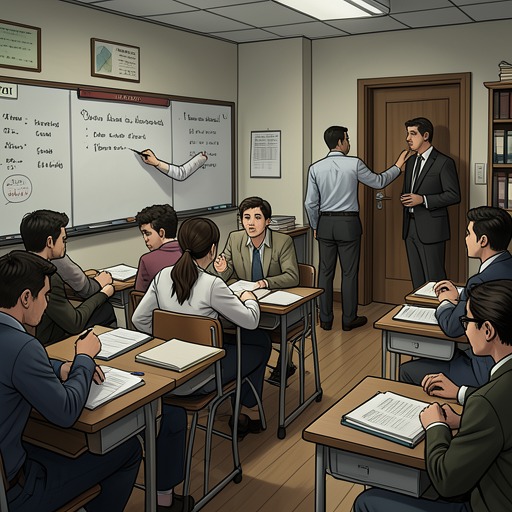
Emotional burden of teaching
I'd Like to Apologize to Every Teacher I Ever HadEmotional burden of teaching is the strain produced when educators are expected not only to teach but also to counsel, comfort, and sustain students through problems that reach far beyond the classroom. In Tony Danza’s account, caring is both the heart of the work and a source of its exhaustion: connection helps students participate, yet the demands of that connection can overrun a teacher’s time, energy, and private life.
More Than Instruction
The emotional scope of teaching first becomes visible to Danza through conversations with veteran teachers. They describe the many roles demanded of an educator: parent, sibling, social worker, counselor, and friend, among others. Their examples are not abstractions. Students may arrive hungry, lose sleep because of gunfire outside their homes, or remain silent because of abuse inside them. Teachers may find themselves imagining adoption as a way to keep a child from homelessness or foster care. The phrase adoption fantasy captures both the depth of their concern and the limits of what a teacher can provide: care can extend beyond the lesson, but it cannot by itself repair every circumstance in a student’s life.
Danza gradually acquires unofficial advisory students even though he has no assigned advisory group. They find him in hallways, the cafeteria, and his classroom, where air-conditioning and the offer of half sandwiches give them practical reasons to come. They also appear to want his company. Their visits become a recurring part of his day, sometimes requiring him to write notes explaining why they have returned late to class. A student’s explanation that the electricity was shut off and the night too cold for sleep makes clear how little a conventional lesson plan can contain. Danza can listen, offer sympathy, and write a note; he recognizes that such gestures may not be enough, but that trying is part of the responsibility.
The distinction between teaching and personal care is not cleanly maintained. David Cohn reminds Danza, “You can’t learn for them, Tony.” The advice cautions against mistaking a teacher’s effort for a student’s own learning, while Danza’s experience shows why detachment is difficult: helping students engage often means attending to the lives that shape their ability to engage at all. The work demands both limits and involvement, without offering a reliable formula for balancing them.
Work That Cannot Be Finished at the Bell
A conversation at a gym gives this tension a stark numerical measure. A teacher Danza meets there has 150 students across five classes a day. She describes students trying to leave gangs, coping with relatives killed or imprisoned, or living without a home. She wants to give them individual attention, but cannot make enough hours for it. Even weekly quizzes create an unavoidable workload: grading each of 150 papers for just one minute would take 150 minutes, before accounting for the fact that school tasks rarely take only the time allotted to them.
The numbers do not capture the emotional cost. The teacher says that students may interpret a lack of extra attention as evidence that she does not care. Danza recognizes the bind from his own relationships with students: being there can mean extending himself to offer or seek help, while setting aside his personal life to make room for their troubles. The extra care is not a separate, neatly scheduled task. It competes with preparation, grading, and the life outside school that teachers are also expected to maintain.
The burden can begin early in a career. Veteran educators advise new teachers to set clearer boundaries, yet Danza notes that many first-year teachers have not mastered them. More than one hundred of the new teachers who attended his August orientation had quit before Christmas. His proposed Three-Fifths Solution—three classes per teacher rather than five—would give teachers more preparation time and more opportunity to follow through with students. He acknowledges its expense and describes it as a pipe dream, but the proposal makes a structural point: exhaustion cannot be addressed simply by asking individual teachers to care more efficiently.
Emotional Strain and Public Scrutiny
The memoir presents emotional exhaustion as something that can surface suddenly, even when its causes are not immediately clear. During the final week of school, Danza wakes up furious. He suspects the television production may be a convenient target, but recognizes that his anger is out of proportion. When the crew arrives to film an early goodbye, he turns his frustration on them and on the students, at one point dragging Eric Choi’s chair into the hall with him still sitting in it. He refuses to pretend that school is over when the week has not ended.
The refusal is followed not by composure but by a breakdown. Danza begins to cry while trying to explain that he will miss the students. The students gather around him, some crying too, and comfort him as he tells them how much he loves them and how they have changed his life. The scene reverses the expected direction of care: the teacher who has tried to support his students is, in this moment, held by them. The episode shows the force of attachment and its cost without reducing the relationship to either a professional duty or a private friendship.
The television series adds another pressure. The crew wants an end-of-year farewell before the school year has ended, turning a real separation into a scene to be staged. Danza’s anger at the proposed shoot is only part of what he is feeling, but the artificial timing sharpens the conflict between genuine attachment and the production’s schedule. After the series premiered, a viewer’s letter relayed that the writer’s psychiatrist wife thought Danza might be having a nervous breakdown in the first episode. Danza considers the observation potentially close to the truth in retrospect and takes it as evidence of how emotionally grueling teaching can be. He hopes that showing his breakdowns made viewers more aware of teachers’ daily challenges.
Structural Pressures and Lasting Meaning
The memoir distinguishes emotional burden from mere busyness. In its account, teachers are expected to teach, counsel, comfort, coach, and inspire, while also documenting and evaluating their own work and students’ progress. They must respond to changing district mandates and national policies, often under pressure to produce measurable results. After Northeast High School fails to meet its Adequate Yearly Progress target, the school faces closer scrutiny, additional professional development, district walk-throughs, more assessments, and pressure to perform. These demands surround the emotional work rather than replacing it.
Danza argues that public blame obscures the conditions under which educators work. He describes most of the teachers he met at Northeast High School as discouraged and overwhelmed rather than simply inadequate, and points to poverty, limited parental involvement, and a culture that devalues knowledge as pressures on classroom life. The expectation that teachers calmly and brilliantly serve 150 students while meeting extensive administrative demands collides with the reality of finite time and energy. His criticism is not that accountability or effort has no place, but that accusations and pay cuts do not supply the help teachers and students need.
The emotional burden remains inseparable from what makes the work meaningful. Danza concludes that engaging students required him to become engaged in their lives, problems, and futures; that connection was the most rewarding part of the job and also what made teaching harder than he expected. He does not claim to have solved the question of where a teacher’s responsibility should end. Instead, his account leaves the tension intact: care creates the possibility of trust and participation, but it asks for a kind of sustained emotional labor that individual goodwill cannot indefinitely replace with adequate time, support, or boundaries.