Howard
I'd Like to Apologize to Every Teacher I Ever HadHoward is one of the most revealing students in Tony Danza’s Northeast High School classroom: physically imposing, athletically accomplished, funny, and apparently unable to make reading stick. His importance lies in the contradiction he embodies. He is identified as gifted, yet says he cannot remember the page he has just read; he can master a competitive scavenger hunt and pass a demanding literature test, yet later uses a phone to cheat on a Julius Caesar examination. Howard’s trajectory turns a familiar school label—gifted, athlete, underperforming student—into an unsettled question about how ability is recognized, supported, and sometimes concealed.
Identity and Introduction
Howard first becomes conspicuous during Tony’s opening encounter with the class, when he interrupts the students’ barrage of questions by asking whether the new celebrity teacher is a millionaire. His question instantly changes the room: the students listen, Tony admits that he is wealthy, and Howard helps establish the skeptical, performative atmosphere in which the class tests its new teacher. Howard is not introduced as a quiet academic presence. He is a beefy student whose directness and humor make him part of the class’s social center, even while his academic difficulties remain less visible.
His physical presence is reinforced by his extracurricular life. Howard is the biggest student in the class and plays football, soccer, and baseball. He also has no father in his life, a biographical detail that places his school experience within a wider pattern of absence and uneven support. The combination of athletic status and academic frustration complicates any simple division between successful and unsuccessful students: Howard is plainly capable of commitment and performance, but those capacities do not automatically transfer to the classroom.
Reading Difficulty and the Gifted Label
During the unit on John Steinbeck’s Of Mice and Men, Howard comes to Tony after class and says that he does not understand the story. He has tried, he explains, but nothing stays with him. Tony responds by demonstrating practical reading strategies: underlining important passages, writing notes in the margins, returning to sections that remain unclear, and rereading rather than treating rereading as failure. Howard answers that he reads the same page repeatedly and still cannot remember it, concluding that he is simply not good at reading.
Howard’s resistance is not merely laziness. He insists that he does not enjoy reading at all, rejecting Tony’s comparison between literacy and sports practice. Tony argues that practice can produce competence and eventually enjoyment, just as repeated work has made Howard better at soccer and the ukulele. Howard refuses the analogy, maintaining that soccer was fun from the first kick even when he was bad at it. The exchange captures a conflict between two ideas of learning: Tony’s belief that skill can generate pleasure, and Howard’s experience of reading as an activity that offers neither immediate reward nor a stable sense of mastery.
The conversation becomes more troubling when David Cohn shows Tony the school’s list of identified gifted students and Howard’s name appears near the top. The label does not resolve Howard’s problem; it intensifies it. Tony must consider whether the reading issue reflects a serious, longstanding difficulty or whether Howard is manipulating the situation. Howard therefore occupies an unstable institutional position: formally recognized as gifted, but practically underserved by the ordinary expectations of the classroom. His case pushes Tony to look beyond a literacy initiative built around prescribed articles, short stories, informational texts, and tests, and to search for ways of making students want to read rather than merely assigning them more reading.
Engagement Through Action
Howard’s strongest academic breakthrough occurs not through a conventional lecture but through an Of Mice and Men scavenger hunt. Tony turns the literature unit into a school-wide competition, asking students to race through clues involving characters, quotations, literary devices, and the novel’s language. The activity converts reading from an isolated task into a collective, physical, competitive event, a form of participation that resembles the athletic environments in which Howard already feels competent.
Howard unexpectedly joins the winning team. The moment carries particular force because he has been presented as the student who cannot remember what he reads and does not like reading. He emerges from the challenge celebrating the victory, and Tony meets his grin with a high five rather than humiliating him for his earlier resistance. The final horseshoe game continues until the bell rings, leaving the class—including Tony—tired but feeling successful. Howard’s participation does not prove that his reading difficulty has vanished, but it demonstrates that the right structure can draw him into sustained contact with literary material.
The next day, almost everyone passes the Of Mice and Men test, including Howard. The class understands the irony of George killing Lennie and recognizes the significance of Steinbeck’s biblical tone. Howard’s successful result is evidence that the scavenger hunt and the surrounding work have produced more than temporary excitement. It also contrasts sharply with his earlier claim that nothing sticks. Tony’s pleasure is heightened by the fact that Howard, previously reluctant and dismissive, has absorbed enough of the book to perform well under formal assessment.
Friendship, Surveillance, and Cheating
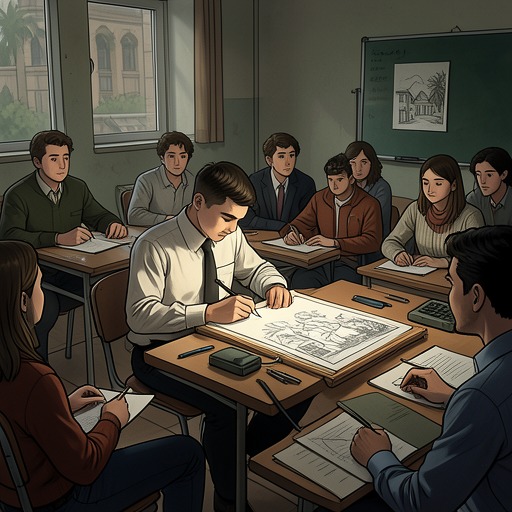
Howard’s later conduct shows that engagement is neither linear nor secure. He is close friends with Matt, another solid athlete, and the two become involved in a Julius Caesar cheating incident. Howard is absent when Tony gives the first three acts test because of an approved doctor’s appointment. When he returns, Tony places him in the hall to make up the examination while the rest of the class reviews the material. The arrangement appears practical: the closed classroom door should prevent Howard from hearing the discussion, and Howard accepts the plan with his usual goofy grin.
The evidence later reveals that Matt was texting Howard in the hall while Tony was telling Matt to put away his phone. When Tony compares the two tests, Howard’s and Matt’s answers contain almost identical right and wrong responses. Classroom cameras provide the decisive confirmation. The footage shows Howard repeatedly dropping a phone from his pocket, checking the screen, and writing on the test, wearing a grin that suggests he believes he is successfully staging a small heist. The cameras, installed for the television production, transform the scene into an unintended lesson in contemporary surveillance: Howard and Matt forget that they are being watched, while Tony discovers that teaching in a technologically connected classroom requires the vigilance associated with what his orientation called classroom awareness.
The incident does not erase Howard’s earlier achievement, but it prevents that achievement from becoming a simple redemption story. The same student who can understand Shakespeare through translation, compete intensely in a literature-based game, and pass Steinbeck with a strong score can also use friendship, technology, and the physical separation of a hallway to evade the rules. Howard’s contradiction is precisely what makes him a rounded figure rather than a single classroom type. His conduct forces Tony to hold ability, frustration, humor, loyalty, and misconduct in view at the same time.
Narrative Significance
Howard becomes a test of Tony’s developing philosophy as a teacher. Tony initially tries to persuade him through familiar comparisons to sport and practice, but Howard’s refusal exposes the limits of motivational language when a student’s experience of reading is defined by repeated failure. Tony then changes the conditions of participation, using movement, competition, objects, and shared discovery to make literature accessible through forms Howard already understands. The later test cheating shows the limits of that method as well: participation can create genuine learning without eliminating the temptation to take shortcuts.
Howard also embodies the school’s problem of classification. He is a large athlete, a student without a father in his life, a gifted learner, a reluctant reader, and a cheater caught on camera. None of these descriptions is sufficient by itself. His presence makes visible the gap between what Northeast High School knows how to record and what an individual teacher has to interpret. For Tony, Howard is not only a difficult student but a challenge to the belief that effort, encouragement, and inventive instruction will always produce a clean moral or academic result. Howard’s importance lies in leaving that challenge unresolved while showing, in the same school year, both the possibility of real learning and the persistence of the conditions that make students hide, resist, or cheat.