Ignorance is no excuse
I'd Like to Apologize to Every Teacher I Ever HadIgnorance is no excuse is a chapter heading and a compact statement of accountability in Tony Danza’s first days as a teacher at Northeast High School. When he uses the phrase after misunderstanding the school’s sign-in procedure, it earns no leniency: the episode makes his inexperience visible while insisting that good intentions do not erase a rule or its consequences.
A maxim for a first-year teacher
The phrase appears as the heading for the account of Danza’s second morning at school. He has spent the night waking in panic, gets up at 4:20 a.m., and reviews his lesson plan before setting out. His anxiety is not incidental to the maxim’s meaning: he is entering a job he once planned to pursue, but his degree in history and his experience playing a teacher on television have not prepared him for the practical demands of teaching in a real school.
That change of direction follows a period of upheaval. After his talk show is canceled, Danza separates from his wife, confronts the possibility of turning sixty, and thinks about how little time his father lived beyond that age. Recalling his original ambition to teach, he decides to return to the classroom and contribute in a way that could make his children proud. The heading therefore frames the early school encounter not simply as a procedural mishap but as part of a larger beginning: Danza has chosen a vocation whose rules and responsibilities he must learn by doing.
The sign-in confrontation
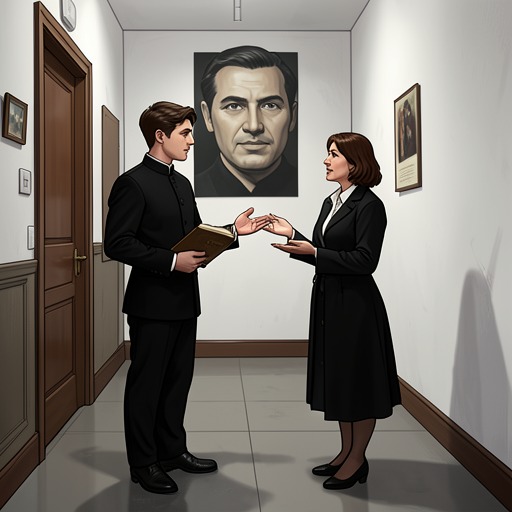
Danza arrives on campus at 7:05 a.m. on both of his first two days, but he has not signed in on the first day because he did not know the procedure. On the next morning, Ms. DeNaples points to the clock and challenges him about being late. Danza tries to explain that he was unaware of the sign-in policy; she interrupts to clarify that teachers must sign in every day, no later than 7:38, and that the sheet is a legal document with no room for error.
The details make the dispute sharper than a simple question of punctuality. Danza believes that arriving early demonstrates commitment, while the school’s formal record requires a separate act that he has failed to perform. He apologizes as he signs and adds the expression as an admission that not knowing the rule does not excuse his failure to follow it. Ms. DeNaples answers, “That’s correct!” Her brisk reply confirms the maxim, but also punctures Danza’s effort to make his apology charming: the office audience has already laughed at his earlier attempts to ease the exchange, and this time there is no joke to soften the correction.
Rules, responsibility, and the school’s wider pressures
The episode sets Danza’s mistake within a school culture where written rules and their enforcement do not always align. Northeast High School has posted behavior codes and policies, yet Danza later observes that rules concerning uniforms, hoodies, earbuds, and other conduct are not consistently enforced. Teachers may have to involve the dean’s office and sacrifice class time to pursue a violation, while students learn how far they can push. In this context, the maxim describes an individual obligation, but it does not by itself explain why a school’s systems make consistent enforcement difficult.
The same tension appears in the school’s performance requirements. After Northeast fails to meet its Adequate Yearly Progress target despite gains in every category except writing, the school receives closer scrutiny, additional professional development, district walk-throughs, and more student assessments. Danza also records Linda Carroll’s concern that the school is held responsible for children in its designated region who are not enrolled there. The contrast gives the phrase a limited but pointed reach: accepting responsibility matters, yet the book also shows institutional outcomes shaped by procedures and pressures beyond any one teacher’s knowledge or control.
A lesson that outlasts the incident
The phrase’s importance is established through a small, public correction rather than a dramatic turning point. Danza enters the year hoping to prove that he is serious about teaching; the sign-in exchange shows that sincerity does not substitute for learning the work’s ordinary obligations. The rule is precise, the mistake is understandable, and the correction is immediate. His attempt to repeat the maxim back to Ms. DeNaples makes him its first subject.
Later episodes deepen the book’s attention to the cost of taking responsibility. Danza struggles to read his daughter’s reassurance that his delayed visit home is all right, and, after learning that Brittiny has been moved to another foster home, admits that he is unsure he wants to care so much at his age. Asked whether he will return to teach the following year, he initially says he does not know, even as he recognizes that he does. These moments do not repeat the phrase, but they extend its central tension: commitment requires acting without complete knowledge, while caring deeply brings obligations and limits that a maxim cannot resolve. In the opening school encounter, Ignorance is no excuse is a rule of conduct; across the year, it becomes a terse frame for the harder work of learning what responsibility demands.