More with less
I'd Like to Apologize to Every Teacher I Ever Had“More with less” is the central classroom correction David Cohn gives Tony Danza after observing his first-year teaching. It does not mean doing less work or lowering expectations. It means less of the teacher’s voice, performance, and need for approval, and more of the students’ independent activity. In the book, the expression marks Danza’s shift from treating teaching as a performance to treating it as the organization of student thought and action.
Definition and Origin
The principle emerges during Danza’s daily postmortem with David Cohn. After looking over an origami piece Danza has taken from Eric’s class, David advises him to “Think about doing more with less.” He immediately clarifies the formula as “Less of you, more of them”: Danza should focus his lesson plans, spend more time on less information, be specific, stay on topic, and let students read and do their own work. The advice responds to a concrete weakness rather than offering a general slogan. Danza has been trying to fill every silence and carry too much of the lesson himself.
David also identifies the emotional source of that overactivity. Danza is “trying too hard to make them like you,” and his desire for approval has made popularity seem dangerously close to instructional success. David insists that teaching is not a popularity contest. Students may become more interested in a teacher they like, but the decisive aim is to involve them in their own education. The phrase therefore joins classroom method to a change in Danza’s understanding of authority: the teacher’s success is measured not by how much attention the teacher commands, but by how much meaningful work students undertake.
Classroom Method
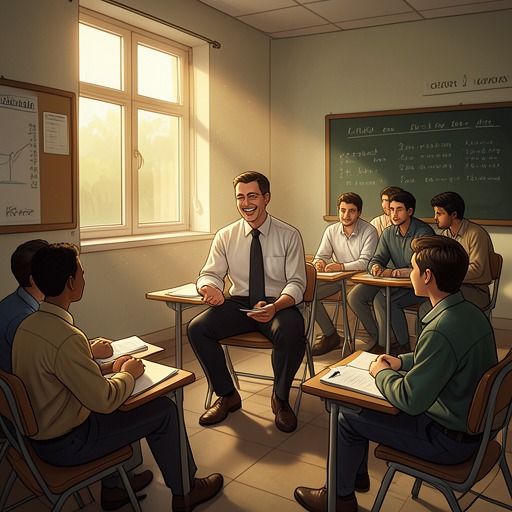
“More with less” becomes a practical alternative to lecture-centered instruction. David tells Danza that teachers no longer simply stand at the board while students take notes; they must teach students to teach themselves. In collaborative teaching, students work in small groups after the teacher sets out the lesson, while the teacher moves among them, guiding individuals quietly. A silent classroom may not be an inactive one. As David explains, silence can mean that students are thinking and working, so the teacher must give them time rather than treating every pause as failure.
The method directly challenges Danza’s instincts as an entertainer. When nervous, he talks too much, performs the class instead of teaching it, and sometimes asks a question only to answer it himself. David’s observation also gains force because Danza recognizes the same habit in other parts of his life: Coach Chris Riley has heard Danza’s voice too much around the football team, and his wife and children have complained about his interrupting and commenting. Danza has understood this behavior as evidence that he is engaged, but the teaching problem forces him to consider that constant verbal intervention can prevent other people from being heard.
Danza’s response is physical as well as verbal. He repeats “More with less” and makes a talking motion beside his mouth, accepting the need to restrain his own speech. The gesture turns David’s criticism into a memorable classroom rule. It also exposes the tension inside the expression: producing “more” from students requires the teacher to relinquish the visible activity that has traditionally made teaching look like teaching.
Applications in Teaching
The first clear application comes in the mythology unit. Danza gives students an assignment to write their own creation myths explaining creation and natural phenomena and including at least three gods, goddesses, or spirit forces. Rather than keeping the work at the level of teacher explanation, he pairs students and asks them to write and perform their myths together. Eric Choi and Ben-Kyle create “The Magic Button Myth,” using a large paper button attached to a paper spring and labeled “DO NOT PUSH.” Their performance turns a simple classroom object into a collaborative act of invention, and the class cheers when the forbidden button brings the world into existence.
The scene demonstrates what “more with less” makes possible. Danza supplies the structure, requirements, and encouragement, but the students generate the language, objects, performance, and humor. Eric, described as shy and gawky, is especially unprepared for the praise. His uncertainty in receiving the class’s approval shows that participation is not merely a decorative addition to a lesson; it can alter who occupies the center of classroom attention and allow a quiet student’s constructed work to become the event.
The same principle later shapes the response to the school-uniform controversy. Danza abandons a planned opening task on physical fitness and nutrition when students begin arguing about the new uniform policy. He replaces it with a prompt asking them to explain their feelings about the policy, then divides the class into debate teams. The students write with more energy and conviction than they have shown in much of their earlier work and eagerly read their opinions aloud. The teacher’s contribution is to recognize a live disagreement, frame it as an academic task, and step back enough for students to supply the conviction and argument.
Limits and Significance
The expression does not pretend that withdrawal alone solves teaching. David tells Danza, “You can’t learn for them,” placing a firm limit on the teacher’s power. A teacher can design conditions, clarify a task, guide individuals, and create reasons to care, but learning remains an activity students must perform. That limit is especially important in a school as large as Northeast High School, where Danza works inside an Arts and Education Small Learning Community while veteran teachers such as Lynn Dixon manage extensive academic, administrative, and practical responsibilities beyond their classrooms.
“More with less” also acquires a wider moral meaning as Danza’s teaching year progresses. He begins the year after the cancellation of his television show, the separation from his wife after twenty years of marriage, anxiety about approaching sixty, and the fear that time is running short. His return to teaching is an attempt to recover a vocation that had been displaced by boxing and acting. Yet the classroom teaches him that commitment cannot be reduced to visible enthusiasm or emotional display. When his daughter’s seemingly casual reassurance makes him wonder how much of her life he has missed, and when he later admits to Ms. Dixon that he is unsure whether he wants to care so much about anything at his age, the phrase’s demand for restraint meets the deeper cost of caring.
By the end of the year, Danza’s uncertainty about returning is tied not only to the difficulty of teaching but also to the obligations competing for his attention. At the Sons of Happiness gathering, Joe Connelly asks whether he will come back the next year. Danza says he does not know, even though he already understands that he must go home, work on being a husband and father, and acknowledge how hard teaching is. “More with less” therefore remains both a pedagogical principle and a measure of personal transformation. It asks Danza to make room for student voices, but it also exposes how difficult it is for a performer, parent, and newly committed teacher to know when presence becomes interference and when stepping back becomes the more demanding form of care.