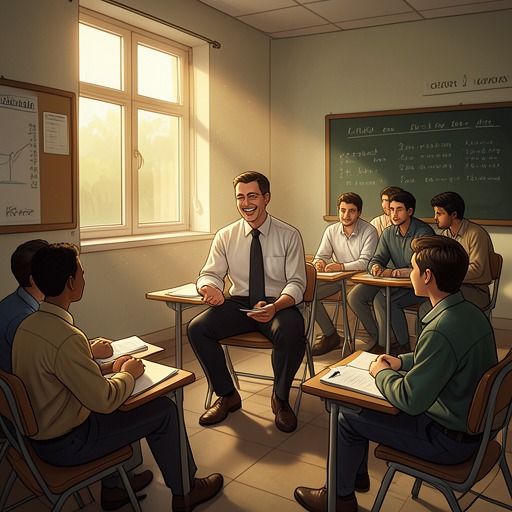
Never smile before Christmas
I'd Like to Apologize to Every Teacher I Ever Had“Never smile before Christmas” begins as practical survival advice and becomes a recurring measure of Tony Danza’s transformation as a teacher. The maxim tells a novice to conceal warmth until authority is secure, yet the year at Northeast High School steadily exposes the limits of treating teaching as performance, discipline, or emotional self-protection alone. By the end, the phrase has been absorbed into a larger lesson: a teacher must remain calm and credible without becoming unavailable to students whose lives demand far more than instruction.
Origin and Initial Function
The expression comes from a veteran teacher Tony Danza meets at Becker’s, a local school-supply warehouse. The man is moonlighting as a checkout clerk to make ends meet, an encounter that undercuts the stereotype of “outrageous” public-school salaries. He recognizes Danza as a novice because Danza is charging a huge pile of classroom decorations to his own credit card, far beyond the one hundred dollars Philadelphia teachers receive for annual classroom supplies. The warning is therefore offered as hard-earned occupational advice rather than theatrical cynicism: “Never smile before Christmas,” the veteran says, because smiling puts a new teacher “at their mercy” and students will “eat you alive.”
The phrase appears at the threshold of Danza’s first classroom experience, when the school corridors are bedlam but his room falls quiet as the first student enters. It functions as a rule for managing the first impression: before students know what limits a teacher will enforce, visible friendliness may be interpreted as weakness. Its calendar reference also makes authority a delayed performance. Warmth is not forbidden forever; it is postponed until the teacher has established control.
From Classroom Rule to Repeated Refrain
Danza later records the maxim as “Never Smile Before Christmas,” the title of a section in his account, while beginning Shakespeare with a class that is already capable of energetic, creative work. Students build a paper model of the Old Globe Theatre, make posters and dioramas, design a board game about Shakespeare’s life, and prepare the Shakespeare to Street exercise, in which they recast Julius Caesar in their own language. The recurrence of the expression against this backdrop creates an irony: the classroom’s most productive moments depend not on the total suppression of warmth, but on finding forms of participation that students can claim as their own.
The advice returns more explicitly after a near altercation. David Cohn tells Danza that students must not see how deeply they affect him. Danza answers by invoking the original maxim, asking whether the solution is not to smile before Christmas. David’s fuller counsel shifts the emphasis from facial expression to conduct: Danza should act as the students’ leader, watch and listen, learn from what he sees and hears, model the behavior he expects, and refuse to be pulled into the fray. The final instruction, “Have the courage to be calm,” revises the slogan from a ban on smiling into a discipline of self-command. Authority is not mere severity; it is the capacity to remain composed when provoked.
The Limits of Emotional Distance
The maxim becomes more complicated as Danza confronts the personal cost of caring. After his television show is canceled, his marriage ends after twenty years, his youngest child remains at home in Los Angeles, and he begins to feel that he is approaching sixty. His father lived only to sixty-two, so age becomes a pressure that sends him back toward his abandoned plan to teach. The classroom is meant to be a meaningful new direction, but the work soon threatens to absorb the personal life he hoped to recover.
A call with his elder daughter exposes the contradiction. When Danza says he is not sure when he can get home, she replies, “Oh, that’s okay, Dad.” He cannot determine whether she is resigned to his absence, proud of the importance he has found in teaching, or simply distant from him. He is trying to teach students to read while admitting that he can no longer read his own daughter. The emotional restraint implied by “Never smile before Christmas” cannot solve this problem. A teacher may protect himself from classroom manipulation, but that same protective distance offers no easy answer to obligations at home.
The expression also fails to describe the work Danza performs outside formal instruction. His unofficial advisory students begin appearing in hallways, the cafeteria, teams, clubs, and eventually his classroom. They come in the morning, at lunch, or whenever they can obtain a hall pass, drawn partly by the air-conditioning and half sandwiches he provides, but also by the chance to remain with him. Danza writes notes excusing their lateness, even when their lateness results from severe hardship, such as electricity being shut off and a home becoming too cold for sleep. The teacher’s role expands into counseling, friendship, and surrogate parenthood, precisely the forms of care that a rigid reading of the maxim would conceal.
Care as Labor and Risk
Veteran teachers explain that students in poorer schools may arrive hungry, lose sleep because of gunfire, remain silent because of abuse, or face foster care and homelessness. One teacher calls the fantasy of adopting students part of the territory. This context turns the maxim into a problem of boundaries. Smiling is not the central danger; the deeper danger is that the teacher’s emotional availability is treated as an inexhaustible resource.
A teacher Danza meets at the gym gives the problem numerical force. She has one hundred and fifty students across five classes. Some are trying to escape gangs, some have brothers shot or killed by gangs, some have fathers in prison, and some are homeless. Weekly quizzes alone require at least one hundred and fifty minutes of grading at one minute per student, before accounting for the fact that school tasks rarely take only a minute. She wants to give students extra attention, but they interpret its absence as proof that she does not care. Her conclusion is that the hardest part of teaching is the emotional grind.
Danza recognizes that “being there” means paying attention, extending himself to secure help, and putting aside his personal life to make room for students’ troubles. More than one hundred new teachers from his August orientation leave before Christmas, suggesting that the maxim’s seasonal boundary is also grimly literal: the first months demand a form of emotional endurance many beginners cannot sustain. Veteran teachers advise clearer limits, but Danza acknowledges that few first-year teachers have mastered those boundaries. The expression therefore names not only a classroom tactic but also the unresolved conflict between compassion and self-preservation.
Reinterpretation and Significance
By the time Ms. Dixon asks whether Danza will return the following year, he admits, “At my age, I’m not sure I want to care this much about anything.” Her response is that caring this much is exactly what the work requires. The exchange reverses the original warning. The novice initially fears that smiling will surrender authority; the experienced teacher’s answer implies that the greater test is whether he can remain ethically present without being destroyed by the demands of presence.
The same tension shapes Danza’s final decision. When Joe Connelly asks whether he is coming back next year, Danza says he does not know, even though he realizes that he does. He needs to return home and work on being a husband and father, and he acknowledges that teaching is extraordinarily hard work. The choice is not a rejection of the students or of the value of teaching. It is an admission that the emotional labor dramatized by the maxim has limits within one person’s life.
The expression ultimately becomes a compact emblem of the book’s critique of the blame game. At Northeast, educators are not generally depicted as uncaring so much as discouraged and overwhelmed by low-income and immigrant students, limited parental involvement, hostility toward knowledge, counseling and comforting duties, constant documentation, changing mandates, and the daily logistics of serving 150 students. Teachers are expected to perform these tasks calmly and brilliantly for less pay than many other occupations, while politicians and parents blame them for failures produced by wider conditions. “Never smile before Christmas” begins by protecting the individual teacher from students, but the book’s larger argument turns the protection outward: teachers and students need help, investment, and understanding rather than accusations and cuts.