Northeast High School uniform policy
I'd Like to Apologize to Every Teacher I Ever HadNortheast High School uniform policy is one of the clearest examples of how an apparently practical school rule becomes a struggle over power, identity, money, and belonging. Planned for two years and introduced in November under Linda Carroll’s authority, the policy ends free dress at Northeast High School, where students and parents regard it as an infringement of rights and an added expense. Because Tony Danza is teaching there while cameras record the year for a television project, many students also suspect that the policy exists because of his presence, although that suspicion is explicitly false. The rule therefore arrives not as a neutral administrative measure but as a visible symbol of institutional control and of the uneasy relationship between Northeast High School, its students, and the production surrounding Tony Danza’s teaching year.
Background and Institutional Setting
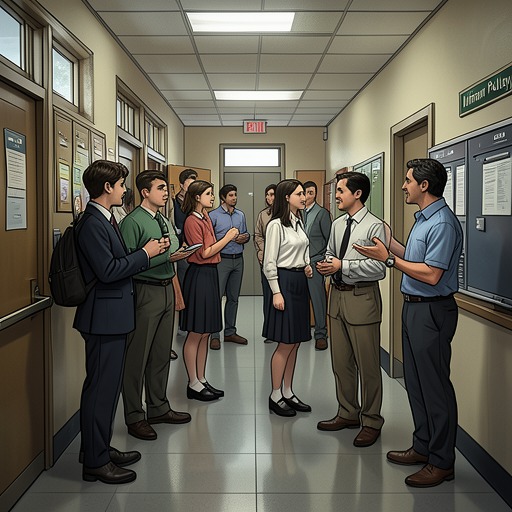
Northeast High School is Philadelphia’s largest high school, a sprawling campus with three stories, trailers, sports fields, a football stadium, a huge cafeteria, cavernous gyms, and even a Philadelphia police station. That scale helps explain why a uniform policy carries unusual symbolic weight: clothing is one of the few forms of identity that students can display across an enormous institution. The school is divided into eight Small Learning Communities because of its size, and the policy enters a culture already marked by formal rules, uneven enforcement, and competing claims about what discipline should mean.
The policy has been under discussion for two years before taking effect. Linda Carroll makes the final decision, but students and some parents continue to oppose it as the change approaches. Students object that compulsory clothing limits their rights and free expression; parents are angered by the cost of purchasing uniforms. The controversy also exposes the gap between official policy and local interpretation. Students repeatedly say that the only reason they must dress alike is that Tony Danza is at Northeast High School, making the uniform a reminder of the cameras and of the outsiders now observing their school.
The wider school environment makes the dispute more complicated. Teachers are already burdened by administrative mandates, deadlines, seminars, common planning requirements, technology instruction, and district oversight. Lynn Dixon, the veteran English teacher who leads the Arts and Education Small Learning Community, distributes such requirements and mediates the practical work of school life. At the same time, many school rules are inconsistently enforced. Students know the policies on uniforms, hoodies, iPods, running, and shouting, but they also know that teachers may lack an effective response when students refuse to comply. Against this background, the uniform policy is both a formal regulation and a test of whether Northeast can make a regulation real in daily practice.
What the Uniform Requires
The prescribed clothing includes khaki pants, a white shirt, a striped school tie, and a dark sweater; shoes are also regulated. Pepper’s encounter at the security gate demonstrates that compliance is judged by details rather than general appearance. He is wearing the required pants, shirt, tie, and sweater, but his shoes are the wrong color, so Ms. DeNaples directs him to the auditorium for a uniform violation. His claim that the correct shoes are in his backpack does not satisfy the rule: possession is not the same as wearing the approved item.
Tony Danza decides to present himself as subject to the same standard. He tells his class that, in solidarity with the students, he will wear the same outfit every day. His set consists of black shoes, gray pants and a belt, a blue dress shirt, and a Northeast High School tie. He buys five pairs of identical slacks and six shirts to last through the school year. The production team objects to the tie, considering it stodgy and old-fashioned, but Tony Danza refuses to remove it because he sees the tie as a sign of respect for teaching and for his students. His insistence becomes especially pointed because the boys’ uniform includes the same school tie: the garment links him to the students even while his celebrity status separates him from them.
His attempt at solidarity has a public, immediate cost. On the first day the policy takes effect, students who are not in uniform are sent to the auditorium, where Tony Danza has been assigned monitor duty. When he appears in the doorway, more than a thousand students boo him so loudly that he must leave in order to stop the disturbance. The scene turns him into the policy’s most recognizable representative, regardless of whether he supported the decision. The uniform consequently attaches institutional anger to a person standing in the school’s halls, making the difference between symbolic participation and actual authority impossible to ignore.
Pepper and the Rule’s Everyday Enforcement
Pepper’s shoe violation gives the policy its most concentrated drama. He is a small, quirky student who is not usually a troublemaker, yet he responds to the gatekeeper’s demand with a grin and the information that the correct shoes are in his backpack. His resistance is minor, but it is public, witty, and immediately legible to his classmates. When David Cohn witnesses the exchange, the moment becomes comic enough to unsettle the authority of the rule without erasing its consequences. Pepper is still sent toward the auditorium, and Tony Danza later arranges a private meeting rather than allowing the incident to become a group spectacle.
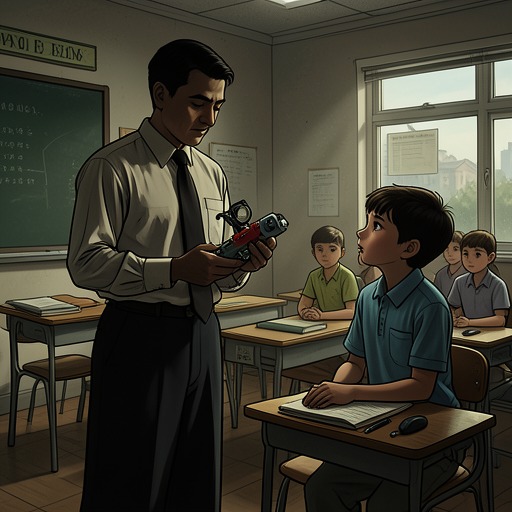
The response is disciplinary but also theatrical. Tony Danza has Pepper write an apology note to Ms. DeNaples, providing stationery and an envelope and dictating the opening so that the student cannot evade the assignment. Pepper’s stunt has already made him a hero to the class, so a public exercise would reward the performance; the private appointment instead separates the student’s popularity from the behavior being corrected. The episode shows how enforcement depends on individual judgment. The written policy does not itself determine whether the response will be humiliation, punishment, conversation, or an opportunity to redirect attention. A teacher must translate a rigid clothing requirement into a social encounter with a particular student.
Pepper’s case also reveals the policy’s paradox. The rule claims to produce uniformity, but enforcement makes difference visible: one student’s shoes, one teacher’s decision, one administrator’s threshold, and one class’s interpretation become more important than the standardized outfit itself. The same system that seeks to erase distinctions creates new occasions for contesting them. Pepper becomes memorable not because his clothing is dramatically different, but because a small deviation exposes the authority structure behind the clothing.
From Conflict to Classroom Debate
The uniform controversy becomes unexpectedly productive when Tony Danza abandons the planned opening task about physical fitness and nutrition. Eric Lopez and Matt begin ranting about the policy, while Monte says he likes it because it makes everyone look as serious about school as he is. Eric Choi welcomes relief from the shirts his mother chooses, whereas Chloe and Katerina mourn the loss of shopping and Ileana and Ben-Kyle object to the restriction of free expression. Their disagreement supplies the lesson’s real subject.
Tony Danza writes a new prompt asking students how they feel about the uniform policy and why. The class responds with more energy and conviction than it has shown in many earlier writing assignments. Students then read their opinions aloud and debate the issue in teams. The policy thus becomes an example of teaching through conflict: a regulation that has divided the school gives students a reason to write, speak, listen, argue, and support claims. Tony Danza recognizes that discussion, particularly debate, helps students retain ideas, and decides to make debates a weekly feature of the class.
The arguments range beyond fashion. Charmaine invokes America and the rights of a minor to dress as desired. Monte argues that uniforms will save money over time and eliminate the daily effort of choosing clothes. Other students frame the issue through identity, parental control, practicality, and economic pressure. The final vote gives the supporters a narrow edge over the opponents. The result does not settle the school-wide controversy, and even Pepper merely seems more thoughtful rather than converted, but it changes the conflict’s educational value. The policy’s most durable classroom consequence is not agreement; it is the creation of a recurring structure for disagreement.
Consequences and Significance
The uniform policy remains entangled with Northeast High School’s larger struggles over discipline and accountability. The school’s rules are posted and announced, yet enforcement is uneven, particularly when teachers would have to sacrifice limited class time and instructional momentum to involve the dean’s office. The uniform therefore becomes a highly visible test of selective discipline: it is easy to identify a wrong shoe or missing tie, but harder to establish a consistent institutional response to the many forms of disorder that shape school life.
The controversy also stands beside other pressures on the school. After the real Pennsylvania System of School Assessment tests, Northeast High School fails once again to meet its Adequate Yearly Progress target despite gains in every category except writing. The school is labeled an Empowerment School and moves closer to Renaissance School status, bringing more professional development, district walk-throughs, assessments, and pressure to perform. In that environment, a uniform can appear to administrators as an orderly, measurable intervention while students experience it as another demand imposed on them. The contrast between visible compliance and meaningful learning is central to the rule’s significance.
Later, after free dress returns, Tony Danza predicts that Northeast will become chaotic, and the school’s disorder exceeds even that expectation. During the ceremony passing leadership from seniors to juniors, a water-balloon fight erupts between the eleventh- and twelfth-grade classes and escalates into bottles, screaming, and a stampede. The episode does not prove that uniforms create order or that free dress creates disorder, but its placement sharpens the book’s institutional irony: clothing regulations promise control, while the deeper culture of enforcement, ritual, peer identity, and school leadership remains much harder to govern. The Northeast High School uniform policy matters because it makes that difficulty impossible to overlook.