Northeast High School uniform policy implementation
I'd Like to Apologize to Every Teacher I Ever HadThe Northeast High School uniform policy implementation is a defining institutional conflict in the school year: a long-planned change from free dress to uniforms that makes the school’s competing ideas of discipline, equality, expression, cost, and belonging visible. The policy is presented as an administrative decision, but its meaning is contested by students, parents, teachers, producers, and disciplinary staff. Its implementation produces boos, violations, arguments, and improvised enforcement, yet it also gives Tony Danza an unusually effective lesson in which students debate the rule with more energy than they have shown in much of their ordinary writing.
Background and Institutional Stakes
For two years, Northeast High School has been preparing to replace free dress with uniforms. Linda Carroll makes the decision, while students and some parents resist it. Students see the change as an infringement of their rights, and parents object to the expense of buying the required clothing. The dispute is intensified by the suspicion that the policy exists because Tony Danza is at the school with a television production. Students repeat the accusation that the only reason they must wear uniforms is Tony Danza’s presence, although the narrative establishes that this is untrue. Even after the policy begins, that suspicion remains part of the atmosphere around it.
The controversy belongs to a school already surrounded by formal rules and external demands. The classroom walls display slogans such as “THE ONLY PLACE SUCCESS COMES BEFORE WORK IS IN THE DICTIONARY,” “NO MOANING, NO GROANING,” and “TAKE PART IN YOUR OWN EDUCATION,” while the class rules begin with the demand that students be present, on time, and prepared. At the same time, Lynn Dixon’s staff announcements reveal how teachers are burdened by district notices, deadlines, seminars, common planning requirements, technology instruction, and new academic mandates. The uniform therefore arrives not as an isolated dress code but as another visible sign of an institution trying to impose order while teachers and students negotiate a crowded and inconsistently enforced system.
Implementation and Public Resistance
Tony Danza tells his class that he will wear the same outfit every day in solidarity with the students. He personally favors uniforms because they remove the daily problem of deciding what to wear, but his own clothing becomes a dispute with the production team. The approved set consists of black shoes, gray pants and a belt, a blue dress shirt, and a Northeast High School tie. He buys five pairs of identical slacks and six shirts. The producers oppose the tie because they consider it stodgy and old-fashioned, but Tony Danza refuses to remove it because he associates the neckwear with respect for teaching and for the students. His insistence ultimately aligns him with the boys’ required uniform, which includes the same school tie.
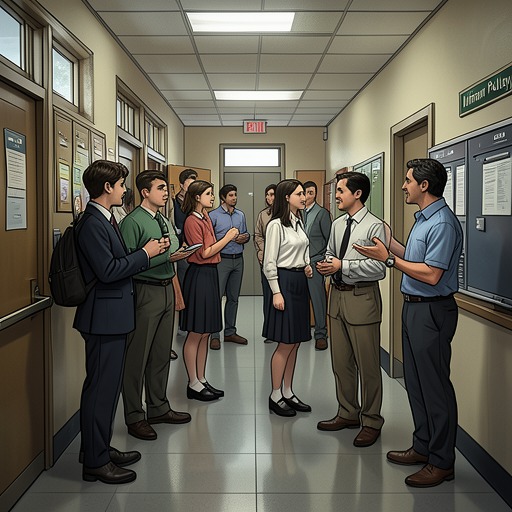
He tries to turn that alignment into school spirit, pointing to his clothing as students pass and urging them toward “Viking pride” and the feeling that everyone is in the same situation. The gesture fails to quiet the complaints. On the day the policy takes effect, students who are out of uniform are sent to the auditorium, where Tony Danza has been assigned monitor duty. When he appears in the doorway, more than a thousand students boo so loudly that he has to leave in order to make them stop. The scale of the reaction converts a policy dispute into a collective public rejection of the adult figure most visibly associated with it, even though the policy was not created for him.
Pepper’s violation shows how the rule operates at the smallest scale. Pepper is not generally a troublemaker, and he is wearing the required khaki pants, white shirt, striped school tie, and dark sweater. His offense is limited to wearing the wrong color shoes. Because Ms. DeNaples, the assistant principal and school disciplinarian, is monitoring the security gate, Pepper is directed to the auditorium. He responds that he has the correct shoes in his backpack, turning a minor technical violation into a comic challenge to the policy’s literalism and to the authority enforcing it.
Classroom Debate and Active Participation
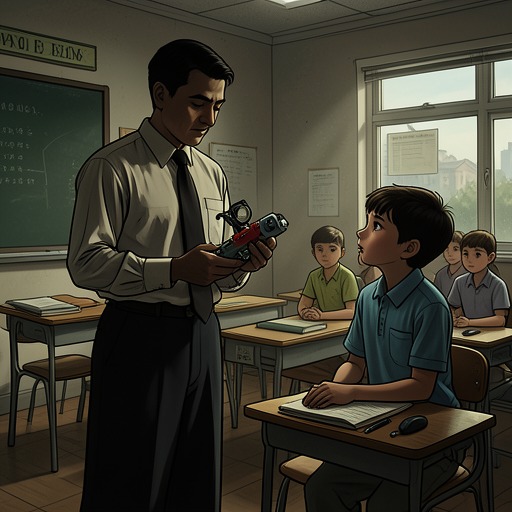
The uniform dispute becomes productive when Tony Danza abandons a planned opening task on physical fitness and nutrition. Eric Lopez and Matt attack the policy; Monte says he likes it because it makes everyone look as serious about school as he is; Eric Choi appreciates no longer having to wear shirts selected by his mother; Chloe and Katerina mourn the loss of shopping; and Ileana and Ben-Kyle object to the restriction of free expression. Rather than suppress the disagreement, Tony Danza replaces the planned prompt with a request that students explain how they feel about the uniform policy and why.
The students respond immediately. Their compositions carry more energy and conviction than almost anything they have written earlier in the year, and they soon want to read their opinions aloud. Tony Danza divides them into debate teams, drawing on the principle that discussion helps students retain ideas. The policy becomes classroom material rather than merely an administrative command: students articulate positions, connect clothing to distraction and expression, and test one another’s assumptions.
The debate exposes contradictions within the students’ arguments. White Nick asks what happens when clothing is distracting. Al G agrees that some girls wear unusually eye-catching clothes, though he admits that he likes them. Paige rejects the idea that she should be punished because some girls dress in revealing ways. Charmaine then undercuts the tension with a complaint about her two different socks, which makes the class laugh. Cost becomes another line of argument. Monte suggests that uniforms may save money over time and eliminate the energy spent deciding what to wear. The discussion lasts the entire period, and the students remain so engaged that Tony Danza decides to make debates a weekly feature.
The final vote does not resolve the policy, but the supporters narrowly outnumber the opponents. Even Pepper appears more thoughtful about the rule by the end of the period. This is the event’s sharpest reversal: a policy that produces mass booing outside the classroom creates sustained, serious participation inside it. Tony Danza does not manufacture agreement; instead, he converts imposed discipline into an occasion for students to speak, disagree, and practice judgment.
Discipline, Authority, and Uneven Enforcement
Pepper’s response is followed by a deliberately personal disciplinary measure. When he comes to Tony Danza’s classroom for fifth period, Tony Danza asks whether he has ever written an apology note, gives him stationery and an envelope, and orders him to compose one to Ms. DeNaples in his best handwriting. Tony Danza dictates the beginning rather than leaving Pepper entirely to his own words, because he does not want to risk the apology going wrong. The episode places the uniform rule within the school’s broader culture of enforcement, where authority depends on the discretion of particular adults and where a small violation can become a lesson in submission, responsibility, or both.
That discretion is especially visible elsewhere in the school. Before the Washington, D.C. field trip, Tony Danza recognizes that Northeast has extensive manuals, policies, and behavior codes, even though a Philadelphia police station is on campus, but serious consequences are applied most consistently to students involved in physical fights. Rules concerning uniforms, hoodies, iPods, running, shouting, and earbuds are posted and announced, yet they are not enforced consistently. Teachers who insist on compliance may have to involve the dean’s office, lose class time, and sacrifice the classroom momentum they consider essential. Students understand this gap between the written rule and its practical enforcement and therefore test how far they can go.
The policy consequently reveals an institutional split. Ms. DeNaples represents formal disciplinary authority, while teachers such as Tony Danza operate as frontline interpreters who must decide whether a breach deserves confrontation, referral, apology, or a teachable moment. The school’s public claim to order is maintained through rules, uniforms, monitoring, and official procedures, but daily practice remains selective and improvised. That gap helps explain why the uniform can be enforced intensely at a security gate while other regulations remain negotiable in classrooms and corridors.
Consequences and Significance
The uniform controversy does not end with the students’ classroom vote. It continues to shape perceptions of Northeast as a school attempting to impose discipline without possessing a stable, shared enforcement structure. The later return to free dress is associated with Tony Danza’s prediction that Northeast would become chaotic, a prediction that appears to have come true “and not in a good way.” The contrast makes the uniform policy part of a larger cycle in which visible institutional controls are introduced, resisted, relaxed, and then judged by the disorder or legitimacy that follows.
The policy also sits alongside wider pressures on Northeast. After the real Pennsylvania System of School Assessment tests, the school fails once again to meet its Adequate Yearly Progress target despite gains in every category except writing. Northeast becomes an Empowerment School, moves closer to Renaissance School status, and receives more professional-development meetings, district walk-throughs, assessments, and pressure to perform. Parents are notified that the school missed its target and may move their children elsewhere. Linda Carroll argues that Northeast has effectively met the standard as far as she is concerned, pointing to the unfair way the system credits the school for children in its designated region even when they are not enrolled there. The uniform, like the testing regime, therefore dramatizes how institutional measures can claim neutrality while producing pressure and resentment unevenly.
The event’s significance lies in this double movement. As a school rule, the uniform policy narrows visible choice and invites resistance over rights, expense, cultural expression, and the meaning of seriousness. As classroom material, however, it produces a form of active participation that official mandates rarely achieve on their own. The episode does not offer a simple victory for either students or administrators. It shows that institutional authority is strongest when students can argue with it, and weakest when the school’s formal rules are disconnected from the uneven realities of enforcement, poverty, racial tension, family conflict, and the daily work of teaching.