Northeast High leadership-passing water-balloon battle
I'd Like to Apologize to Every Teacher I Ever HadThe Northeast High leadership-passing water-balloon battle is the book’s clearest image of school order collapsing from ceremony into collective chaos. What begins as a formal transfer of authority between graduating seniors and rising juniors becomes a three-minute barrage of water balloons, bottles, screams, and bodies pressing toward the exits. The incident is both comic and dangerous: it temporarily overturns the school’s hierarchy, then restores it through Linda Carroll’s unmistakable command and leaves the institution confronting the difference between symbolic rules and effective authority.
Ceremony and Participants
The battle occurs during a Thursday auditorium assembly for all eleventh- and twelfth-grade students. The seniors and juniors sit on opposite sides, giving the ceremony a visibly divided structure before any violence begins. Its stated purpose is orderly succession: senior football players first hand a ceremonial torch to junior football players, followed by the other senior sports teams, cheerleaders, band members, choirs, and academic and social clubs. Each transfer receives an enormous ovation, with students shouting “One Six Nine” and “One Seven O,” the numbers of the graduating and rising senior classes.
The ceremony therefore stages leadership as a public inheritance. The torch, the sequence of organizations, and the opposing seating arrangements turn student status into a ritual that can be seen and heard. The audience’s cheers temporarily make the succession appear stable. Yet the students are not merely observers. They are organized into rival class groupings, already equipped to act collectively, and the theatrical display of authority contains the possibility of its own disruption.
From Ritual to Stampede
The mood changes when someone from the senior side throws a water balloon toward the junior side. The narration suggests that the act is not wholly spontaneous: the students appear to have brought their ammunition in advance, as though the conflict had been prepared before the ceremony began. A single projectile becomes a declaration of war. Within seconds, both classes are throwing water balloons rapidly across the auditorium, soaking students, seats, and the surrounding space.
When the balloons run out, the students substitute water bottles. The escalation changes the character of the incident. What first resembles a prank becomes a broader exchange of plastic projectiles, with one thrown bottle prompting another until the air is filled with objects. Students begin screaming and running for the exits, and the assembly turns into a stampede. The transition from water to bottles shows how quickly a collective event can generate new means of conflict once its original resources are exhausted.
Adults Confront the Crowd
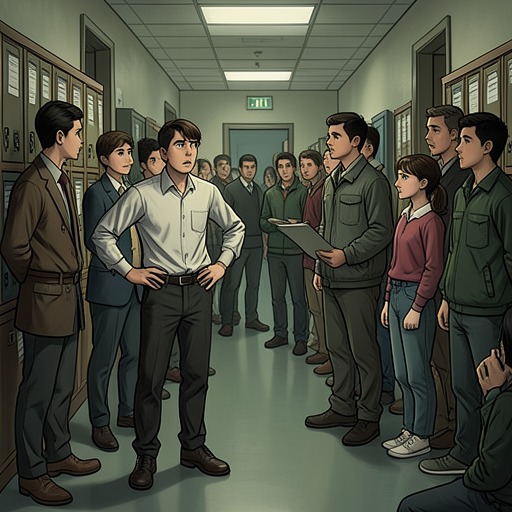
Tony Danza stands at the back and tries to slow the students, but the density and momentum of the crowd overwhelm him. He pulls another teacher out of the aisle and brings her to safety while students pile onto one another and yell. His position is revealing: he is present as an adult authority, but he cannot control the movement of the assembly by personal intervention alone. The crowd has become a physical force larger than any single teacher.
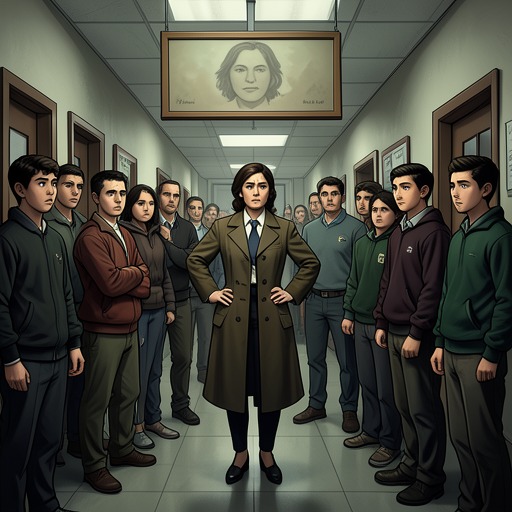
Linda Carroll ends the crisis from the stage. She orders the students to sit down and be quiet and threatens to cancel every remaining plan for the year, including graduation, if they refuse. Her intervention works because it addresses the students’ collective stake rather than attempting to chase individual offenders through the panic. The narrator has seen Carroll manage other situations and has sometimes suspected that her authority involved performance. In this emergency, however, there is no appearance of bluff. Her anger is described as genuine and overwhelming, and the students—especially the seniors—stop immediately.
Consequences and Significance
No one is injured, although the students and the auditorium are left soaking wet. The students return sheepishly to their drenched seats, and the immediate danger passes without the cancellation of graduation. Carroll’s decision not to impose that threatened consequence preserves the school’s culminating ceremony, but it also marks the episode as a contained restoration rather than a simple victory over disorder.
The incident follows the book’s larger concern with rules that are widely announced but inconsistently enforced. Before the school’s Washington, D.C. field trip, Tony Danza observes that students know the codes governing uniforms, hoodies, iPods, running, and shouting, yet teachers often lack a workable framework for enforcing them. Physical fights receive serious consequences, while lesser violations frequently consume class time without producing reliable compliance. The water-balloon battle makes that institutional weakness spectacular: a formal ceremony can coexist with a prepared assault on the assembly because the school’s visible structure is not the same as its operative capacity.
The battle also gives the leadership ritual a carnivalesque reversal. Seniors and juniors are supposed to exchange authority through a ceremonial torch, but instead they temporarily erase the distinction between ceremony and combat. The same school community that applauds the succession becomes a drenched, shouting mass, and the auditorium’s stage shifts from a platform for ritual recognition to the point from which Carroll reasserts command. Order returns not through the ceremony’s symbolism but through a credible threat backed by the school’s most valued future event: graduation. The episode’s significance lies in that reversal. Northeast High can produce ceremony, enthusiasm, and collective identity, but maintaining them requires authority capable of acting at the instant when performance becomes danger.