Pepper’s assault investigation
I'd Like to Apologize to Every Teacher I Ever HadPepper’s assault investigation is a decisive episode in Tony Danza’s attempt to teach within Northeast High School’s volatile social and disciplinary culture. On the day before the Washington, D.C. field trip, Pepper is punched in the hallway for no clear reason, leaving him with a bruised, swollen eye and a discolored cheek. The search for the attacker leads through the school police station and its surveillance system to Elvis Jones, a student far larger than Pepper. More consequential than the identification itself is Tony’s reaction: his sympathy for the vulnerable student briefly turns into an urge to punish the aggressor personally, forcing him to confront how easily protection can become another form of violence.
Causes and School Context
Pepper’s attack occurs within a school where rules are widely announced but inconsistently enforced. Northeast High School has a Philadelphia police station on campus, yet ordinary violations involving hoodies, earbuds, running, shouting, and other classroom behavior often produce no effective consequence unless a student gets into a physical fight. Teachers risk losing valuable instructional momentum when they escalate minor infractions to the dean’s office, and students understand that the disciplinary system is porous. Against this background, a hallway assault is not an isolated breach but a concentrated expression of the school’s larger problem: violence receives the clearest institutional response, while the conditions that allow intimidation and disorder to persist remain harder to address.
Pepper is presented as a small student who can be a slacker and occasional instigator but is not mean. He is standing and talking with a friend when another student passes and punches him in the face. Pepper tells Tony that the blow nearly knocked him down, that he saw the attacker running away, and that he does not know why he was hit or who the boy was. His inability to supply a motive makes the assault especially destabilizing. There is no described quarrel to explain it, only sudden physical force delivered in a crowded corridor.
Investigation Through Surveillance
At the school police station, Tony sees that the incident is part of a constant stream of fights. When a guard points out a boy in a holding cell, the student matter-of-factly says that he got into a fight with the boy inside. Tony is nearly drawn into that case because fighting still exerts a powerful attraction on him, but Officer Anderson redirects the immediate inquiry by calling Pepper over to review surveillance footage. The cameras do not cover every part of the school, but they cover the hallway where Pepper was attacked.
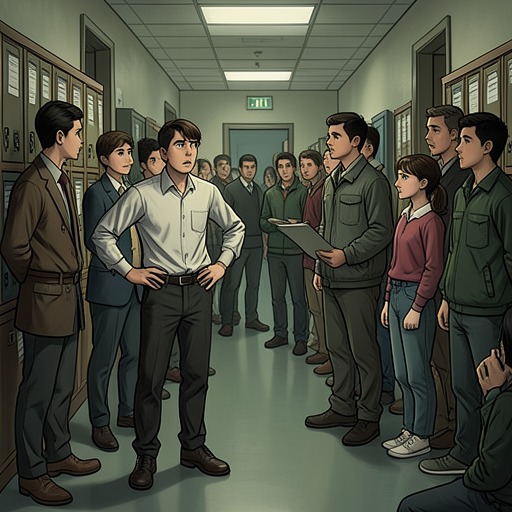
The recording reconstructs the event with a precision that Pepper’s frightened account cannot provide. The hallway fills with students changing classes. Pepper is visible standing and talking, with no evidence that he is provoking anyone. The actual punch is outside the camera’s view, but the aftermath is unmistakable: Pepper recoils, and the attacker runs down the hallway into the stairwell before appearing on another monitor as he climbs the stairs. The footage converts uncertainty into identification without supplying a larger explanation. It shows what happened, and who fled, but not why the blow was delivered.
Officer Anderson recognizes the attacker as Elvis Jones, one of the roughly two hundred students he characterizes as troublemakers within a school of more than three thousand. He retrieves Elvis’s photograph and schedule, then sends Officer Morton to room 238 to bring him down. The bureaucratic procedure is swift and practiced: Anderson calls for the student over the radio, hands over the paperwork, and returns to his desk with the weary assurance that there is never a dull moment. The efficiency of the response contrasts with the randomness of the assault and with the emotional disturbance it creates for Tony and Pepper.
Tony’s Confrontation with Elvis
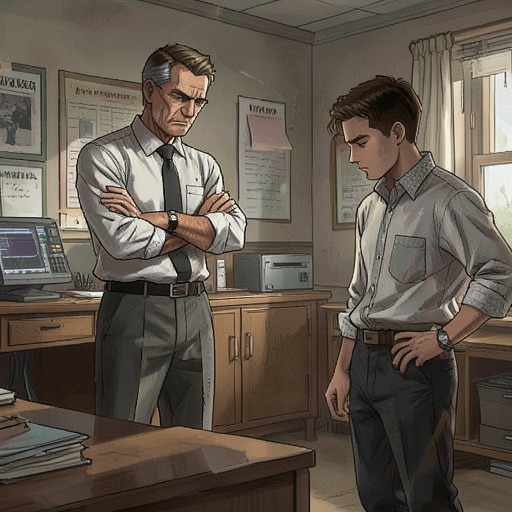
Officer Morton asks Tony to accompany him to room 238, where Mr. Florio, the basketball coach, calls Elvis Jones out of English class. Tony waits in the hallway, but the encounter immediately unsettles him: Elvis is more than a foot taller than Pepper and outweighs him by at least fifty pounds. Rather than remain a detached observer, Tony demands to know why Elvis hit a much smaller student. Elvis denies the assault, says he does not have to speak to Tony because Tony is not his teacher, and then challenges the authority behind Tony’s anger by pointing out that Tony is speaking aggressively only because the uniformed officer prevents Elvis from responding physically. The exchange exposes how quickly the investigation can become another confrontation. As they reach the stairwell, Officer Morton recognizes the danger and tells Tony that he will take over. The stairwell door closes between them, ending the immediate encounter but not Tony’s agitation; he fears that Elvis may retaliate personally or through friends, while the school’s prevailing code of pushing back threatens to draw him into the same cycle of force he is supposed to resist. Tony later acknowledges that Elvis’s code resembles his own former code, yet understands that it is wrong, and David Cohn advises him not to let students see how deeply they can provoke him.
Racialized Conflict and the Limits of Protection
The investigation also belongs to the wider racial and cultural tensions that shape Northeast High School’s conflicts. Matt’s assault by four African-American students has already left him black-eyed, bruised, and ready to explode, while his father interprets a later confrontation with Black girls in the hallway as proof that Matt’s complaints about the school are justified. Tony resists that conclusion, warning the father not to tell Matt that he is right and explaining the girls’ language as part of the culture they encounter at home and in the media. The school-uniform debate exposes a related struggle over whose conduct is treated as provocative: when Paige objects that girls should not be punished because some dress like sluts, the question shifts from individual clothing to unequal assumptions about responsibility and distraction. In the classroom, Tony connects these disputes to the social-justice theme running from Of Mice and Men through the year’s curriculum, asking how people respond when they believe they have been denied a fair chance. Pepper’s assault therefore cannot be reduced to a simple contest between an innocent victim and an identified offender. The surveillance establishes responsibility for the blow, but the surrounding narrative keeps pressing toward the harder problem of how racialized expectations, honor codes, uneven discipline, and a culture accustomed to disadvantage make violence seem both ordinary and self-justifying.
Narrative Significance
Pepper’s assault investigation ultimately changes Tony’s understanding of what protection requires. His first impulse is intensely personal: because Pepper is small, frightened, and plainly unable to explain why he was attacked, Tony imagines himself as a protective father and wants to beat the bully. Yet the investigation gives him no satisfying moral release. The cameras identify Elvis Jones, but they do not reveal a motive; the officers can retrieve a photograph, schedule, and suspect, but they cannot erase the atmosphere in which such violence is routine. Tony’s near-altercation makes the episode a test of his fitness as a teacher rather than merely a police matter. He must distinguish sympathy from possession, authority from intimidation, and justice from retaliation. That distinction also links the event to his larger teaching project: students repeatedly confront unequal opportunity, racialized suspicion, and social codes that treat resistance as necessary for survival. The investigation does not resolve those forces, but it makes Tony recognize that reproducing the school’s code of answering force with force would betray the very students he wants to defend.