Pepper’s dog-biscuit prank
I'd Like to Apologize to Every Teacher I Ever HadPepper’s dog-biscuit prank is a small but consequential act of resistance during Northeast High School’s new uniform policy. Stopped for wearing the wrong color shoes, Pepper technically complies by changing them, then transforms the correction into an insult by handing Ms. DeNaples a dog biscuit. The gesture exposes how a school rule can become a stage for status, humor, and disciplinary power: Pepper wins admiration from his classmates, while the adults must decide whether to treat his creativity as defiance or as a teachable moment.
The Uniform Context
The prank occurs on the first day the uniform policy takes effect. Students who are out of uniform are sent to the auditorium, where Tony Danza has been assigned monitor duty. More than a thousand students boo him so loudly that he has to leave the doorway. The atmosphere is therefore already charged with collective resentment before Pepper reaches the security gate.
Pepper is not generally a troublemaker. He is a small, quirky student whose nickname reflects his personality, and he appears to be wearing nearly everything the policy requires: khaki pants, a white shirt, a striped school tie, and a dark sweater. His violation is limited to his shoes. Ms. DeNaples directs him toward the auditorium, but Pepper says, “I have the right shoes in my backpack.” After he changes them, the formal issue should be settled. Instead, he hands Ms. DeNaples a small object and tells her, “This is for your trouble.”
The Insult and Its Meaning
The object is a dog biscuit. Another teacher soon reports the incident with barely contained laughter, but Tony Danza initially cannot understand why the gift is funny or offensive. David Cohn is equally bewildered when Danza recounts what happened. Ms. DeNaples supplies the missing cultural code herself: the biscuit means, “I’m a bitch.” The insult depends on the association between a dog and the word “bitch,” making the apparently harmless object a compact act of verbal aggression.
The scene illustrates the gap between adult authority and student fluency in the school’s symbolic language. Pepper does not need to shout or refuse the rule. He follows the immediate instruction, changes his shoes, and then uses an object to reverse the emotional direction of the encounter. His gift converts obedience into mockery. David Cohn’s observation, “At least he’s creative,” briefly recognizes the ingenuity of the act, but Ms. DeNaples rejects that interpretation because the creativity is inseparable from disrespect. The same gesture can therefore appear as wit to one observer and as a direct challenge to another.
Peer Recognition and Classroom Opportunity
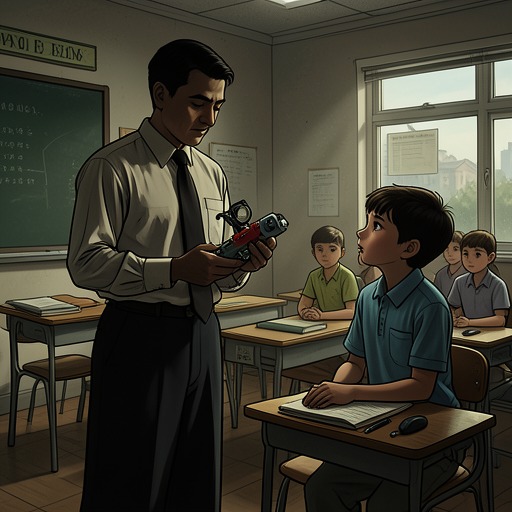
The prank makes Pepper a hero among his classmates. By the time he returns to class, everyone has heard about it and is already lionizing him. Tony Danza recognizes that a public punishment could strengthen Pepper’s status rather than correct his conduct, so he invites him to meet privately after class instead of turning the incident into a group exercise. The decision preserves the seriousness of the offense while denying the prank the larger audience that would make it more powerful.
The episode also redirects the day’s lesson. Tony Danza had planned a writing prompt about physical fitness and nutrition, but the uniform dispute produces a more immediate educational opportunity. Students argue over whether uniforms suppress free expression, save money, reduce distraction, or make the school look more serious. The discussion lasts the entire period, and a final vote gives the policy a narrow advantage. Even Pepper appears more thoughtful about the issue by the bell, although Tony Danza reminds him that their private business is not finished. The prank thus becomes part of a broader debate about rules, identity, and participation rather than remaining an isolated disciplinary anecdote.
Apology and Limited Resolution
When Pepper arrives for the meeting, Tony Danza gives him stationery and an envelope and asks whether he has ever written an apology note. Pepper looks down at his shoes and shrugs. Danza dictates the note, including its opening address, because he does not want to risk another insult disguised as independence. Pepper writes exactly what he is told without protest and delivers the apology to Ms. DeNaples in person.
Ms. DeNaples does not treat the incident as fully erased. She reads the note in Pepper’s presence, sighs, and dismisses him with a warning: “Disrespect is no laughing matter.” The response restores some of her dignity without pretending that the original humiliation never occurred. When Pepper emerges, Danza asks whether he is going to lunch. Pepper answers, “Yeah,” and walks away looking disheveled and hangdog, but he gives Danza a small backward wave as he enters the stairwell. The gesture suggests a negotiated settlement: Pepper has accepted the consequence, Danza has avoided a theatrical confrontation, and the school has regained only a modest measure of order.
Significance
Pepper’s prank condenses the book’s larger concern with the difference between control and education. A rule imposed from above produces mass booing, argument, and resentment; a student’s response turns a tiny technical violation into a contest over who gets to define respect. Tony Danza’s handling of the incident is neither simple permissiveness nor pure punishment. He separates Pepper from the approving crowd, makes him perform repair through a written apology, and uses the surrounding controversy to create a genuine classroom debate.
The event also shows why labels such as “problem student” are unstable. Pepper is celebrated as clever by his peers, regarded as insulting by Ms. DeNaples, and treated by Danza as someone capable of reflection as well as mischief. His act causes real offense, but the response does not reduce him to that offense. Instead, the prank becomes a compact example of school life as continual negotiation: policies are enforced by adults, meanings are supplied by student culture, and consequences are shaped through face-to-face improvisation.