School uniform controversy
I'd Like to Apologize to Every Teacher I Ever HadThe School uniform controversy at Northeast High School is more than a dispute about clothes: it exposes competing ideas about student choice, household costs, school discipline, and what it means to belong to a school. The policy provokes sustained resistance, but Tony Danza also turns that resistance into a rare, energetic classroom debate in which students argue the issue on its merits.
Origins and Stakes
The school had been planning for two years to replace free dress with uniforms, with the change scheduled for November. Linda Carroll made the decision, but students and some parents opposed it as the implementation approached. Students regarded the requirement as an infringement on their rights; parents were concerned about the expense of buying uniforms. The dispute was further inflamed by a suspicion that the policy was connected to the television production at the school. Students blamed Tony Danza’s presence for the change, although the book makes clear that this accusation was unfounded. The sentiment nevertheless lingered throughout the year, giving an already unpopular rule an additional layer of resentment.
The debate also involved a tension between a common appearance and individual expression. In class, students objected that uniforms would limit free expression and remove the pleasure of shopping for clothes. Other students welcomed the prospect of not having to choose an outfit each day. Cost mattered alongside principle: Danza asked what students’ school clothes already cost, and Daniel reported that his mother worried about the price of uniforms; several classmates said their parents shared the concern. The controversy therefore joined an abstract argument about rights to a practical question about what families could afford.
Danza’s Uniform and the Rule’s First Day
Danza publicly told his students that he would wear the same outfit every day in solidarity with them. His chosen clothes were black shoes, gray pants and a belt, a blue dress shirt, and a Northeast High School tie. He bought five pairs of identical slacks and six shirts for the year. The tie prompted a separate dispute with the production team: producers considered it stodgy and old-fashioned, while Danza regarded it as a sign of respect for teaching and for students. He kept it, and the boys’ school uniform included the same tie. His clothing thus became a small parallel to the students’ situation: an externally regulated image that Danza could accept as a professional statement, even as he recognized the students’ resistance to the school’s decision.
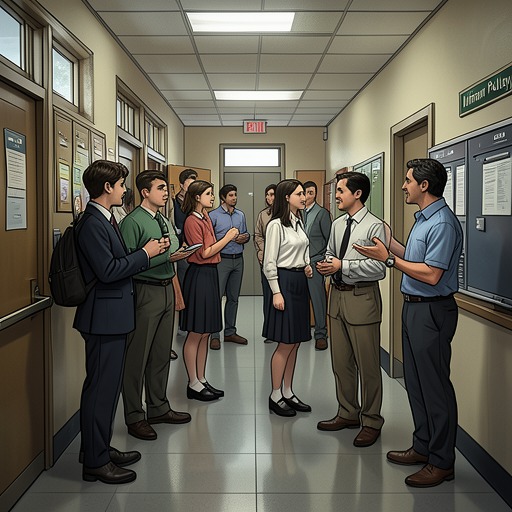
Danza pointed to his own uniform in the hall and encouraged students to take pride in being part of the same school. The gesture did little to quiet their complaints, though it made him feel that he looked good and was standing with them. When the policy took effect, students not in uniform were sent to the auditorium, where Danza had been assigned to monitor them. More than a thousand students booed him so loudly that he had to leave the doorway to stop the noise. The scale of the response made plain that his personal show of solidarity could not resolve opposition to a decision made by the administration.
Pepper’s case brought the rule down to the details of enforcement. Stopped at the security gate, he was wearing the required khaki pants, white shirt, striped school tie, and dark sweater, but his shoes were the wrong color. Ms. DeNaples, monitoring the entrance, directed him to the auditorium. Pepper said he had the correct shoes in his backpack; she challenged him on why he was not wearing them. The incident was a small one, but its precision mattered: a student could comply with nearly every element of the prescribed outfit and still be sent away over a single item. Danza’s later attention to Pepper, including asking him to stay after class, linked enforcement to an individual student rather than leaving the episode as a general argument about rules.
From Complaint to Classroom Debate
When students again began arguing about uniforms in class, Danza abandoned his planned opening task on physical fitness and wrote a question asking how they felt about the policy and why. The shift let students’ immediate disagreement set the lesson’s agenda. They quickly began writing, then eagerly read their views aloud. Danza divided them into debate teams, drawing on the idea that discussion helps students retain what they learn. The uniform conflict became not only a subject for argument but a way to practice making and explaining arguments.
The students’ positions were varied rather than neatly divided into two camps. Charmaine argued for freedom to dress as she wished; classmates raised the possibility that some clothing could distract others. Paige objected to being punished for how other girls dressed, while Charmaine’s joke about her mismatched socks brought laughter and briefly shifted the tone. Danza introduced the cost question, and Daniel’s report about his mother prompted others to voice similar concerns. Monte made the case for uniforms as a way to save money over time and avoid the daily effort of choosing clothes. Each argument gave the class a different measure of the policy: personal liberty, shared expectations, family expense, or convenience.
The discussion lasted the whole period and was lively enough that Danza decided to make debates a weekly feature. The class did not settle the uniform issue, but its final vote edged in favor of the policy. By the bell, even Pepper seemed more thoughtful about it. That change did not erase his earlier experience at the gate, nor did the vote prove that the school’s decision had won general approval. Instead, it showed that students could engage with a contested rule without all arriving at the same conclusion.
Enforcement and Continuing Significance
The controversy sits within a school environment where formal rules were not always consistently enforced. The book describes students who knew the behavior policies but often encountered little active enforcement, while teachers could lose valuable class time if they escalated a dispute. That wider gap between written expectations and everyday practice helps explain why the uniform requirement could be experienced at once as strict and as a source of argument: its meaning was shaped by how particular adults applied it to particular students.
Later, Danza reflects that free dress had made Northeast chaotic, suggesting that the clothing question continued to matter beyond the first day and the classroom debate. The account does not detail the transition between the uniform dispute and that later assessment, so the two moments do not amount to a simple verdict on whether uniforms succeeded. Together, they preserve the controversy’s central tension. A dress code could promise order and shared identity, yet provoke resistance over autonomy, cost, and enforcement; a classroom vote could favor the policy without bringing the underlying disagreement to an end.