School violence
I'd Like to Apologize to Every Teacher I Ever HadSchool violence at Northeast High School is not presented as an isolated crisis but as a recurring condition of school life: visible in the security students say helps them feel safe, in fights that leave students injured, and in the difficulty adults face when rules are inconsistently enforced. Through incidents involving Matt and Pepper, Tony Danza traces how violence travels beyond the punch itself, shaping students’ expectations, family responses, and his own struggle to distinguish protection from retaliation.
Conditions and Setting
When Tony Danza begins teaching, arriving at Northeast High School means passing several groups of guards and metal detectors. One student, watching his backpack go through the screener, says the measures make him feel safer, even though the lines take time; he knows students who might try to bring something dangerous into school. Danza contrasts that account with his own memory of public high school, where he worried about larger boys throwing punches but gave security little thought. The difference establishes a school where violence is not merely a possibility but part of the background against which students and staff move through the day.
The threat is also present in the school’s uneven discipline. During morning truancy patrol, Danza encounters students lingering outside after the bell, smokers who refuse to move when told, and others walking away from school. He is intimidated by some of the students he must confront, but recognizes that getting them through the doors once does not ensure they will return the next day. Later, while preparing a class trip, he reflects that the school has posted behavior codes and a police station on campus, yet many rules are not consistently enforced; physical fights, by contrast, bring serious consequences. The gap between formal rules and daily practice leaves teachers with little reliable authority in the moments when conflict escalates.
Matt’s experience shows how fighting can become entangled with identity and racial tension. A strong athlete and the football team’s starting middle linebacker, he is used to contact being acceptable on the field, but in class he provokes other students and argues when they respond. By the end of October, he is tied for the school record in fights. After a friend is attacked, Matt gets into a confrontation with African-American students; four of those students later jump him, leaving him black-eyed and badly bruised. A classmate identifies a racial element, and Danza observes that Matt’s attitude changes after the assault: he seems ready to explode at any moment.
Family Responses and the Limits of Discipline
Danza’s response to Matt’s escalating anger is not simply to punish him. After Matt is badly beaten and begins seeming ready to explode, Danza asks whether he would speak with a counselor; Matt agrees without brushing the suggestion aside. Danza then calls his father, who joins Matt’s mother, the counselor, the department head, and Danza for a meeting. They decide Matt will see the counselor regularly, an intervention that makes family and school jointly responsible for addressing the problem rather than treating each fight as an isolated offense.
The meeting’s apparent progress is unsettled almost immediately. As Matt’s parents leave, they are caught behind a group of Black girls in a crowded corridor. The girls are talking crudely and using racial epithets; when Matt’s father asks them to watch their language because they are at school and he is there with his wife, they take offense, insult the parents, and turn the exchange into a shouting match. The confrontation gives Matt’s father a vivid confirmation of his son’s complaints about Northeast. He calls Danza to say he now believes Matt is right about the school and its students.
Danza sees that this validation could harden the very outlook he is trying to loosen. He urges Matt’s father not to tell his son that he is right, and explains the girls’ behavior as cultural—learned from what they see at home and in the media—while insisting that they are still children. The explanation calms the father for the moment, but does not erase the conflict: he agrees to let Matt finish the year and says that Matt will attend a Catholic school the following year. Danza reluctantly allows that stricter parochial discipline may be what Matt needs, leaving unresolved the tension between seeking support for an angry student and removing him from the environment in which that anger has intensified.
Pepper’s Assault and the Pull of Retaliation
The day before the Washington, D.C. trip, an alert from Assistant Principal McCloskey brings Tony Danza downstairs to the school police station, where Pepper sits with a bruised, swollen eye and a discolored cheek. Pepper says he had been standing in the hallway talking to a friend when another student punched him and ran. He is close to tears, and cannot identify his attacker or explain why he was hit. Danza knows Pepper as a small student who can slack off or provoke others but is not mean; his sympathy is immediate, sharpened by his own memories of being small and taking punches.
The security cameras turn a frightened account into a traceable incident. Officer Anderson searches footage from the reported time and place. The hallway is crowded with students changing classes; the video shows Pepper standing and talking, then recoiling, followed by the attacker running toward a stairwell and appearing on another camera as he goes upstairs. The punch itself is not visible, but the footage offers no sign that Pepper invited trouble and gives the officers a route to the student. Anderson recognizes the boy, identifies him as Elvis Jones, and retrieves his photograph and schedule. The school’s surveillance system can establish where the attacker went and whom to find, though it cannot show the instant of impact.
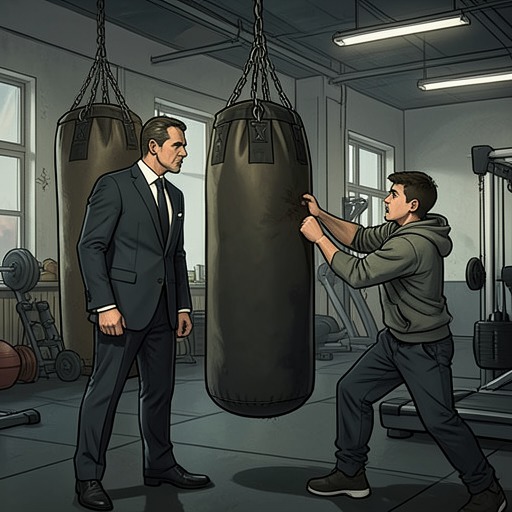
Danza’s reaction reveals how easily the role of protector can turn toward the logic of the fight. Seeing Elvis’s photograph, he feels like a protective father and wants to beat the bully. Officer Morton asks him to accompany him to retrieve the student, a choice Danza recognizes as risky because his emotions are running high. At room 238, where basketball coach Mr. Florio is teaching English, Morton calls Elvis into the corridor. Danza is stunned by the size difference: Elvis is more than a foot taller and at least fifty pounds heavier than Pepper. When Elvis denies hitting anyone and says Danza has no authority over him, the exchange edges toward a fight. Danza challenges him, while Elvis points out that he is speaking boldly because Elvis cannot hit back in front of the officers.
Danza admits to himself that the urge to fight is mutual and that the old deference once attached to being a teacher no longer protects him. Morton, maintaining his composure, tells Danza he will take over. The stairwell door closes between them as Elvis gives Danza a final glare. The encounter leaves a possibility of retaliation hanging over him, whether from Elvis himself or his friends, and makes the danger personal as well as institutional. Danza recognizes the code behind the impulse—to push back when challenged—as one he once lived by, but now understands it as wrong. The intervention therefore ends not with a visible resolution about Elvis’s punishment, but with Danza having to restrain the very violence he came to address.
Violence, Honor, and Opportunity
A fight in the school police station gives the book’s recurring violence a blunt, everyday setting. When Tony Danza visits Pepper there, another student points toward a boy pacing and yelling in a holding cell and says that he got into a fight with him. The scene sits alongside the camera footage and officers’ procedures, but also Danza’s admission that fighting still exerts a magnetic pull on him: violence is not only an administrative problem to be processed but a familiar code that can draw even an adult back toward participation.
Danza later uses Coolio’s Gangsta's Paradise to examine the reasoning that sustains that code. He asks why the song’s gangsta feels that disrespect deserves a deadly response; a student explains that the figure must defend his honor or others will get him if he lets them. Danza connects the discussion to the class’s recurring study of social justice, which has returned since Of Mice and Men to equal opportunity and to the ways people respond when they are denied a fair chance to succeed. His own recognition that he might never have had a chance without extraordinary luck makes the theme personal, while the students’ explanation exposes how violence can be understood from within as a defense against vulnerability rather than as an isolated outburst.
That perspective complicates the book’s accounts of individual responsibility without dissolving it. Danza recognizes the force of a retaliatory code because he once lived by one, yet understands that answering a threat with another threat perpetuates the danger. School violence therefore appears both as immediate bodily harm and as a learned expectation about how to preserve safety or honor. The classroom’s turn from a rap lyric to questions of opportunity gives students a way to examine that expectation, even as the assaults and fights elsewhere in the narrative show how difficult it is to interrupt.