Teach For America
I'd Like to Apologize to Every Teacher I Ever HadTeach For America is presented as an organization that trains college graduates to teach in rural and urban public schools, and as the immediate catalyst for Tony Danza’s transition from entertainment into education. Its importance in the book lies less in an extended institutional history than in the way it turns a private vocational regret into a public experiment: after years in boxing, acting, and television, Tony encounters the organization’s work, imagines himself entering the classroom, and eventually joins a school community in which many TFA recruits are also beginning their teaching careers.
Mission and First Encounter
Teach For America first reaches Tony through a documentary about TFA teachers in Baltimore, Maryland. The film culminates in a production of Bye Bye Birdie, a setting naturally attractive to Tony as a performer, but the decisive image comes after the performance, when the camera pans across an audience of only about seven people applauding the students. Tony contrasts that sparse audience with the packed family, friends, and teacher audiences he had known from his own children’s private-school productions. The absence of support for the inner-city students moves him to say that he wanted to help, making TFA’s work the emotional trigger for his reconsideration of teaching.
The encounter also reconnects Tony with a long-delayed ambition. He had originally planned to teach after college and holds a degree in history, but his career moved first into boxing and then into acting. Even his television character on Who’s the Boss? eventually became a teacher, suggesting that the educational vocation had remained present beneath his entertainment career. The documentary gives that old aspiration a concrete route back into public life: Tony investigates Teach For America and learns that he technically qualifies to apply, although the prospect of beginning a third-act career frightens him as much as it attracts him.
Entry into the Teaching Experiment
Tony’s decision to speak openly about applying to Teach For America becomes a form of self-commitment. He tells the executive producer of his former talk show that he is considering giving up acting to become a teacher, and the producer immediately suggests making the transition into a reality show. Tony initially rejects the idea because he wants to teach rather than combine teaching with show business, and because the proposed program would involve real students and their real education. He fears that television’s demand for drama would compromise or exploit the students.
The resulting Teach project is not described as a direct TFA production, but TFA supplies the institutional and moral context for Tony’s new direction. Tony insists that students must come first, that the cameras should observe rather than script, and that the production should contain no forced or artificial drama. His concern is closely related to the book’s treatment of Teach For America teachers: the organization represents an effort to place committed newcomers in public schools, while the television project risks turning the same educational setting into entertainment. Tony’s proposed standard of responsible reality therefore depends on preserving the students’ educational interests against the commercial logic of ratings.
TFA Teachers at Northeast High School
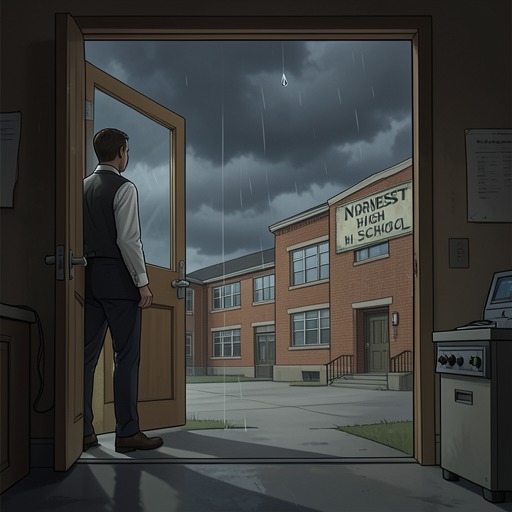
Teach For America becomes visible within Northeast High School through the young recruits working there. When Tony organizes a Friday teachers’ gathering at Nick’s Roast Beef, he initially invites teachers from his small learning community and asks Crystal Green and Joe Connelly to recruit other new teachers. A contingent of Teach For America teachers from the school has already discovered the bar independently, and Tony draws them into the gathering. Their presence helps turn an improvised meeting into a recurring community for teachers.
The gathering reveals the pressures confronting these recruits. Conversation begins with politics, city government, and the Phillies but repeatedly returns to work, becoming more candid as the evening continues. Job security emerges as the teachers’ central anxiety. Tim Flaherty warns that teachers remain at the mercy of the administration and the district, while the experiences of new teachers are set against the protection offered by a union. A Teach For America recruit who looks young enough to be a schoolgirl objects passionately to limits on teachers’ willingness to volunteer for students, arguing that layoffs, cutbacks, and overcrowded classrooms ultimately harm the children. Her intervention places the organization’s idealism inside a much harsher institutional reality: commitment to students is expected, but the time, staffing, and security needed to sustain that commitment are uncertain.
The book also records the fragility of beginning a teaching career. More than one hundred new teachers who attended Tony’s August orientation had quit before Christmas. Tony responds by imagining a “Three-Fifths Solution,” in which teachers would teach three classes rather than five, gaining time to prepare and to follow through with individual students. The proposal is his critique of a system that demands deep engagement while providing too little time and too few resources. TFA thus appears alongside, rather than outside, the problem of teacher burnout: it recruits people into difficult schools, but the narrative emphasizes how rapidly idealism can collide with workload, institutional dependence, and emotional exhaustion.
Education Beyond Full-Time Teaching
By the end of the book, Teach For America has become one example in Tony’s larger argument that educational responsibility does not belong only to professional teachers. After spending a year trying to engage students in their lives, problems, and futures, he concludes that educators deserve wholehearted respect and support, even while acknowledging that he may not be suited to remain in the classroom as a career. He rejects an all-or-nothing model of educational service: people can read to children at a local library, volunteer in neighborhood schools, or support organizations that promote teaching excellence.
Teach For America is named first among several organizations that can contribute to that wider public effort. Tony places it alongside DonorsChoose, the Freedom Writers Foundation, the EnCorps Teachers Program, and the Fulfillment Fund, describing such organizations as providers of counseling, mentoring, scholarships, and grants for educational innovation. Its final significance is therefore both personal and civic. Teach For America opens the route through which Tony tests his abandoned dream of teaching, while its continuing presence in his conclusion helps him transform a difficult year into a broader claim: even those who cannot become full-time teachers remain responsible for supporting public education, because the country’s future depends on its success.