The Of Mice and Men scavenger hunt
I'd Like to Apologize to Every Teacher I Ever HadThe Of Mice and Men scavenger hunt is a literature-review activity designed by Tony Danza for his tenth-grade English students at Northeast High School. It begins with a formal exam covering story points, background information, vocabulary, figurative language, tone, mood, imagery, and sensory appeal, but Danza refuses to let preparation for that exam become passive repetition. Instead, he turns the review into a schoolwide team challenge whose materials, rules, movement, competition, and final horseshoe game make reading a collective and energizing experience.
Purpose and Preparation
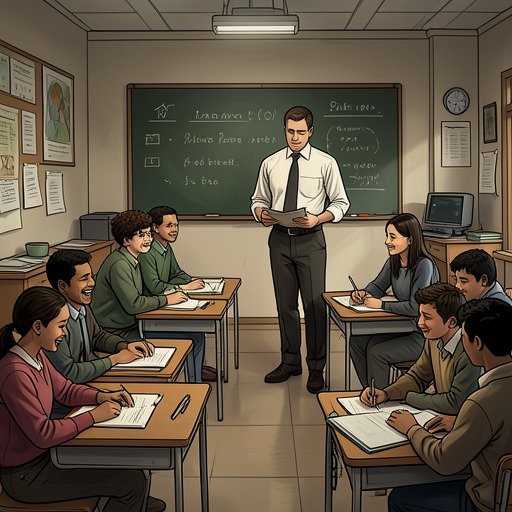
Danza’s immediate problem is familiar: when he announces a final review for the Of Mice and Men exam, the class answers with its customary “groans and moans.” His response is to announce that the review will be a scavenger hunt. The shift is pedagogical as well as theatrical. He has been trying to engage students, and he treats creativity as part of the teacher’s work rather than as decoration added after the real lesson.
The preparation is extensive. Danza divides the class into six teams and tells them to meet the next morning at the baseball bleachers behind the school. For each team he assembles a paper bag containing a map of Northeast High School marked with test-station locations, a passport bearing photographs of the team members, a page for each challenge, Post-it notes, and two Sharpies. He fills burlap bags with sand and persuades Dr. G., the science teacher, to lend live hamsters as stand-ins for the dead mice associated with the novel. Teachers, guards, and other available adults are recruited as station monitors, extending the lesson beyond the English classroom and into the larger school community.
The activity also exposes the scale of Northeast itself. The school is the largest high school in Philadelphia, with three stories, trailers, multiple sports fields, its own football stadium, a large cafeteria, cavernous gyms, and even a Philadelphia police station. A review that moves through such a campus is not a small worksheet exercise: it uses the institution’s immense physical environment as an instructional map. Danza’s colleagues make that possible, especially the teachers connected through the Arts and Education Small Learning Community, led by veteran English teacher Lynn Dixon. Their participation turns the hunt into a collaborative production rather than a solitary performance by a celebrity newcomer.
Rules and Challenges
The next morning brings crisp October weather, and every student is present at the bleachers. Danza explains that teams must visit six locations, complete a challenge at each one, receive a passport stamp and the clue to the next station, remain together, keep every member present when a task is completed, avoid leaving campus, and refrain from running or making disruptive noise. The final rule is ethical rather than logistical: each team must show integrity, a word Danza identifies as the day’s vocabulary. Academic review is therefore joined to conduct, cooperation, and accountability.
The challenges translate different forms of literary knowledge into concrete tasks. One, titled “Pet Lenny’s Dead Mouse,” uses the hamsters as comic substitutes for the mouse in the novel. Another, “Name That Character,” asks students to identify characters from personality descriptions and quotations. Other stations require them to identify the mood and tone of passages, match passages to literary devices, and work through additional material from the book. The structure mirrors the exam Danza has written: factual knowledge, vocabulary, characterization, figurative language, tone, mood, and sensory response are all present, but they are encountered through action and discussion rather than a silent sequence of questions.
The rules do not survive contact with competition. Students taunt one another, declare that opponents are going down, boast about their skills, and urge weaker teams to quit. When Danza blows the whistle, the teams open their bags, read their first clues, and rush off with the energy of racehorses leaving the gate. The prohibition against running is immediately described as a lost cause. This breach is not presented simply as classroom failure. It reveals how quickly students who had responded to review with boredom become invested once the work offers rivalry, movement, and a public test of competence.
The Final Challenge and Student Response
While the students race through the school, Danza remains on the baseball field preparing the final challenge: a game of horseshoes modeled on the game played by characters in Of Mice and Men. The labor is physical and improvised. He uses a rolling desk chair as a dolly to move equipment around the building and works up one of his best teacher sweats before the first team comes out of the gym.
The first team arrives shouting that it has won, as though a million-dollar purse were attached to the victory. The moment becomes especially important because one of its members is Howard, a student associated with forgetting and disliking reading. Danza could embarrass him by recalling that reputation, but instead raises a high five, which Howard meets with a broad grin. Danza keeps the team focused by reminding them that the game is not over and that another challenge remains, preserving suspense while recognizing Howard’s unexpected achievement.
The horseshoe game continues until the bell rings. By then, everyone feels like a winner, including Danza himself, though exhaustion is part of the victory. The activity has not erased academic difficulty or transformed the school into a frictionless community. It has, however, created a temporary culture in which students compete over literary knowledge, depend on one another, and experience success in a subject that some had treated as tedious. Howard’s participation gives the event its clearest reversal: the student least associated with reading becomes part of the winning team.
Educational Significance
The scavenger hunt embodies Danza’s effort to make students active participants in their own education. Its design does not discard assessment; the formal exam still follows the next morning. Instead, the hunt gives assessment preparation a social and physical form. Students identify characters, interpret literary devices, distinguish mood from tone, and handle details from the novel while moving through familiar but newly repurposed spaces at Northeast High School.
The event also demonstrates the hidden labor of teaching. Danza must write the exam, construct materials, recruit adults, borrow live animals, coordinate stations, enforce safety rules, and create a final activity that connects directly to Steinbeck’s text. His colleagues contribute time and institutional knowledge, while the school’s architecture becomes part of the lesson. The apparent spontaneity of the competition is therefore produced by careful planning and by the often-unseen cooperation of teachers, guards, and staff.
Its deepest effect lies in the change from disengagement to participation. The students begin with groans, then become boastful competitors, and finally remain involved through the last horseshoe game. The lesson’s value is consequently both academic and motivational. It shows Danza that a class can approach demanding literary material through play without making the material trivial, and that a student’s established identity as someone who does not like to read need not determine what that student can accomplish. In the larger trajectory of his year at Northeast, the hunt stands as a compact example of his central teaching principle: engagement is not an ornamental reward after learning has occurred, but one of the conditions that makes learning possible.