The creation-myth rap lesson
I'd Like to Apologize to Every Teacher I Ever HadThe creation-myth rap lesson is a decisive example of Tony Danza’s effort to make learning participatory rather than merely instructional. When Monte appears almost ready to die at the announcement of a mythology unit, Danza discovers that the disengaged-looking student can define a myth precisely. He responds not by treating Monte’s reluctance as evidence of inability, but by building outward from the knowledge already present in the room. The lesson becomes a miniature account of teaching itself: attention is not assumed, participation is invited, and the teacher risks embarrassment so that students can risk invention.
The Unit and Its Starting Point
Danza begins by asking the class to define “myth,” and Monte is the only student who answers. Monte describes it as a story involving supernatural gods or goddesses that explains why things happen, including an origin myth. Danza affirms the answer and narrows the unit toward creation myths. The class then considers how myths helped ancient civilizations understand natural phenomena such as the planets and the rising and falling of tides, while also addressing the larger riddle of human existence.
The topic immediately becomes personal for Danza. As he prepares the unit, he finds himself thinking about where he originally came from, where he has been living, and where he is in his life. That movement from ancient cosmology to autobiography gives the lesson a double scale: students are asked to imagine how worlds begin, while Danza is quietly confronting his own beginning, displacement, and return. The classroom exercise therefore links a general academic question about origins to the teacher’s changed professional identity.
Danza’s Performance as Teaching Method
Instead of presenting creation myths only as material to be read and discussed, Danza announces that he has written his own creation-myth rap. He taps his foot and begins with the exact opening, “In the beginning before there even was time, / the world was so quiet without even a rhyme.” The performance continues through the figure of Thor, the God of Thunder, and eventually ends with the declaration “Peace out.” The form is deliberately contemporary and comic, placing the language of rap beside the traditional authority of mythology.
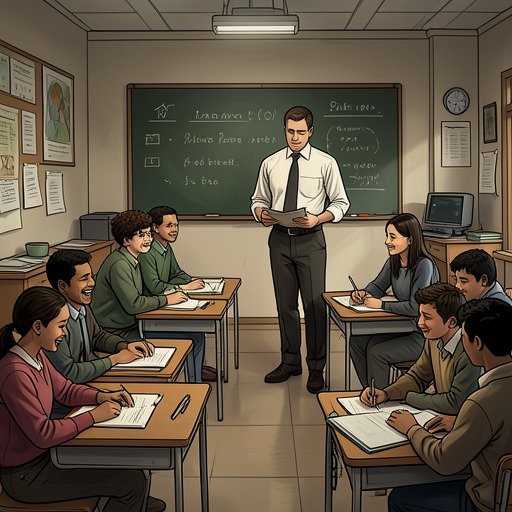
The rap’s most important function is not literary polish but demonstration. Danza makes himself the first performer and, in doing so, shows the students that the assignment does not require solemn expertise or adult dignity. The class claps along, laughs, and nods as he makes a fool of himself. Their amusement is not a distraction from the lesson; it is the mechanism by which the lesson opens. Danza’s willingness to appear foolish lowers the social risk of creative work for everyone else. His performance tells the students that invention can begin before confidence does.
The rap also produces a moment of recognition for Danza himself. He explains that a line he had written as “a him he never knew” should actually have been “a him he used to know.” Teaching in Philadelphia has brought him back to his former self, a child from Brooklyn like the students he is now supposed to teach. The correction transforms a small verbal mistake into the emotional center of the lesson: the creation myth becomes an account of return, and the teacher’s attempt to recover an earlier vocation becomes inseparable from the students’ own acts of creation. Chloe and Katerina answer together, “You’re welcome, Mr. Danza!”, turning his confession into shared classroom humor.
From Lecture to Student Creation
After the rap, Danza assigns the students to write their own creation myths. Each myth must explain creation and natural phenomena, include gods, goddesses, or spirit forces, and contain at least three required elements. The students initially moan and groan, so Danza supplements the assignment with discussion of Anansi, the trickster spider credited in Ashanti legend with creating the sun, stars, and moon. He then follows David’s advice and pairs the students so they can write and perform together.
The paired format changes the assignment from solitary compliance into collective production. Danza urges the students to get creative and tells Eric that he might use his paper skills. The next day, Eric Choi and Ben-Kyle present “The Magic Button Myth.” Eric has made a large round paper button attached to a paper spring and fixed it to the blackboard; the button says “DO NOT PUSH.” In their performance, one god warns another not to push the button, thereby guaranteeing that the second god pushes it and blows the world into existence. The physical prop, the built-in joke, and the students’ acting turn an abstract requirement into something visible and theatrical. The class cheers, while shy, gawky Eric does not know what to do with the praise.
Other students make the myths increasingly outrageous. In Matt’s version, a god suffering from indigestion farts the world into being. Another student invents a god named Danzeus. These details matter because they show the students taking ownership of the form rather than reproducing a teacher’s model. The classroom accepts comic irreverence as evidence of engagement, and Danza recognizes that he has won their enthusiastic participation. The victory is not that the students have become quiet or conventionally obedient; it is that they have begun producing, performing, and responding to one another’s ideas.
Classroom Culture and Institutional Pressure
The lesson unfolds within the unusually large and bureaucratic environment of Northeast High School. The school occupies a sprawling campus with three stories, trailers, sports fields, a football stadium, a huge cafeteria, cavernous gyms, and even its own Philadelphia police station. Its Arts and Education Small Learning Community contains teachers of English, music, drama, art, math, and social studies, and veteran English teacher Lynn Dixon guides the group after more than thirty years in some of Philadelphia’s toughest schools.
That setting clarifies what Danza is trying to overcome. Teachers at Northeast manage demands beyond ordinary classroom instruction: grades, district mandates, seminars, planning schedules, technology training, student advocacy, discipline, and the practical maintenance of the school itself. Dixon distributes administrative notices, mediates with problem students, repairs the copy machine, and maintains an office stocked with Tootsie Pops, colored pencils, Viking helmets, movies, books, costumes, certificates, magazines, newspapers, and a life-size cutout of President Obama. Her Shakespeare materials, including a shirt portraying Shakespeare as “ripped,” embody the same principle as Danza’s rap: academic content can be carried through objects, humor, and performance.
The teachers’ lounge also contains signs of fatigue and resistance. During Dixon’s announcements, one teacher reads a diet book while eating health food, another unwraps a large cinnamon bun and nudges his neighbors, and a man sits alone because the room’s decibel level overwhelms him. The creation-myth lesson’s energy is therefore not produced by an idealized institution. It is a local, improvised intervention in a place where teachers are besieged by work and students bring their own skepticism, humor, and social rules.
Significance in Danza’s Teaching Arc
The lesson’s immediate consequence is a movement from reluctance to active participation. Monte, who initially looks as though the mythology unit might kill him, supplies the opening definition. Danza’s rap then creates a public model of vulnerability, and the students respond with paired myths, props, jokes, performances, and applause. The sequence demonstrates Danza’s emerging method: begin with what students know, connect the material to lived experience, take a personal risk, and give students a form in which their own intelligence can become visible.
The scene also foreshadows the larger pressures surrounding Danza’s teaching year. He entered the classroom after a canceled talk show, a separation from his wife of twenty years, an awareness of approaching sixty, and the realization that his father had lived only to sixty-two. Teaching was his return to a road not taken, but the work continually demands emotional investment. Later, he worries that he cannot read his own daughter while trying to teach his students to read; after learning that Brittiny’s circumstances require another foster-home placement, he admits to Lynn Dixon that he is unsure whether he wants to care so much about anything at his age. Dixon’s answer, “That’s what it takes, baby. That’s what it takes,” gives the creation-myth lesson its retrospectively serious meaning. The rap is funny, but it is also an early demonstration of the cost and necessity of caring.
Finally, the lesson stands against the television production pressures that surround Danza’s classroom. He had insisted that the program be made as a documentary, with no scripting, forced drama, or fake conflict, because the students had to come first. When Leslie Grief later complains that a day in Washington produced a boring show because nothing dramatic happened, Danza defends the students’ learning and engagement as the day’s value. The creation-myth rap lesson embodies that defense. Its drama is not manufactured through crisis; it emerges from a teacher’s risk, a student’s unexpected knowledge, a paper prop, an absurd myth, and the collective discovery that a class can become creative when someone gives it permission to begin.