The school-uniform debate
I'd Like to Apologize to Every Teacher I Ever HadThe school-uniform debate is both a schoolwide conflict and a deliberately redirected English lesson at Northeast High School. The policy, introduced after two years of planning, provokes students and parents who see it as an infringement of personal rights and an unfair financial burden. It also carries the suspicion that the rule exists because Tony Danza and the television production have arrived at the school. By transforming the dispute into writing and debate, Danza makes the controversy a practical exercise in participation: the students do not merely receive a rule, but argue over what it means, whom it serves, and how it should be lived.
Background and Institutional Conflict
The uniform policy is scheduled to replace free dress in November after a prolonged struggle between school administration, students, and some parents. Students object to the loss of choice and self-expression, while parents worry about the expense of buying the required clothes. The policy is also entangled with the presence of the show. Students complain that the only reason they must wear uniforms is that Tony Danza is there, a belief Danza knows is untrue but recognizes will persist throughout the year.
The controversy develops within a school whose formal rules are more consistently announced than enforced. Northeast High School is a vast Philadelphia institution with its own stadium, multiple gyms, trailers, sports fields, and even a Philadelphia police station, yet Danza observes that discipline is often concentrated on physical fights while rules concerning uniforms, hoodies, earbuds, iPods, running, and shouting are applied inconsistently. Students understand the gap between written policy and everyday practice, and that gap makes the uniform rule especially visible: clothing becomes a concrete sign of authority in an environment where many other regulations remain negotiable.
The dispute also reflects the pressure placed on teachers by the institution around them. Lynn Dixon, the veteran English teacher who leads the Arts and Education Small Learning Community, distributes district notices, deadlines, seminar requirements, technology instructions, and academic mandates in addition to supporting classroom teaching. Danza’s growing awareness of this administrative burden helps frame the uniform debate as more than a quarrel over clothing. It is one instance of the larger struggle between policy, implementation, teacher discretion, and the lived culture of the school.
Danza’s Uniform and the Schoolwide Protest
Danza responds to the students’ resentment by promising to wear the same outfit every day in solidarity with them. He says he likes the idea because uniforms remove the worry of deciding what to wear, but his own clothing becomes a separate contest between the teacher and the production team. The approved outfit consists of black shoes, gray pants and a belt, a blue dress shirt, and a Northeast High School tie. He buys five pairs of identical slacks and six shirts for the year.
The tie becomes the symbolic center of his disagreement with the producers. They consider it stodgy and old-fashioned; Danza refuses to give it up because he associates it with respect for teaching and for the students. His insistence acquires an additional practical force when the boys’ uniform includes the same school tie. He presents the clothing as a shared identity, pointing to it in the hallway and invoking Viking pride, although the students’ complaints do not disappear. His gesture creates solidarity without pretending that solidarity has resolved the political disagreement.
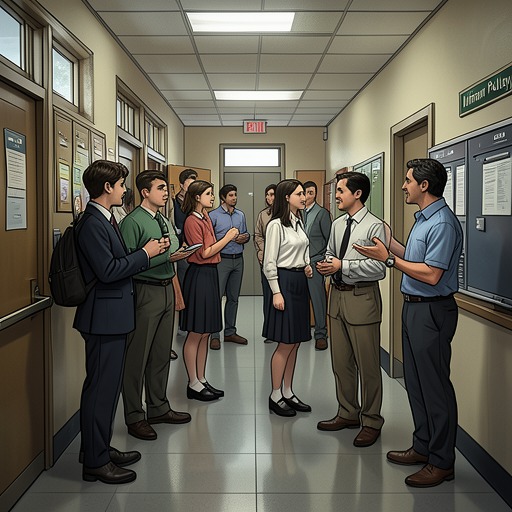
When the policy takes effect, students who are out of uniform are sent to the auditorium, where Danza has been assigned monitor duty. His attempted identification with the policy produces the opposite of the welcome he expects: more than a thousand students boo him so loudly that he has to leave the doorway. The scale of the reaction shows that the uniform has become a schoolwide symbol of imposed authority, and that Danza’s public association with the rule makes him a convenient target even though he is not its author.
The Classroom Debate
Danza’s response is to use the conflict rather than suppress it. The class has already begun celebrating Pepper’s clever uniform violation, so Danza asks Pepper to see him after class rather than turning the incident into a group exercise. On the day of the policy’s implementation, however, the planned opening task about physical fitness and nutrition no longer fits the mood. Eric Lopez and Matt begin criticizing the uniforms; Monte says he likes the policy because it makes everyone look as serious about school as he does; Eric Choi appreciates not having to wear the shirts his mother chooses; Chloe and Katerina mourn the loss of shopping choices; and Ileana and Ben-Kyle object that the rule limits free expression.
Danza erases the original task and replaces it with a prompt asking students how they feel about the uniform policy and why. The change converts an immediate institutional grievance into academic work without draining it of its urgency. The students write with unusual energy and conviction, then eagerly read their opinions aloud. Danza divides them into teams and turns the writing into a formal debate, drawing on the principle that discussion helps students retain ideas. The disagreement becomes not a distraction from English but the material through which the class practices writing, speaking, listening, and reasoning.
The arguments expose several competing ideas of freedom and responsibility. Charmaine argues that being a minor should not prevent her from choosing how to dress in America. White Nick asks what happens when clothing becomes distracting. Al G agrees that some girls wear extreme outfits, even while admitting that he likes them. Paige responds with a judgment about girls who dress provocatively, prompting Charmaine to joke that Paige must be referring to her two different socks. The laughter does not end the argument; it reveals how quickly a debate about policy becomes a debate about gender, respectability, peer judgment, and who is blamed for distraction.
Cost adds another layer. Danza asks how much students now spend on school clothes, and Monte argues that uniforms may save money over time while also saving the energy otherwise spent choosing outfits. The discussion continues for the entire period. The class does not settle the policy, but when students take a final vote, the arguments in favor narrowly defeat the arguments against. Even Pepper appears more thoughtful by the bell. The result is important not because it validates the administration’s decision, but because the students have moved from spontaneous resentment to sustained consideration without being required to surrender their objections.
Pepper, Discipline, and Unequal Consequences
Pepper’s role gives the debate a disciplinary counterpart. He arrives in the required khaki pants, white shirt, striped school tie, and dark sweater, but his shoes are the wrong color. Because Ms. DeNaples is monitoring the entrance, he is sent toward the auditorium despite claiming that the correct shoes are in his backpack. His prank has already made him popular with the class, and Danza recognizes that punishment alone would leave the public performance intact while missing the opportunity to teach responsibility.
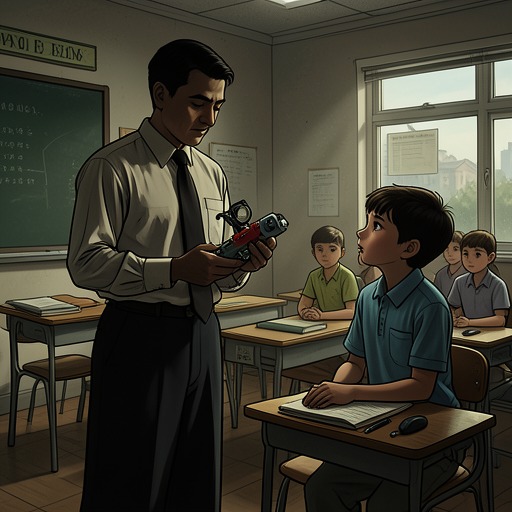
Danza therefore summons Pepper for fifth period and requires him to write an apology note to Ms. DeNaples. He supplies stationery and an envelope, tells Pepper to use his best handwriting, and dictates the opening so that the apology will be completed properly. The intervention is small but revealing. The school’s rule is enforced through a public removal to the auditorium, while the teacher adds a private, educational consequence designed to connect misbehavior with repair. The uniform debate thus operates on two levels: as a policy argument among the whole class and as a test of whether discipline can produce reflection rather than merely compliance.
The harshness of school discipline is also visible in the separate crisis surrounding Matt. By the end of October, Matt is tied for the school record for the most fights after being attacked by four African-American students connected to an earlier altercation. His father describes him as energetic and troubled by problems at school, while a girl in Danza’s class identifies a racial element. Later, after Matt’s parents encounter a group of Black girls using racial epithets and crude language in the corridor, the confrontation escalates into a screaming match. Matt’s father concludes that his son’s complaints about Northeast are justified, but Danza warns him not to tell Matt that he is right, arguing that the girls’ speech must be understood as part of a cultural environment rather than treated as proof of the school’s entire character. The episode complicates the uniform debate by showing how rules, language, race, and violence are interpreted unevenly by families and school personnel.
Broader Significance
The debate belongs to the larger curriculum Danza builds around participation and social justice. He has decorated his classroom with commands such as “TAKE PART IN YOUR OWN EDUCATION,” and the uniform lesson enacts that principle by allowing students to generate the content of the period. The issue also connects with the class’s repeated examination of unequal opportunity. In discussions ranging from Of Mice and Men to poetry and “Gangsta’s Paradise,” Danza returns to the question of how people respond when they are denied a fair chance to succeed. Clothing cannot be separated entirely from that question: it touches money, dignity, visibility, group identity, and the power to define oneself.
The debate also exposes the difference between formal equality and lived consequences. A single dress code appears neutral on paper, but its cost falls differently on families, its enforcement depends on the discretion of staff, and its cultural meaning changes across racial and social groups. Students challenge the policy from different positions rather than forming a single opposition, while Danza’s own participation shows how institutional rules can absorb even a gesture intended as solidarity. The policy promises order and seriousness, yet its first public effect is mass booing; the teacher’s lesson begins with anger but ends in sustained engagement. That contrast captures the event’s decisive significance: a contested rule becomes valuable educational material precisely because it cannot be made politically innocent.
The controversy continues beyond the classroom. After a later reversal from uniforms back to free dress, Danza’s prediction that the change would make Northeast chaotic comes true, and not beneficially. The reversal does not prove that uniforms solved the school’s problems, just as the classroom vote does not erase the students’ objections. Instead, the recurring conflict shows that clothing policies function as visible containers for deeper struggles over authority, belonging, enforcement, and the meaning of school itself. Through the debate, Danza does not present consensus as the measure of success. He presents the students’ willingness to argue, listen, reconsider, and participate as the more durable educational achievement.