Three-Fifths Solution
I'd Like to Apologize to Every Teacher I Ever HadThe Three-Fifths Solution is Tony Danza’s response to the hidden workload of teaching: instead of assigning each teacher five classes, schools would assign three. The proposal emerges when the demands of instruction, discipline, paperwork, student counseling, and emotional care reveal that teacher commitment cannot be sustained by goodwill alone. Its decisive claim is that educational quality depends not merely on asking teachers to care more, but on giving them enough time and institutional capacity to act on that care.
Origins in the Classroom
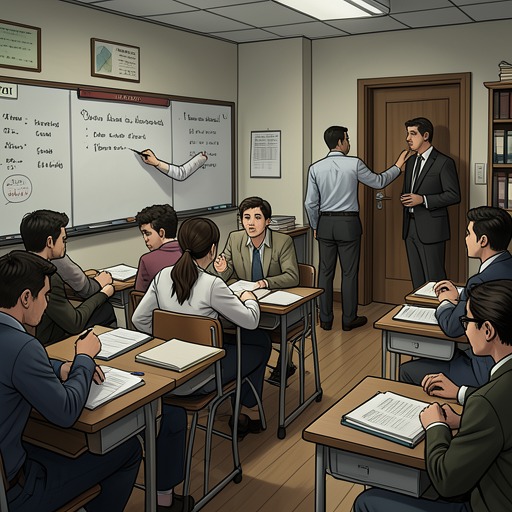
The idea begins with a conversation between Tony Danza and an experienced teacher who describes having 150 students across five classes a day. Her students include young people trying to escape gangs, children with relatives who have been shot or imprisoned, students with no dependable support, and some who are homeless. She wants to be present for them, but says that the hours are insufficient. Even routine assessment consumes time: grading one weekly quiz for 150 students at one minute per paper would already require 150 minutes, and schoolwork rarely takes only a minute. When students do not receive extra attention, they may interpret the omission as indifference, making care itself another source of pressure.
The teacher identifies the hardest part of the profession not as paperwork but as the emotional grind. Tony Danza recognizes the same conflict in his dealings with Alex, Phil, Gwen, Paige, and Brittiny. Being there for students requires attention, persistence, and sometimes intervention, but it also means setting aside parts of one’s personal life to make room for their crises. The discussion reframes teaching as an expansive form of labor whose most consequential tasks are often invisible in a timetable.
From Burnout to a Structural Proposal
Veteran teachers advise Tony Danza to establish clearer boundaries. Without limits, students can consume more energy than a teacher possesses, while first-year teachers often have little control over that boundary. The scale of the problem becomes stark when more than 100 new teachers who attended his August orientation leave before Christmas. Their departures suggest that attrition is not simply a matter of individual weakness or insufficient dedication; the organization may be demanding an unsustainable combination of teaching, management, paperwork, and personal availability.
In that context, Tony Danza formulates the Three-Fifths Solution: three classes per teacher instead of five. The numerical reduction is the proposal’s forceful simplicity. Fewer classes would provide more preparation time, less chaotic schedules, and greater opportunity to follow through with individual students. It would also make room for the work that conventional staffing models tend to hide, including conferences, grading, parent and counselor communication, emotional support, and the sustained attention required when a student’s academic difficulty is entangled with housing insecurity, violence, family separation, or disengagement.
What the Proposal Assumes About Learning
The Three-Fifths Solution belongs to the same educational philosophy that Tony Danza develops throughout the school year. David Cohn tells him that a teacher cannot learn for a student and that teaching is not a popularity contest; the goal is to involve students in their own education. Tony Danza repeatedly tests that principle through active classroom methods. He turns a creation-myth assignment into paired performances, uses debate over the school uniform policy to generate unusually energetic writing and discussion, and transforms review for the Of Mice and Men examination into a six-team scavenger hunt involving maps, passports, challenge stations, Post-its, Sharpies, sand-filled burlap bags, and live hamsters standing in for the book’s dead mice.
These activities require more than enthusiasm at the front of a classroom. They demand planning, materials, coordination with teachers and guards, rule-setting, monitoring, and follow-up. A lesson built around student participation transfers some intellectual authority to the students, but it does not reduce the teacher’s work; it often increases the preparation needed to make participation meaningful. The proposal therefore treats active learning as a staffing issue. If students are to become producers of knowledge rather than passive recipients, teachers need time to design, observe, respond, and revise.
Tony Danza also uses popular culture to connect classroom discussion with social experience. A debate over uniforms gives students an avenue for arguments about expression, distraction, seriousness, and freedom. A rap video addressing Harriet Tubman, Rosa Parks, Harriet Beecher Stowe, and Uncle Tom’s Cabin leads to a vigorous discussion of social justice. Even a boxing lesson with a cobra punching bag draws roughly a dozen students, including boys and girls, self-described nerds, and football players, into a shared activity centered on coordination and discipline. The Three-Fifths Solution provides the practical condition for this kind of teaching: time to build lessons around student voices and interests instead of merely moving through assigned material.
Individual Attention and Classroom Authority
The proposal also responds to the tension between students who need intensive support and students whose academic ambitions can be compromised by disorder. When Monte criticizes the pace and discipline of the class, Tony Danza creates a Student Teacher program and gives him an entire period to design and lead his own lesson on the trial in To Kill a Mockingbird. Monte prepares demanding work on legal terminology and character interactions, but the class interrupts him, mocks his authority, and continues its ordinary distractions. The experiment shows that high standards alone cannot produce a functioning classroom; teaching requires time to establish relationships, routines, and authority.
The same problem appears in Tony Danza’s struggle to read the needs of individual students while remaining responsible for the whole class. He worries that focusing on students who refuse to work may deprive stronger students of the education they deserve, yet fears that harsh treatment will cause struggling students to stop participating altogether. The Three-Fifths Solution does not promise to eliminate that conflict. Its narrower and more credible purpose is to give teachers a better chance to manage it through preparation and sustained attention rather than constant improvisation.
Personal Stakes and Significance
The proposal is inseparable from Tony Danza’s own transition into teaching. After his television talk show is canceled, his marriage ends after 20 years, his youngest child is the only one still living at home in Los Angeles, and the approach of his sixtieth birthday makes him feel that time is running short. Teaching appears as a return to an earlier vocational dream: he has a history degree, originally intended to teach, and recognizes that even his television role as a teacher had preserved that unrealized ambition. His new work consequently becomes both a public commitment and a test of whether he can make a meaningful contribution before time closes around him.
That commitment strains his family life. When he tells his elder daughter that he has not bought a ticket home because he is unsure whether he can return, her brief reassurance leaves him unable to tell whether she is accustomed to his absence or proud that he is serving students without her advantages. Later, after reporting information from Brittiny that results in her being moved to another foster home, Tony Danza admits to Ms. Dixon that he is unsure he wants to care so much about anything at his age. Her answer—that such caring is precisely what the work requires—captures both the moral appeal and the danger of the profession.
The Three-Fifths Solution turns that danger into an institutional question. It would be expensive and may sound like a pipe dream, but Tony Danza argues that money and public awareness could make it possible if education were treated as a national priority. The proposal stands against a system increasingly preoccupied with test scores and the Pennsylvania System of School Assessment, whose results are used to judge a school’s Adequate Yearly Progress. By contrast, the Three-Fifths Solution measures educational seriousness in the time available for preparation, relationships, and response. Its significance lies in insisting that teachers cannot be held responsible for deep, durable learning while being denied the conditions that make such learning possible.