Times Square
I'd Like to Apologize to Every Teacher I Ever HadTimes Square functions in the book as more than a destination on a New York field trip: it is a crowded, theatrical, and potentially dangerous public space where Tony Danza’s responsibilities as a teacher collide with memories of his own childhood. The square’s spectacle briefly promises shared excitement, but its disorder forces him to confront how quickly pleasure can become fear and how strongly the present can reopen the past.
Setting and Public Spectacle
After visiting Central Park, Tony Danza and his students travel by bus to Times Square. The students climb the TKTS bleachers and inspect the enormous digital billboards, absorbing the visual scale of Manhattan. The square is presented as an intensified urban environment, full of movement and display, but the group cannot experience it as ordinary tourists. When Al G begins to drift away, Tony calls after him, yet the student ignores him, converting a sightseeing stop into a supervision problem.
A Place of Separation and Memory
Al G’s repeated attempt to leave the group makes Tony unexpectedly remember being lost in the city at about seven years old. During a Christmas visit to Radio City Music Hall, Tony had slipped away with his brother and cousins to look at the Automat across the street. When they turned back, their grandmother was gone from sight; the children stood frightened in the holiday crowd until a New York City police officer returned them to the theater, where their grandmother first reacted with fury and then burst into tears while embracing Tony. The memory gives the present scene a double perspective: Tony is simultaneously the adult trying to keep a child safe and the child who once needed to be found.
The Teacher’s Intervention
Tony’s recollection does not immediately make him gentle. As Al G forces him to chase him through Times Square, Tony feels fury as well as anxiety and tells the student that he must stay with the group because the crowds could make him impossible to find. When Tony reaches for Al G’s arm, Al turns sharply away and says, “Don’t put your hands on me!” The moment exposes the difficulty of translating concern into authority: Tony must control the student without allowing irritation, public danger, or the student’s defiance to dictate his response.
Commercial Danger and Group Responsibility
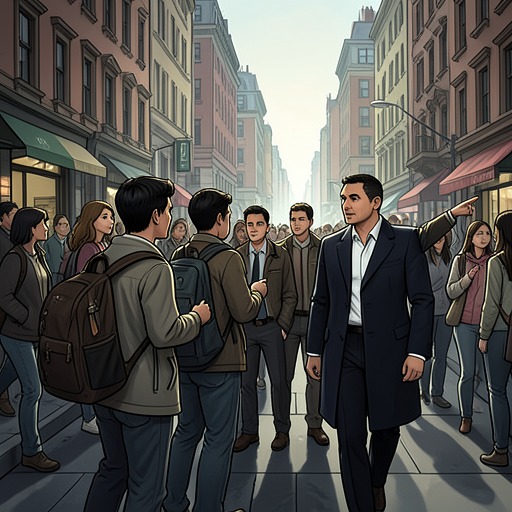
The square’s attractions quickly become threats to an inexperienced school group. After the theater, Tony leads the students through crowded streets toward Patsy’s Italian Restaurant, only nine blocks away but difficult to reach safely. Sidewalk salesmen press flyers for girlie shows into the boys’ hands, merchants try to draw the girls into souvenir shops, and a homeless person asks the students for money while claiming it is for “college tuition.” Several children give him change before Tony can pull them away. The scene makes supervision a continuous physical task: extra chaperones help, but keeping every student together remains nerve-racking.
Narrative Significance
Times Square gathers the book’s concerns with performance, exposure, and responsibility into one location. The students are surrounded by billboards, theater culture, sales pitches, and street improvisation, while Tony is forced to perform the less glamorous role of guardian. The place also links his adult teaching identity to his childhood vulnerability. Al G’s wandering is not merely misbehavior in the narrative; it activates Tony’s recognition that the child he is chasing resembles, in a crucial way, the child he once was. Times Square therefore becomes a testing ground where spectacle gives way to care, and where a teacher’s anger is redirected by the memory of what it means to be lost.