Tony Danza–Gwen relationship
I'd Like to Apologize to Every Teacher I Ever HadTony Danza’s relationship with Gwen turns a conference about slipping schoolwork into an unusually candid exchange about unemployment, family strain, and empathy. He does not solve her problems at home or excuse her father’s behavior; instead, he uses his own experience of losing a job to help Gwen consider what her father may be going through, while insisting that she remain responsible for her studies. Her work improves, and she later tells him that things at home are getting better, though the hard looks that first marked their classroom relationship do not disappear.
The Conference and Gwen’s Withdrawal
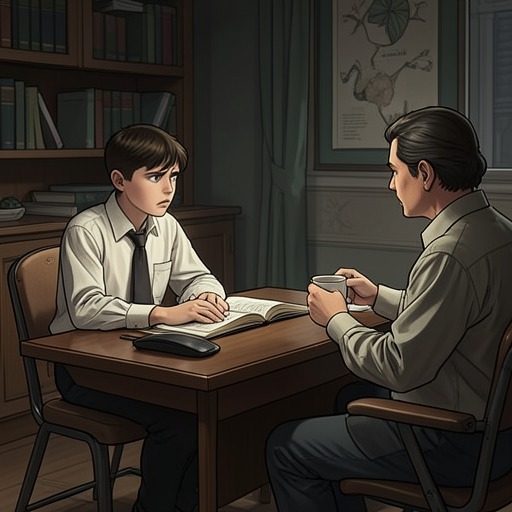
The conversation begins while Danza is standing alone at a classroom window during fifth period, thinking about his own family. Gwen arrives for a conference he has nearly forgotten to arrange. He knows her as a capable student whose work had been solid, but whose recent tendency to slack off has prompted concern. In class she gives him dirty looks, which the television cameras capture and the show later uses in a comic montage. Her hostility is conspicuous; so is the gap between that public impression and her record as a student.
Gwen slouches behind her desk and rubs her chronically sweaty palms against her jeans. She is fifteen, embarrassed by her hands, and dealing with more than a schoolwork problem: she is one of the few openly lesbian students at Northeast High School and belongs to its Gay-Straight Alliance, ALLY. Her senior girlfriend has recently ended their relationship, leaving Gwen angry. Danza wonders how to talk to her about relationship troubles, but when he raises her declining work, she initially says nothing. Asked whether something is bothering her, she eventually mentions that there is trouble at home.
The immediate source of that trouble is her father’s job loss. He has been unable to find work and has largely stopped looking; Gwen’s mother, a nurse, responds by taking double shifts, and the parents fight. Gwen says she and her father used to be close, but that he has become different and their relationship is no longer what it was. The family’s financial and emotional strain has reached her school life: Danza is trying to understand why a previously solid student has begun to disengage, while Gwen is carrying anger about her girlfriend and anxiety about changes at home.
Recognition Through Job Loss
Danza’s first attempt to connect comes from his own recent experience. He tells Gwen that he was fired the previous year and recalls feeling finished, too old to be wanted on television. Gwen responds skeptically, wondering whether he came to teach because he had lost his television job. Her reaction prevents the disclosure from becoming an easy appeal to celebrity or authority. Danza has to explain what he means rather than assume that their circumstances are alike.
He describes how the firing affected his family life as well as his sense of himself. He felt sorry for himself and lost his temper; he suspects that his wife and daughters might also have described his behavior as creepy. His account is not presented as proof that he knows precisely what Gwen’s father feels. Rather, it gives him a personal point of comparison for the combination of unemployment, wounded identity, and family conflict Gwen has described. The word canceled, familiar from television, becomes his way of explaining the feeling of being erased after losing work.
Gwen initially remains unconvinced, watching him with a cold stare. As Danza continues, however, her attention shifts. He acknowledges that losing a job can be especially difficult for men whose sense of worth is bound up with work, and relates that observation to the change in Gwen’s father. The exchange moves from a teacher questioning a student’s reading to two people comparing how job loss can alter a family’s relationships. Danza’s disclosure makes his advice more personal, but it also exposes how fragile his own family life feels at this point.
Empathy Without Excusing Behavior
Danza’s counsel has two distinct parts. First, he tells Gwen that the stress at home cannot be allowed to derail her studies, even when the reasons for struggling are serious. He then asks her to apply the classroom idea of walking in another person’s shoes: she should try to understand her father’s distress without treating that understanding as approval of his conduct. Danza explicitly distinguishes empathy from excuse-making, drawing on his own experience of bringing hurt and anger home after losing his job.
He also reflects on his temper and on the different ways his and his wife’s families expressed emotion. In his family, raised voices signaled that people cared; his youngest daughter, Emily, called his loudness temper rather than passion. This self-criticism matters to the advice he gives Gwen. He is not offering a tidy account of a parent’s behavior from the outside: he admits that his own anger has affected his family, while maintaining that Gwen’s father remains responsible for how he acts.
The conference does not end with a dramatic declaration that the problem is settled. Danza says he does not know her father and cannot speak for him. Gwen listens with a new attentiveness, and he senses that her black mood has lifted, although she does not tell him directly what she thinks of his argument. When Joe Connelly appears at the door to ask Danza to lunch, Gwen herself indicates that they are good. She leaves hugging her backpack to her chest and thanks him. Danza asks her to keep him informed and do her reading; she answers with a small thumbs-up.
A Qualified Change
The effect becomes clearer over the following week. Gwen’s work improves, while the hard looks continue. She also tells Danza that things at home are getting better, and he tells her he is proud of her. These changes are limited but concrete: her schoolwork responds, and she shares an update about home. The relationship has not turned her into an openly affectionate student, nor does the narrative claim that one conversation resolves the family’s problems. The persistence of her looks preserves the difference between a useful moment of trust and a complete transformation.
The conversation also runs alongside Danza’s own uncertainty about family and work. Earlier that November, his elder daughter’s easy response to his uncertainty about when he could come home for Thanksgiving leaves him wondering whether he can still read her. During the conference, his account of unemployment includes his fear that his wife may not want to remain married to him and that things with his daughters are poor. Gwen’s situation prompts him to draw on those experiences, and her response becomes part of a wider reckoning with the consequences of job loss inside a family.
Danza later admits that caring this much about anything has become difficult, a feeling sharpened by the emotional demands of teaching and by Brittiny’s disclosure and subsequent move to another foster home. Gwen’s encounter is not the source of that later uncertainty, but it shows one form the work takes: noticing a student’s change, listening to what lies behind it, and making a personal connection without abandoning academic expectations. In this relationship, empathy is neither a substitute for responsibility nor a promise of rescue. It is the means by which Gwen can be asked to understand her father while still being expected to do her reading—and by which Danza’s own experience becomes useful to someone else.