Tony Danza’s first class
I'd Like to Apologize to Every Teacher I Ever HadTony Danza’s first class at Northeast High School is the decisive early failure in his transition from television celebrity to working English teacher. The lesson begins with a simple act of welcome and ends with students disappearing before he can recover, leaving him feeling as though he has lost a ten-round fight. Its importance lies not merely in the comedy of a soaked shirt or an awkward introduction, but in the collapse of his prepared persona: the students immediately test whether the famous newcomer can actually teach, and Tony Danza discovers that care, authority, and credibility cannot be borrowed from television.
Setting and Immediate Stakes
The class takes place at Northeast High School, Philadelphia’s largest high school, a sprawling campus with three stories, trailers, sports fields, a football stadium, a huge cafeteria, cavernous gyms, and even its own Philadelphia police station. The school’s campus dates back to the 1840s, while its current brick building was erected in 1953 and resembles a postwar factory. This immense institutional setting makes Tony Danza’s first classroom encounter more than a private embarrassment: he is entering an established school culture whose scale and routines dwarf his previous experience.
The class contains twenty-six tenth graders, evenly divided by gender and varied in appearance, ethnicity, skin tone, hairstyle, attitude, and level of interest. Some appear bored, some amused, some disdainful, and others merely curious. Tony Danza tries to register each student as an individual while also confronting the practical problem of remembering their names. The presence of a television crew filming a reality show intensifies the stakes. The students are not meeting an anonymous novice; they are meeting a recognizable performer whose authority may look like a publicity stunt.
The First Encounter
Tony Danza begins by standing at the doorway and asking each arriving student to state a name, sanitize his or her hands, and take a seat. Nakiya is the first student introduced, and Tony Danza initially decides to call her Nicky after repeating her pronunciation to himself. Daniel enters next, visibly unimpressed by the hand-sanitizer instruction, but complies reluctantly. The students’ shared reaction suggests that the new teacher appears eccentric before he has even introduced the subject.
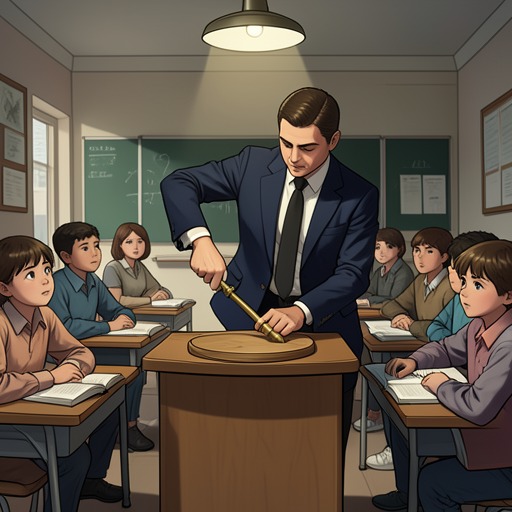
Once the class is seated, Tony Danza writes his name on the board and tries to establish himself as Mr. Danza. His opening announcement is halting: he struggles to explain that he is there to teach English. Matt, a large student with the look and build of a linebacker, interrupts to ask whether anyone else finds it strange that Tony Danza is teaching English. The question exposes the central contradiction of the scene. Tony Danza has trained and intends to teach, but his public identity as an actor makes his appointment seem inherently improbable to the students.
Tony Danza attempts to answer the challenge with humor, acknowledging the irony rather than denying it. The response opens the floodgates. Students ask who he is, whether the class is a stunt, and why he chose Northeast. When Howard asks whether he is a millionaire, Tony Danza abandons his usual privacy about money and admits that he is. His qualification that a million is not what it used to be fails to make the disclosure more meaningful to students whose circumstances make wealth a sharp rather than abstract subject. The exchange shows him trying to be honest while still speaking from a world the students do not necessarily share.
Physical Exposure and Loss of Control
A girl then asks whether Tony Danza is nervous. Relieved to have an opportunity to answer plainly, he admits that he is terrified. Charmaine immediately turns the admission into a joke by pointing out that his shirt is completely soaked. Tony Danza looks down and realizes that sweat has penetrated the front, back, and both sides of his pressed light blue dress shirt, even though fewer than fifteen minutes have passed.
Charmaine compounds the embarrassment by suggesting that he wear another undershirt. The class erupts in laughter. Tony Danza responds by lifting his arms, looking at his stained armpits, and shrugging in surrender. The gesture is important because it replaces controlled performance with visible vulnerability. He cannot conceal his fear from the students or the cameras, and the body itself announces his lack of classroom experience more forcefully than any explanation could.
The humiliation also destroys the lesson plan. Tony Danza has forgotten everything he intended to do, and in his nervousness he falls back on monologue. He tells the students about growing up in Brooklyn and beginning school at Blessed Sacrament School, where nuns and priests physically disciplined children. He recalls being taken into a walk-in closet by a notorious nun and receiving a “double ear cuff.” He also explains that his parents did not attend college, that his father worked as a city sanitation man, and that his mother was a bookkeeper. These autobiographical details are an attempt to establish common ground, but the scene makes clear that personal testimony cannot substitute for a lesson when the speaker has lost control of the room.
Tony Danza then speaks about doubt, purpose, and the idea that people are defined by what they do. The students give him enough laughter to continue, but he senses that he is losing them. Rather than prolong the performance, he asks the students to introduce themselves. Nakiya becomes the first volunteer. She describes playing basketball, lacrosse, and drums in the school band and at church, and says that she likes to smile. Her openness changes Tony Danza’s mood, and his effort to get her name right marks the first small movement from celebrity-centered narration toward attention to an actual student.
Authority, Assignment, and Defeat
The introductions reveal the class’s internal range. Al G presents himself as someone who jokes around, gets on people’s nerves, and can become annoying. Tony Danza reads the statement as a warning and tries to answer by urging the class to become serious about school early rather than waiting until after high school or college. The exchange establishes Al G as a skeptical presence and shows Tony Danza attempting to convert his own delayed educational ambitions into advice.
The bell interrupts him before that appeal can develop. Students begin to leave as though he does not exist. Tony Danza tries to assert authority by declaring that the bell does not dismiss them and that he does, a line learned during orientation that sounds foolish even to him when spoken aloud. The statement is a formal claim to institutional power, but the students’ movement has already demonstrated that the claim has not yet become socially effective.
He suddenly remembers the homework assignment and tells the students to prepare at least half a page about a story they can tell the class the following day, whether it is a family story or something that happened to them. Before he can breathe, the students are gone. The class therefore ends with a modest academic requirement, but emotionally it ends in defeat. Tony Danza compares the experience to losing a ten-round fight by unanimous decision, an image that links his new profession to his earlier boxing life while acknowledging that classroom failure cannot be solved by physical toughness.
Aftermath and Larger Meaning
The first class establishes a pattern that will shape Tony Danza’s year: the students will judge him through concrete behavior, while he must learn to distinguish performance from teaching. His celebrity attracts cameras and suspicion, his wealth creates distance, and his nerves become a visible fact before his intentions can matter. At the same time, the class does not reduce him to a failure. He remains determined to give the students the care they deserve, and his willingness to admit terror, expose his background, and invite student stories creates the beginnings of a relationship even within the debacle.
The scene also foreshadows the broader labor of teaching at Northeast High School. Veteran English teacher Lynn Dixon later explains that the school is divided into eight Small Learning Communities because of its size, and that teachers must manage not only lessons but deadlines, mandates, records, equipment, and student crises. Other teachers describe the need to act as parents, counselors, social workers, friends, and advocates for students facing hunger, gunfire, abuse, foster care, or homelessness. Tony Danza’s first class gives him the first bodily experience of a lesson that the staff already knows: classroom authority is only one part of the work, and emotional endurance is another.
By the end of the school year, Tony Danza will have acquired unofficial advisory students who visit his classroom, sometimes seeking air-conditioning, half sandwiches, companionship, or help with serious problems. He will also hear teachers describe the emotional grind of carrying responsibility for large numbers of vulnerable students. Against that later knowledge, the first class reads as an initiation rather than an isolated comic episode. The soaked shirt, the improvised monologue, the abandoned lesson plan, and the students’ swift exit strip away the fantasy that a television personality can simply step into teaching. The failure is precisely what makes the transition credible: Tony Danza must begin not as the teacher he hopes to be, but as a novice whose students can see every weakness.