senior prom
I'd Like to Apologize to Every Teacher I Ever Hadsenior prom is the culminating social occasion of the school year, and its importance lies in the contrast it creates with the disorder, weak discipline, and institutional pressure that surround life at Northeast High School. At the Bellevue Hotel, students who are often seen through the language of rules and risk appear instead as poised young adults, while Tony Danza experiences an unexpectedly generous form of connection with them.
Setting and Occasion
senior prom takes place the night after Tony Danza’s students overwhelm him with a twenty-five-person group hug. He has volunteered to chaperone with some trepidation, remembering the disorder of the Northeast Winter Formal and expecting another difficult evening. The setting immediately alters that expectation: the dance is held in the lobby of the Bellevue Hotel, not in the school spaces associated with discipline problems and crowded routines.
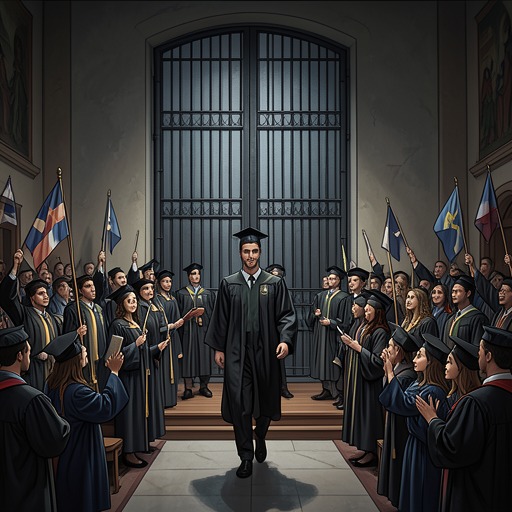
The students arrive in tuxedos and evening dresses, and the visual transformation is central to the scene. Chloe, Tammy, and several sophomores from Tony Danza’s class appear on the arms of seniors, looking radiant and sophisticated. Their clothing and formal behavior do not erase the tensions of school life, but they reveal identities that the ordinary school day tends to conceal. The prom becomes a temporary stage on which students can present themselves as polished, desirable, and socially assured.
The Dance and Its Atmosphere
Unlike the Winter Formal, which Tony Danza associates with dirty dancing, senior prom is described through waltzing, perfume, aftershave, and oldies that he can actually dance to. The event therefore produces a sharp value shift: the apprehension attached to supervising students gives way to pleasure and wonder. Tony Danza does not merely endure the night as a staff obligation; he breathes in the atmosphere, joins the dancing, and wonders how he managed to be included in such an unexpectedly fortunate experience.
The scene also links the students’ celebration to mediated memory. Katerina’s boyfriend videotapes Tony Danza and the others for Katerina, creating what Tony Danza experiences as a digital valentine from a high school prom paradise. The camera is not presented only as a tool of the television production. Here it preserves an intimate sign of participation for a student who is absent, extending the celebration beyond the room and turning the dance into a shared keepsake.
Contrast with School Life
The prom’s grace gains force from its proximity to the school’s more difficult realities. Northeast High School is a vast Philadelphia institution with a factory-like brick building, trailers, sports fields, a stadium, cavernous gyms, and even its own Philadelphia police station. Within that environment, formal rules concerning uniforms, hoodies, iPods, running, and shouting are widely known but inconsistently enforced. Students understand that many violations produce little consequence, while physical fights receive the most serious response.
That institutional gap between announced policy and actual enforcement shapes Tony Danza’s anxiety as a teacher and chaperone. The day before the Washington, D.C. field trip, Pepper is assaulted in a hallway, and the incident makes the prospect of supervising students outside school feel especially hazardous. senior prom reverses that atmosphere without pretending the underlying problems have disappeared. The same students who inhabit a culture of testing rules can also waltz through the Bellevue Hotel in evening clothes, obey the occasion’s expectations, and make the adult supervising them feel lucky rather than threatened.
Narrative Significance
senior prom functions as a counterimage to the school’s bureaucratic and disciplinary pressures. Teachers are burdened by mandates, deadlines, professional-development requirements, audits, and the demand to meet Adequate Yearly Progress; students are repeatedly measured through attendance, behavior, and standardized testing. The dance suspends that evaluative framework. For one evening, the students are not primarily attendance problems, test-takers, or disciplinary cases. They are participants in a communal ritual of passage.
The event also completes a recurring emotional pattern in Tony Danza’s relationship with his class. Just when he believes he cannot stand the sight of the students, they reverse the emotional direction of the relationship and make him feel love again. The group hug immediately before the prom leaves him sobbing while the students laugh at his vulnerability; the dance then gives that renewed attachment a public and celebratory setting. Together, the two moments show how quickly antagonism, embarrassment, affection, and pride can coexist in the teacher-student relationship.
As the school year approaches its final examination, Tony Danza wakes at four in the morning and sees the sunrise through his apartment’s “magic window” as an omen. The prom belongs to the same closing movement: it arrives after the hardest struggles but before the final academic reckoning, allowing the students to be seen in the fullness of their social and emotional lives. Its significance is not that it solves Northeast’s institutional failures. Rather, it supplies a vivid temporary proof that the school’s students contain more dignity, style, tenderness, and capacity for collective joy than the school’s disciplinary and accountability systems can register.