A&E Cold Case Files Forum Community
I'll Be Gone in the DarkThe A&E Cold Case Files message board became a large online research community focused on the East Area Rapist / Original Night Stalker case. Its members assembled information across thousands of posts, built maps, and developed leads that reached beyond what any single participant could readily gather. The board’s value lay in this distributed effort, but its work also unfolded amid pseudonymity, speculation, and disputes over the boundary between public discussion and confidential investigative information.
A crowdsourced case archive
The board’s scale was immediately apparent to the book’s author on first logging in: it contained more than one thousand topics and twenty thousand posts. Participants examined incidents newly associated with the case, including a 1974 burglary in Rancho Cordova, and brought sustained attention to details that might otherwise have remained scattered across reports, calendars, and witness accounts. The author was initially daunted by the volume, then came to appreciate the community’s thoroughness.
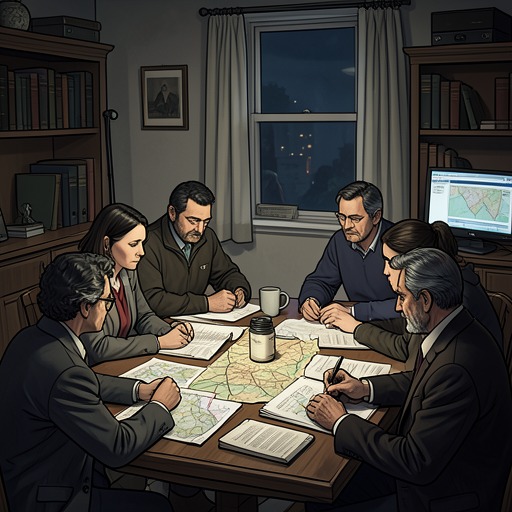
The work was not limited to exchanging theories in text. Members made maps of crime-scene locations, witness sightings, and the place in Dana Point where a bloody motocross glove had been dropped. They also investigated possible connections to the military, real estate, and medicine. One frequent poster, PortofLeith, helped identify a correlation between the academic calendar of California State University–Sacramento during the East Area Rapist’s active years there and the timing of his crimes. That example shows how the community’s research could connect separate kinds of information and turn an overlooked pattern into a question for further examination.
Its collective effort did not make every claim reliable. The board included cranks, among them a well-meaning poster who insisted that Ted Kaczynski, the Unabomber, was the perpetrator; the book explicitly rejects that identification. The contrast between this false assertion and the calendar analysis, detailed maps, and extensive case discussions captures the board’s uneven character: participation could generate valuable investigative work, but the volume of discussion also required readers to distinguish supported leads from mistaken speculation.
Informal leadership and friction
The Social Worker was one of the board’s de facto leaders and occupied an unusual position between the online community and Sacramento investigators. The board’s members tended toward paranoia and made heavy use of pseudonyms; personality conflicts arose within a community spending long periods discussing serial crime. In that atmosphere, the Social Worker’s role as an intermediary could be useful to investigators and contentious among posters at the same time.
Some members resented what they regarded as her hints about confidential information followed by refusals to disclose more. The disagreement concerned not only what she knew, but also who had access to it and what could properly be shared in a public forum. The account does not describe a formal board hierarchy or official investigative authority. Instead, influence came through the Social Worker’s position as a gatekeeper and through the practical value of her contact with investigators.
On July 2, 2011, she posted a drawing of a decal that she said had been seen on a suspicious vehicle near the scene of one of the Sacramento rapes. The post illustrates the kind of material that could pass through the board: a reported observation rendered as a drawing and offered for community attention. It also clarifies the limits of the evidence. The account records what the Social Worker said about the decal; it does not establish that the vehicle or decal identified the perpetrator.
Contact with investigators
The book describes law enforcement’s presence on the board as subtle but increasingly apparent. Members investigated the decades-old case for their own private and idiosyncratic reasons, while investigators steered them in understated ways. The relationship was therefore neither simply independent amateur research nor an official public investigation. Information and attention moved between the two, but the account does not suggest that the board had formal authority or direct control over investigative decisions.
The Social Worker told the author that she had begun working informally with Sacramento investigators about five years earlier. She also took the author on a driving tour of East Area Rapist locations, through modest ranch-house neighborhoods near the old Mather Air Force Base and the leafier areas of Arden-Arcade and Del Dayo. This contact gave the author a view of the geography associated with the case as well as the board’s connection to people working on it. The tour is evidence of the intermediary relationship, not proof that all board members had similar access.
Research beyond the message board
The book also describes the author’s separate effort to organize official case materials while preparing a feature for Los Angeles magazine. As files arrived, the author built an index of the people, places, and things named in the reports, with the aims of locating investigative details, distinguishing individuals and tracking potentially relevant geographic movement, and finding overlapping names or possible connections among victims. This archival work helps frame the board’s broader research environment: case knowledge was distributed among reports, investigators, and online participants rather than held in one place.
The author bought two high-volume digital scanners, and the materials were scanned to make them accessible and searchable. Much of this material had not been seen by active investigators including Paul Holes, Ken Clark, and Erika Hutchcraft. The scanning project was described as a way to provide investigators with a practical service in return for their generosity. It was not presented as an operation of the message board itself; rather, it shows another route by which case information could be organized and shared alongside the board’s crowdsourced analysis.
Together, the board’s extensive discussions, member-made maps, informal investigator contacts, and the author’s parallel archival work reveal a case investigation spread across people and tools. The message board’s contribution was not a single conclusive discovery in this account, but the accumulation and examination of material—and the continuing need to judge what that accumulation could reliably establish.