Discovery of the homework evidence
I'll Be Gone in the DarkThe discovery of the homework evidence turned a neglected property-room box into a new lead in Paul Holes’s investigation of the East Area Rapist. Among the recovered materials were handwritten schoolwork, a residential map, and a forcefully marked word on the map’s reverse. Together they suggested possible connections between childhood punishment, design ability, and the crime-scene area, but they did not establish who made the pages or prove that the writer was the offender.
Recovery and Inventory
The pages had been collected decades earlier by criminalist John Patty during a search near railroad tracks in Danville. The evidence inventory described two sheets of spiral, three-hole binder paper bearing pencil writing, a third sheet bearing a pencil-drawn map, a 41-inch length of purple yarn, and a fragment of paper with typewriting. Patty placed the materials in a tagged plastic bag, which was stored in a box in the property room. The box remained there, among hundreds of similar boxes, for thirty-three years.
The original documentation left important gaps. There was no photograph or sketch showing how the items had been arranged at the scene, and the inventory offered only a brief note about where along the tracks Patty found them. The objects might have been together or scattered; the surviving record could not resolve that question. Patty died in 1991, leaving Holes without the person who had collected the evidence and might have supplied its missing context. The case thus depended not only on what had survived, but also on the limits of the record attached to it.
A Search for a Different Clue
On March 31, 2011, Holes went to the property room asking about a ski cap connected to Jim Walther, a former East Area Rapist suspect he was reconsidering. Investigators had once treated Walther as a leading suspect. A friend arrested with him for selling marijuana in Sacramento in 1977 had given investigators some of Walther’s belongings, including a black ski mask. Because Walther’s DNA profile was not in the system, Holes wondered whether hairs or skin cells on the mask might yield a profile.
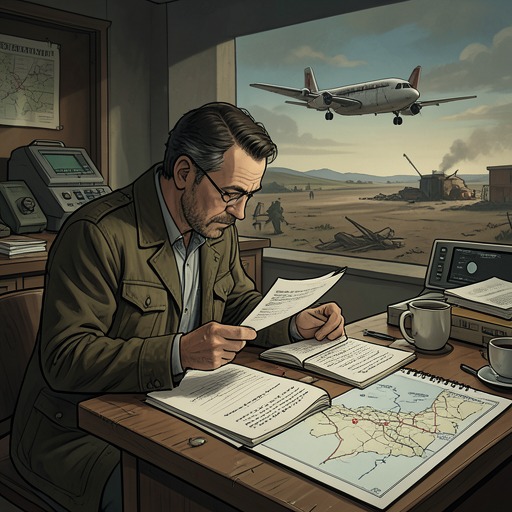
The mask brought Holes to the old box, but it was the separate bag tagged as coming from a railroad right-of-way that caught his attention. He took the pages for photocopying and examined a copy of the map in his lab. At first, the evidence’s mixture of school writing and apparent design skill resisted an easy explanation. Holes sought outside views, including input from experts and a real estate developer. Their observations prompted him to reconsider what kind of person might have produced the materials. His ideas diverged from those of fellow investigators, and he continued exploring the lead without treating an interpretation as a settled identification.
The Pages and the Map
One sheet appeared to begin a poorly written school essay about General Custer. A second page began with the words “Mad is the word” and described a sixth-grade teacher who had humiliated the writer by making him write sentences repeatedly as punishment. The writer expressed intense resentment toward that unnamed teacher. These pages offered a possible trace of a school experience, but they did not name the student or establish when the writing was produced.
The third sheet showed a residential community, including a business area, cul-de-sacs, trails, and a lake. Its reverse carried additional doodling. Holes had noticed the marks but initially paid little attention to them. After his clerk prompted him to turn the page over, he looked again at the uneven collection of writing and drawings. Some words were illegible, and two had been crossed out; the name Melanie could just be made out. One remaining word stood apart from the rest: “PUNISHMENT.”
Its appearance made it especially striking. The letters were larger and darker than the surrounding marks, slanted diagonally across much of the lower half of the page, and mixed cursive with print. The first letter was reversed, and the final T was repeated. The contrast between this emphatic word and the other doodles sharpened the page’s ambiguity: it looked deliberate and emotionally charged, yet the evidence did not identify its writer or explain its relationship to the other materials. For Holes, the word made the pages newly arresting; it did not, by itself, solve the case.
An Investigation Without a Definitive Identification
Holes’s reaction to the turned-over map marked the discovery’s investigative force. The realization came in the lab, after the evidence had already been retrieved and copied: a previously overlooked detail changed how he saw the object. The find drew him into a widening inquiry. He tested possible readings with experts, reconsidered clues, and continued despite knowing that his theories were regarded as unconventional. No specific suspect had yet emerged as a conclusive answer, even as his sense of the investigation’s larger target began to shift.
The school pages also prompted Holes to contact Walther’s sixth-grade teacher. Holes learned from Walther’s school records that the teacher had been male, an unusual circumstance at the time. The elderly teacher did not remember Walther, but said that repeated sentence writing would fit the kind of punishment he had used in class. He also recalled an unidentified man calling about ten years earlier and singing “Freedom Isn’t Free,” a song the teacher had made unruly students sing. The caller had told him to remember it and then hung up; the episode had upset the teacher enough that he changed his phone number and kept it unlisted. The call added a possible resonance to the school-related evidence, but its caller was unidentified, and the teacher could not confirm that Walther had been the student or writer.
Significance and Limits
The discovery joined an old physical lead to a contemporary investigation, but its significance rests as much on uncertainty as on revelation. The inventory preserved specific objects and the pages preserved distinctive marks; neither supplied a verified authorship. The missing scene documentation and Patty’s death narrowed the available context, while the teacher’s recollections offered suggestive parallels without closing the evidentiary gap. Holes could reexamine, scan, and seek expert readings of the materials, but interpretation remained vulnerable to competing explanations and investigator bias.
The discovery’s lasting importance is therefore not that the homework pages conclusively identified the East Area Rapist. Rather, they altered the direction and character of Holes’s inquiry. A search for a ski mask opened onto a separate, long-stored collection whose map and writing demanded new questions. The case’s uncertainty persisted, but the overlooked word on the reverse of the map gave the investigation a fresh point of entry.