East Area Rapist Task Force
I'll Be Gone in the DarkThe East Area Rapist Task Force brought investigators together around a serial-crime investigation that crossed local boundaries and resisted easy identification. Its members compared reports, pursued suspects, and collected physical evidence, yet the investigation was marked by uncertainty: even investigators who studied the same attacks formed sharply different impressions of the offender. The task force’s history in the available account is therefore both practical and unfinished—a record of sustained work, uneven cooperation, and leads that could be discarded before later evidence made them worth reconsidering.
Identity and Investigative Problem
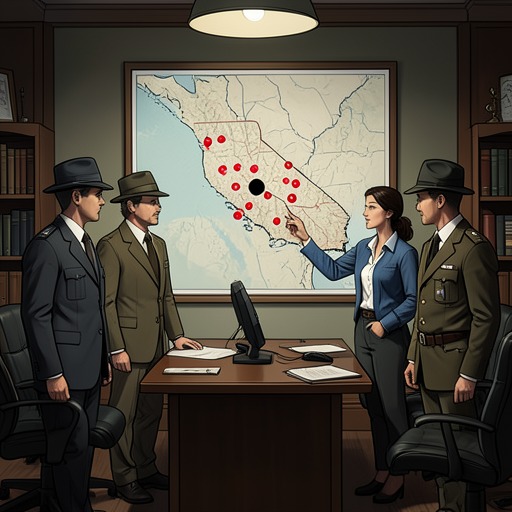
The task force was not presented as a body with a fully documented roster or a single, consistently described command structure. The account identifies investigators associated with its work in Sacramento and Contra Costa County, including Richard Shelby, Carol Daly, and Larry Crompton. A caption identifies Crompton as a sergeant on the Contra Costa County EAR Task Force; later, Paul Holes reads the frequency of Crompton’s name in case reports as a sign that he had been the group’s de facto leader. That description comes from the surviving record rather than a formal organizational chart.
The task force faced a basic problem of recognition. The Sacramento County Sheriff’s Department repeatedly stopped young white men, but the right suspect remained unidentified. Investigators did not share a common mental picture: among their impressions were a blond man in an army jacket, a Mormon riding a bicycle, and an olive-skinned Realtor. The range matters because it reveals how little consensus the case files had produced about the offender’s appearance, even as investigators were attempting to recognize him in the field.
The cases themselves offered another kind of pattern. Reports documented neighborhood prowling, small items going missing, and sharp increases in hang-up calls within a few blocks of an attack. The offender appeared to study residents’ schedules and home layouts before striking. These details gave investigators a way to compare incidents and understand the preparation behind them, but a pattern was not the same as an identity: familiarity with the method did not resolve who was responsible.
Methods, Evidence, and Suspect Leads
The task force’s work depended on reports and physical evidence as well as investigators’ judgments. A photograph caption records Crompton making a plaster cast of a footwear impression, one example of the concrete scene evidence collected during the investigation. Years later, Holes approached the Contra Costa County cases through the evidence held in Property. In July 1997 he began retrieving rape kits and assessing whether they could yield a DNA profile. Three kits appeared capable of producing a rudimentary profile; testing confirmed that the same man was responsible for all three cases. The result supported the connection among those cases with scientific evidence, rather than relying solely on similarities in method.
Crompton also helped Holes revisit old suspects. When Holes asked which names deserved another look, Crompton supplied several, though without much enthusiasm. His deeper interest was an older hunch that his superiors had prevented him from pursuing at the time. The exchange shows how the task force’s accumulated knowledge could survive outside active casework: a retired investigator retained a theory, while a later investigator could return to it with new tools and a different vantage point.
One suspect the task force pursued was Jim Walther. Investigators had several reasons to examine him: he gave an address on Sutter Avenue in Carmichael, a deputy recalled seeing a distinctive car like his in San Ramon around the period of the attacks there, and he later replaced that car. Walther stopped cooperating when questioned and obtained a lawyer through his mother. He also volunteered that he had blood type A and wore size-nine shoes, details that matched characteristics associated with the East Area Rapist. The task force continued to press him for a saliva sample. When investigators told him they would arrest his girlfriend over marijuana cultivation unless he provided one, he agreed to chew on gauze.
The test results eliminated Walther under the method then being used: he was classified as a secretor, while the East Area Rapist was believed to be a nonsecretor. The task force dropped him and moved on. More than thirty years later, Holes questioned whether that elimination was dependable, citing known problems with the earlier testing method and the possibility of people whose secretor status varied across bodily fluids. This later doubt does not establish that Walther was the offender; it shows instead how a conclusion treated as decisive at the time could become uncertain as forensic knowledge changed.
Cooperation and Institutional Limits
The investigation also depended on information moving between agencies, and that movement was often poor. In the late 1970s, police Teletype messages and informal word of mouth were among the ways investigators learned about cases elsewhere. When the East Area Rapist disappeared from the East Bay in the summer of 1979, Crompton feared that the offender was escalating, while his superiors were relieved by the apparent end of the local series. Their different reactions reflect a consequential difference in outlook: Crompton interpreted the pause as a warning, not a resolution.
In early 1980, Jim Bevins, a Sacramento investigator who had become close to Crompton through their task-force work, told him that he had heard rumors of two cases in Santa Barbara, one a homicide, that seemed similar to the East Area Rapist cases. Bevins was trying to step away from the investigation because of the strain it had placed on his marriage, but he still passed the information on. Crompton contacted investigators there and was told that they had nothing like that. The exchange captures both the informal personal ties that carried leads across jurisdictions and the institutional resistance that could stop those leads from being shared.
Record and Significance
The task force’s record is not simply a story of correct leads followed to resolution. Investigators developed comparisons among attacks, collected scene evidence, questioned suspects, and preserved impressions that later investigators could reassess. But they also worked amid uncertain descriptions, uneven cooperation, and tests whose limitations were not yet understood. Crompton’s role as a persistent investigator, Bevins’s warning from Sacramento, and Holes’s later review of both forensic evidence and old suspect eliminations show how knowledge accumulated across time rather than within one uninterrupted investigation.
The task force’s significance lies in that continuing, imperfect effort. Its members could identify connections among cases without knowing the offender’s identity; a biological match could strengthen the link among Contra Costa County attacks without immediately solving the wider series. And a suspect could be dropped on the basis of a test that later deserved renewed scrutiny. The organization’s work left both useful evidence and unresolved questions for those who returned to the case.