Jim Walther EAR suspect investigation
I'll Be Gone in the DarkJim Walther EAR suspect investigation concerns the arrest and elimination of an early suspect, and Paul Holes’s later effort to test whether that decision had been sound. Walther’s address, movements, behavior, and connections to neighborhoods targeted by the East Area Rapist seemed to converge into a persuasive pattern. A saliva test appeared to resolve the question; decades later, doubts about the test and the discovery of an old ski mask brought the investigation back to Walther. Holes eventually established that Walther was not the East Area Rapist, while describing him as the offender’s shadow.
The roadside encounter
The investigation began before dawn on February 2, 1979, in Danville. Contra Costa County Sheriff’s Deputy Carl Fabbri woke Walther with a flashlight beside his gray-primer-coated 1968 Pontiac LeMans. Walther said he had left his job as a brakeman for the Western Pacific Railroad and pulled off Interstate 680 to sleep. Fabbri questioned the explanation: the car stood on Camino Tassajara, about a mile and a half from the freeway. Fabbri was patrolling after unsuccessfully pursuing a prowler in the neighborhood the previous night.
The East Area Rapist had reached the area months earlier, and four attacks had already occurred there. The suspicion that Walther might be connected to them made an otherwise puzzling roadside stop consequential. A records check found an outstanding warrant for vehicle-code violations and a minor marijuana arrest in Sacramento two years before. Walther was twenty-one, five feet ten inches tall, and weighed 150 pounds. Fabbri and his partner arrested him.
Walther’s reaction to the booking photograph added to their concern. When the second deputy brought out a Polaroid camera, Walther suddenly resisted, and the officers had to restrain him and hold his head up for the photograph. The account presents this as striking behavior, not as proof of guilt: his known record was minor, and the reaction seemed disproportionate to the immediate circumstances.
Circumstances that accumulated
Other details reinforced the suspicion. Walther gave Sutter Avenue in Carmichael as his address, within the east Sacramento area where the East Area Rapist had operated. A deputy recalled seeing a car like Walther’s distinctive Pontiac in nearby San Ramon around the time of attacks there. Soon after his arrest, Walther disposed of the car and acquired another. When task-force investigators questioned him, he stopped talking and obtained a lawyer through his mother, who was described as forceful in dealing with authorities and protective of her adult son.
The dispute over a saliva sample became another point of attention. Walther’s lawyer said he would not chew gauze for the sample because it might be incriminating. Walther continued to resist investigators’ requests, though he volunteered that his blood type was A and that he wore a size-nine shoe, details that appeared to match characteristics attributed to the East Area Rapist. These facts helped make him a leading suspect, but their force depended on interpretation: none independently established that he was the offender.
The geographic coincidences seemed especially difficult to dismiss. Walther’s family home on Sutter Avenue sat within a central buffer zone around which the East Area Rapist preyed. In the mid-1970s, Walther had also helped his mother manage low-income apartment complexes in Rancho Cordova, including one beside an attack site. Holes later learned that Walther had been injured in a 1975 car accident in Sacramento and had scars on his face. In an interview described in the account, the East Area Rapist had referred to something having happened to his face. The resemblance between these fragments raised questions; it did not by itself demonstrate a connection.
The test and the reversal
In August, investigators obtained Walther’s saliva. The result seemed decisive: Walther was a secretor, whereas the East Area Rapist was classified as a nonsecretor. The task force dropped Walther as a suspect and turned to others. For more than thirty years, that test stood between Walther and renewed scrutiny.
Holes later reconsidered the elimination while reviewing the limits of older secretor-status testing. Quality-control experts had identified serious problems with the method during the 1980s. Scientists had also found that a small proportion of people were aberrant secretors, expressing ABO type in some bodily fluids but not others. Holes concluded that a result from the earlier method could not safely carry the weight investigators had placed on it. This did not establish Walther’s guilt; it reopened a question that the original test had appeared to close.
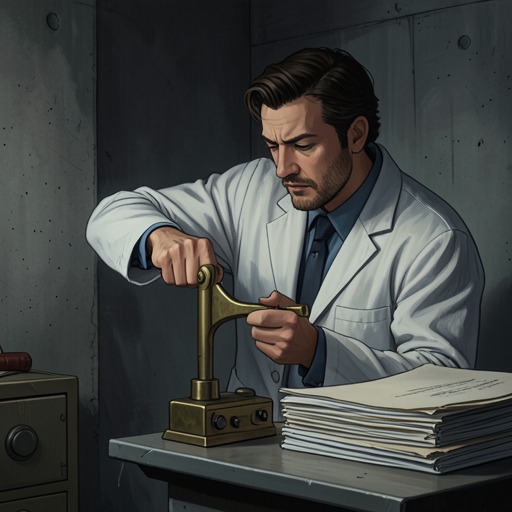
The renewed inquiry grew out of Holes’s search in the Sheriff’s Property Room in 2011. He had been looking for a ski mask associated with Walther, whose friend had given investigators several of Walther’s belongings after being interviewed. The friend had been arrested with Walther for selling marijuana in Sacramento in 1977. Holes hoped hairs or skin cells from the black mask might yield a DNA profile, since Walther’s profile was not in the system. The old object thus linked the first investigation to a modern attempt to reassess the evidence.
Finding Walther and defining the answer
Holes pursued Walther’s background and whereabouts for eighteen months. Walther was difficult to locate; Holes repeatedly contacted coroner’s offices to ask whether they had unidentified men resembling him. He eventually found Walther’s estranged daughter, who said she had not spoken with her father since 2007. She reported that he had called her once from a pay phone and was homeless in Sacramento at the time. The search had moved from a young man’s arrest record and family address to the uncertain trail of a man living without a stable home.
The Sacramento County Sheriff’s Department eventually contacted Holes after approaching Walther’s brother with a mobile fingerprint device. The brother acknowledged Walther’s identity, and a thumbprint confirmed that the homeless man was Jim Walther. Investigators took a cheek swab and rushed the DNA sample to the laboratory. The account records that the central question Holes had spent eighteen months investigating was answered, but does not provide a laboratory result or further technical details about that swab. Its stated conclusion is clear: Holes said Walther was not the East Area Rapist.
That conclusion preserved the distinction between proximity and identity. Walther’s address and past work placed him near the offender’s territory; his scars, vehicle, and behavior had seemed to fit portions of the investigative picture; and an unreliable test had once removed him from consideration. Yet those converging details never made him the offender. Holes’s description of Walther as the East Area Rapist’s shadow captures the investigation’s final, narrower significance: Walther’s life intersected repeatedly with the case’s geography and investigative history, without establishing that he committed the crimes.
The surrounding investigative climate
The investigation unfolded amid a changing public understanding of the East Area Rapist. At first, the Sheriff’s Department asked local newspapers not to publicize the attacks, hoping the offender would remain on the east side, where investigators wanted to contain and catch him. Detectives quietly checked parole and probation records, looked into people with routine neighborhood access, left cards at homes, and followed tips. As news remained scarce, rumors spread, including false claims about the crimes. After two attacks in twenty-four hours, a November town-hall meeting at Del Dayo Elementary School drew five hundred people; the following morning, The Sacramento Bee published a report announcing a manhunt in connection with eight rapes.
By May 1977, fear had become visible in daily routines: residents installed bars and reinforced panels, ordered hundreds of backyard floodlights, and organized patrols in pickup trucks with CB radios. Later accounts of attacks showed how awareness could shape what victims and neighbors did, sometimes producing caution and sometimes retreat. This wider climate clarifies why a suspicious car, a prowling report, and a neighborhood address could carry such weight in Walther’s case. It also underscores the danger of treating a pattern of circumstantial correspondences as a final identification. Holes’s renewed work questioned the old elimination without converting suspicion into a verdict, and the investigation ended with that distinction intact.