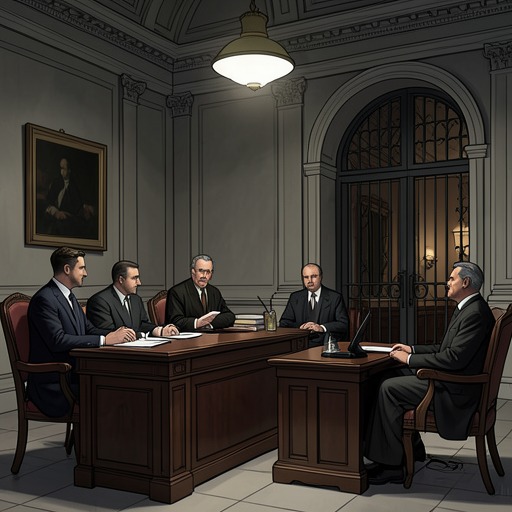
Richard Hanawalt
I'll Be Gone in the DarkRichard Hanawalt was the defense attorney for Joe Alsip in the preliminary hearing over the murders of Lyman Smith and Charlene Smith. Though police and prosecutors expected little from him, Hanawalt investigated the minister whose accusation had helped bring Alsip under suspicion, challenged the minister’s credibility, and presented the killings as the work of an unknown offender rather than someone close to the Smiths.
Reputation and Appointment
Hanawalt was best known to the investigators for defending people charged with drunk driving. The prosecution welcomed his appointment to represent Alsip, a friend and former business partner of Lyman Smith, whose fingerprint had been found on a wine goblet from the Smiths’ home. The minister had also told police that Alsip had essentially confessed. With Alsip arrested and these points supporting suspicion, the prosecution entered the preliminary hearing confident in its case.
Hanawalt’s courtroom manner reinforced that confidence. He was prone to mixed metaphors and non sequiturs, and his remarks could sound like fumbling rather than focused advocacy. Yet that apparent lack of polish concealed a more consequential line of inquiry: he followed anonymous tips urging him to investigate the minister’s past.
Challenging the Minister’s Account
Hanawalt uncovered a decades-long pattern, extending from Indiana to Washington, in which the minister sought police protection and tried to insert himself into investigations. The revelations were especially troubling to Sergeant Gary Adkinson, a lead investigator who had quietly anticipated that the minister’s story might unravel. When Hanawalt began dismantling it in court, Adkinson recognized the danger to the case.
The minister had insisted that he received threats after reporting Alsip, and the police chief had given him a police radio. One afternoon, the minister used it to report that someone was coming for him. Adkinson was nearby and hurried to the minister’s house. When he arrived, the minister was inside, holding the radio, and appeared devastated to see him so soon. The episode exposed a striking gap between the alarm conveyed over the radio and what Adkinson encountered on arrival, reinforcing the doubts surrounding the minister’s account.
Reframing the Murders
Hanawalt’s closing argument offered a second challenge to the prosecution’s theory: he presented the crime scene as evidence of an unknown, predatory intruder, not necessarily someone known to the Smiths. He drew attention to the drapery cord used to bind the victims, the log used in the attack, and the fact that no lights were on in the house, raising the possibility that the encounter took place in darkness. He also emphasized the bathroom window’s clear view into the bedroom and the nearby firewood pile from which the twenty-one-inch log could have been taken.
These details shifted the courtroom’s attention from the Smiths’ complicated personal and business lives toward the physical circumstances of the crime and the possibility of an outsider. Hanawalt’s argument did not identify the killer; it challenged the assumption that the person responsible had to belong to the Smiths’ circle.
Outcome and Significance
After the preliminary hearing, the Ventura County district attorney released Alsip for lack of evidence. The investigators returned to square one, divided over whether the killer knew the Smiths or whether the crime was random and sexually motivated. The file remained in the investigators’ bullpen for years before being moved to the evidence vault after a decade.
Hanawalt’s importance in the case lies in the reversal between expectation and effect: the lawyer whose manner encouraged the prosecution’s confidence became the advocate who exposed weaknesses in a central witness’s account and made an outsider explanation harder to dismiss. The hearing ended without resolving the murders, but it showed how a case built around a persuasive accusation could falter when the accuser’s history and the crime scene were examined from another angle.