Santa Barbara County Sheriff’s Office
I'll Be Gone in the DarkThe Santa Barbara County Sheriff’s Office occupies a pivotal place in the book’s account of how investigators began to consider that seemingly separate attacks on couples might belong to a wider series. It was the first agency described as proposing such a connection. The office’s recognition did not immediately produce agreement or a solution: other jurisdictions resisted the link, the cases remained unresolved for years, and the narrative later returns to the work through the recollections of retired detective Fred Ray.
Early Recognition of a Pattern
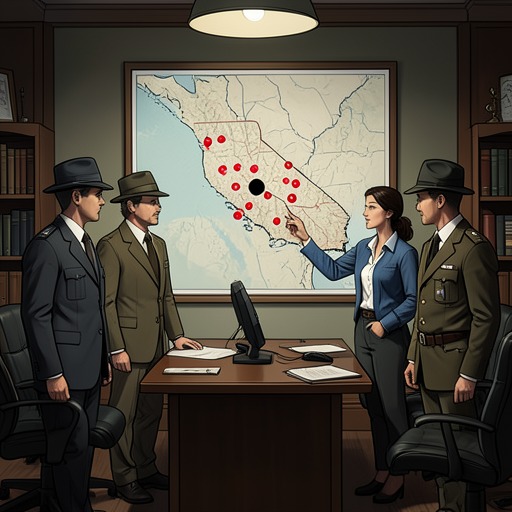
The office’s significance begins with a pattern assembled from a small number of grave incidents: two double homicides and a knife attack in which the couple survived. Investigators in Santa Barbara County were the first, as the book recounts it, to suggest that these cases might be connected. That proposal was an early act of synthesis, made before a forensic match established a relationship among the crimes. At this stage, the possible connection rested on investigative judgment rather than a definitive laboratory result.
The proposal met resistance elsewhere. Ventura officials were wary after a highly publicized preliminary hearing in which the case against a suspect in a double homicide had fallen apart; they considered the Santa Barbara investigators’ theory premature. Orange County investigators were skeptical as well. The disagreement shows the institutional difficulty of treating resemblance as evidence: a proposed series could open new avenues of inquiry, but it could also be challenged when individual cases had different histories and the link remained unproven. The account presents Santa Barbara County as the first to raise the possibility, not as having secured consensus or demonstrated the connection at the time.
That distinction matters to the office’s role in the book. Its early contribution was a hypothesis about relationships among cases, not a resolution. As the cases went cold, periodic reviews of files failed to yield the tip or information that would bring the pattern into focus. The book describes years passing without the answer that relatives and investigators sought. The initial recognition therefore appears as a consequential but incomplete step: an idea entered the investigative record, yet it could not by itself overcome the silence surrounding the crimes.
Fred Ray and the Work of Investigation
Fred Ray gives the office its most sustained human presence. Identified as a detective with the Santa Barbara County Sheriff’s Office, he is interviewed decades after the events about a double murder he investigated. By then retired, he recalls not only a particular case but also the kinds of behavior he encountered while working in the area. His testimony supplies a view of investigative experience that is more specific than the broad institutional question of whether crimes were connected.
Ray describes questioning troubled young men whose outwardly unremarkable lives concealed an interest in entering strangers’ homes at night. In his account, burglary could be secondary to the act of getting inside, moving through a house, and watching its occupants without being noticed. This recollection helps explain why prowling and unauthorized entries could matter to investigators even when nothing valuable appeared to have been taken. It does not establish that the young men Ray questioned included the unidentified serial offender; rather, it conveys the local investigative knowledge through which nocturnal intrusions could be recognized as meaningful behavior.
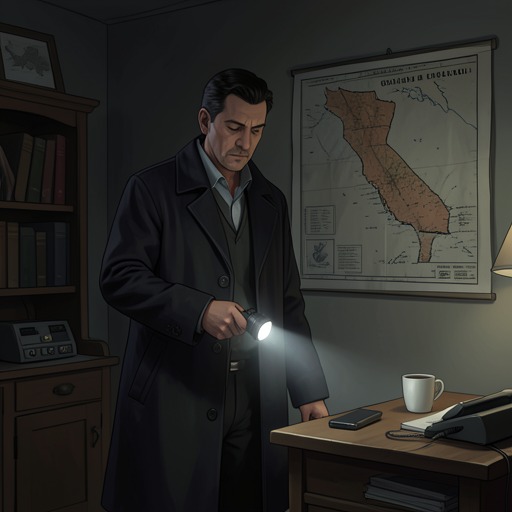
The case also involved close attention to small traces. Ray once followed tennis-shoe impressions through a neighborhood, retracing a prowler’s movements from window to window as he searched for victims. The physical impressions gave investigators a partial route to reconstruct, but not an identity. That combination—careful reconstruction alongside persistent uncertainty—runs through the book’s depiction of the office’s work. The evidence could clarify how someone moved through a neighborhood while leaving the larger question of who he was unanswered.
An Unresolved Investigation and Its Later Meaning
The book emphasizes that Ray’s experience did not make the offender readily knowable. Ray had worked on other serious cases, yet this unidentified killer remained especially disturbing to him. Other detectives described in the account likewise believed that close exposure to the evidence might allow them to recognize the man, even though decades of reviewing traces and witness accounts had not produced that recognition. Ray’s recollections thus reflect both expertise and the limits of expertise: years in investigative work could sharpen attention to patterns without turning an indistinct suspect into a confirmed identity.
That uncertainty also shapes how the earlier proposed connection is presented. The Santa Barbara investigators’ instinct that multiple attacks belonged together anticipated a pattern the book later places within the crimes of the Golden State Killer. But the account does not treat the early theory as if it had already been proven. For years, the files yielded no decisive tip, and the cases remained separate in practical investigative terms even as the possibility of a common offender persisted. The long delay between suspicion and confirmation is part of the office’s significance, not a gap to be filled with hindsight.
The Toltec Way Case and Retrospective Confirmation
A later development gives the Santa Barbara County cases renewed importance. Cheri Domingo and Gregory Sanchez were murdered on Toltec Way in Goleta; three decades later, DNA from the crime scene connected their double homicide to the Golden State Killer. The account identifies the crime-scene tape on the quiet cul-de-sac and the eventual DNA link as distinct moments in the case’s history: first, a local investigation into a double homicide; much later, a forensic connection to a broader series.
This later identification changes the meaning of the office’s earlier pattern recognition without erasing the uncertainty that surrounded it. The connection was not available as a settled fact when the first proposals were made, and the evidence does not attribute the later DNA analysis to the office alone. Instead, the book places the Santa Barbara investigations within a longer process in which observations, case files, and forensic evidence accumulated across decades. Through that chronology, the office represents both the early effort to see a series in separate crimes and the prolonged wait before a crucial connection could be established.