Ventura Police Department
I'll Be Gone in the DarkThe Ventura Police Department is central to the account of how the Lyman and Charlene Smith murders, long set aside as an unresolved local case, were eventually linked by DNA to a wider series of killings. Its records preserved a small but consequential lead: a case number that brought Larry Pool to Ventura and helped turn old forensic material into a connection across investigations.
The Smith murder investigation
On March 16, 1980, twelve-year-old Gary Smith arrived at his father’s Ventura home to mow the lawn and found Lyman and Charlene Smith dead. The case drew attention in part because Lyman was a well-known attorney approaching a possible judgeship. Investigators faced a crowded field of leads, including personal and business complications in the couple’s lives, and focused on Joe Alsip, a friend and former business partner of Lyman’s.
Alsip had visited the Smiths the night before the murders, and his fingerprint was found on a wine goblet. His minister also told police that Alsip had essentially confessed. The department’s investigation proceeded to a preliminary hearing, where the prosecution appeared confident. But the case did not hold: after the hearing, the Ventura County district attorney released Alsip for lack of evidence. The investigative team returned to the beginning, divided over whether the killer had known the Smiths or had acted as a stranger.
The Smith file remained on a shelf in the investigators’ bullpen for years and was later moved to the evidence vault. That long dormancy is an important part of the department’s role in the larger account: the case was not solved by the initial suspect inquiry, but material from its file remained available for a later comparison.
A case number opens a path
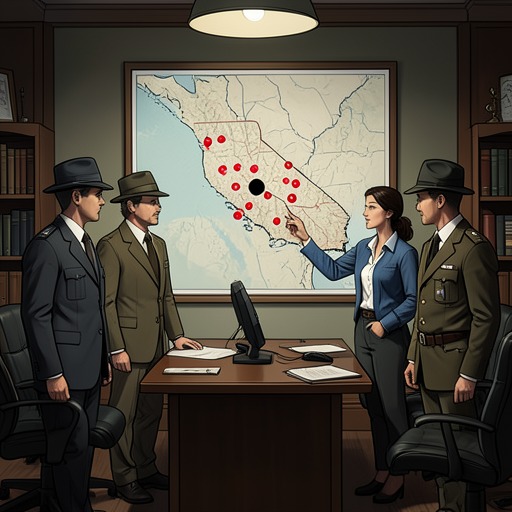
While working through a separate cold-case file, Larry Pool noticed a Ventura Police Department case number written in the margin of a report. He called the department and learned that it referred to the Smith murders. Pool explained that the Orange County Sheriff’s Department had an unsolved serial case involving four homicide victims with similarities to the Smith case. He asked the Ventura department to send any remaining forensic evidence to the Orange County Crime Lab.
The request connected investigations that had previously proceeded apart. The Smith case had been debated locally as either a crime committed by someone familiar with the couple or a random, sexually motivated attack. Pool’s inquiry reframed it as a possible part of a broader series and gave the department a specific evidentiary task: locate surviving material and make it available for testing.
Forensic evidence and the DNA link
Mary Hong opened the package sent from Ventura and found two glass slides. Such slides could retain biological material collected during a rape examination, but the absence of the accompanying swabs limited the material available for analysis. Even so, Hong developed a DNA profile from semen on the slides. On February 17, 1998, Pool received her report: Lyman Smith was excluded as the source, and the profile matched those from three other homicide cases.
The result transformed the significance of the Ventura file. Evidence preserved from a case that had spent years on a shelf and then in an evidence vault now connected the Smith murders to other killings. The contribution was not a new eyewitness or a renewed account of the original suspect; it was the survival and transfer of forensic evidence, followed by laboratory analysis that could test a connection across jurisdictions.
Internal resistance and institutional significance
The DNA connection was not accepted immediately by everyone associated with the Smith investigation. Detective Russ Hayes, one of the case’s leads, later recalled being astonished and said that he initially did not believe the result. His reaction reflected distrust of the technology among some longtime investigators, not a failure of the laboratory match itself as described in the account.
The Ventura Police Department’s part in the case therefore carries two distinct elements: an early investigation that ended without a supported prosecution, and a later evidentiary handoff that helped establish the Smith murders’ connection to a larger series. The file’s changing status—from active inquiry, to shelved case, to source of testable material—shows how an unresolved investigation can retain importance even when its original leads have failed. It also makes clear that a scientific result may alter a case’s meaning before every person involved is ready to accept it.