Ginger Pearl's Bible
I'm Still Here- What didn't kill me made me stronger and sharperGinger Pearl's Bible is a devotional book and an accidental family archive: photographs tucked among its pages help reveal Jensen Brick McCall’s connection to Ginger Pearl, while her handling of the Bible exposes the strain between religious conviction and the truth she has withheld. It is not merely a prop in their reunion. Its pages bring a hidden family history into view, and its presence gives Jensen a concrete focus for challenging Ginger Pearl’s silence.
Appearance and Use
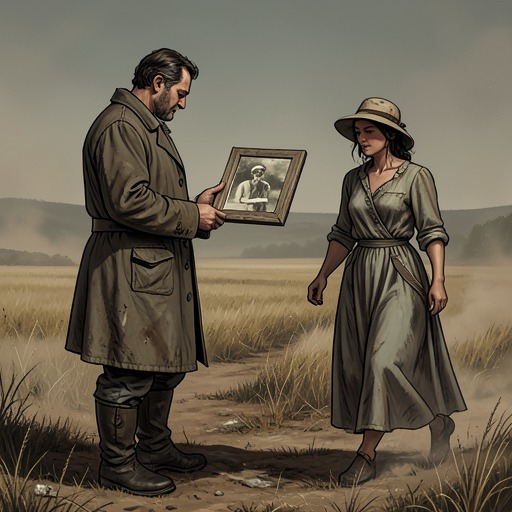
Ginger Pearl reads her Bible during the journey, at one point sitting quietly with it while Jensen reads the Cincinnati Herald. The book accompanies an ordinary moment of travel, but it carries more than scripture: several photographs are kept inside. When Ginger Pearl gets up from her seat, the Bible falls and the pictures scatter onto the floor. Jensen and Janae Morrison bend to gather them. A photograph of a little girl resembles the woman Jensen calls his murderer—his birth mother—and the recognition leaves him struggling to speak.
The Bible’s contents make the revelation material rather than abstract. Jensen holds on to the photograph even as he hands the others back. Ginger Pearl identifies the child as her daughter in a scene where neither of them yet says plainly what the resemblance means to him. The book has allowed a family image to travel with Ginger Pearl, close at hand but concealed among its pages. Once the pictures fall out, what had been privately carried becomes visible to Jensen.
Photographs and Recognition
After the photographs are gathered, Ginger Pearl carefully puts them back into the Bible. She pauses over a picture of a fat baby and traces it with her fingers. Jensen hears her murmur thanks to the Lord for finding him. When he asks whom she means, she explains that she has found a picture of her grandson, which she thought she had lost, and remarks that God protects her valuables. The moment joins religious language, a family photograph, and a recognition that is not yet openly acknowledged to Jensen.
The Bible therefore holds two kinds of evidence at once. The photographs record the family connection visually; Ginger Pearl’s words suggest that she recognizes the child in the picture as her grandson. Later, while speaking on her phone, she tells her daughter that she thinks she has met her son, that he looks like her, and that his gray eyes match the baby in a photograph sent by a nurse. She says she knows Jensen is her grandson and that her daughter had lied about having an abortion. The book’s photographs are part of a larger chain of recognition, linking the family images Ginger Pearl carries with the information she receives about the surviving baby.
Faith, Secrecy, and Confrontation
The Bible’s religious authority becomes especially pointed when Jensen realizes Ginger Pearl has been pretending not to know who he is. He studies saved photographs of her with her daughter and grandchildren, then overhears her affirm to Janae that Jensen is her grandson and that she sees his mother in him. He returns to his seat angry and silent. When he confronts Ginger Pearl, he accuses her of knowing their relationship and invokes the commandment against lying: “Thou shalt not lie is one of his commandments, right?”
Ginger Pearl is holding her Bible during this confrontation. She reaches toward Jensen, but he pushes her hand away; she clutches the book and lowers her head. The gesture places the object beside the specific breach of trust at issue. For Jensen, the Bible cannot make her concealment less real: its moral language instead gives him a way to name the contradiction between professed faith and withheld truth. The force of the scene comes from the book’s double role—as a treasured religious object and as the container from which the photographs that expose the family history have emerged.
Apology and Significance
Ginger Pearl later explains that she did not know how to approach Jensen and say she was his grandmother. She recounts that Jensen’s mother had been sent away to New York after conflict with her, including resentment over Ginger Pearl’s marriage to a white man and the fact that her younger brother was white. Jensen rejects this account as a reason to dwell on his mother’s past, keeping the focus on the relationship and truth he needs in the present. The Bible does not erase the history or settle the dispute; the recognition it helped precipitate must be followed by an honest conversation.
Ginger Pearl acknowledges that Jensen is right and that she is wrong. Her later welcome of him into her life, and their embrace, mark a movement toward repair. The Bible’s significance lies in the tension it gathers rather than in any claim that the object itself resolves their conflict. It is a book of prayer, a holder of intimate family pictures, and the physical setting for a painful test of honesty. Through it, the narrative brings faith and kinship into the same frame, while insisting that reconciliation depends on facing the truth the photographs have helped uncover.