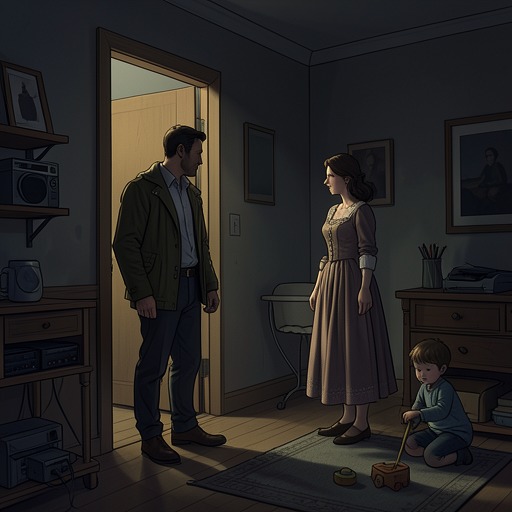
Janae Morrison
I'm Still Here- What didn't kill me made me stronger and sharperJanae Morrison is an artist whose public disgrace and private crises make survival an ongoing struggle rather than a single turning point. In Buffalo, her relationship with Robert Walters brings artistic support and promises of love, but also secrecy, betrayal, and danger. After fleeing, she begins a complicated new life with Jensen Brick McCall in California, where love and family grow alongside the difficult work of recovery.
Identity and Background
Janae’s sense of herself is shaped by how she believes her family and society regard her. She describes herself as the darkest-skinned member of her family, taking after her father, while her mother, sister, and stepfather are lighter-skinned. She compares herself with a sister she describes as thin, beautiful, and a ballet dancer. That comparison is not merely about appearance: it reflects Janae’s sense that she has been placed outside the family’s preferred image and left feeling less valued.
She also describes the effects of colorism on Black women as something she has experienced throughout her life. In her view, complexion shapes who is praised as attractive, who is disparaged, and who is considered worthy of love and care. Her account places her own experiences of rejection within a wider social pattern, while remaining rooted in her personal sense of being overlooked.
Art is one of Janae’s means of expression and a practical part of her life. She tries to sell her work at an event, takes art classes, and paints a portrait that Robert displays in his office. Later, she draws Jensen on a sketchpad during their first encounter. Painting also recurs during a counseling visit, when she turns to it after using cocaine and crying. Her art therefore accompanies both her efforts to establish herself and her attempts to live with distress.
The Affair and Flight from Buffalo
Robert first approaches Janae at an event where she is trying to sell her artwork. He buys her art supplies, pays for art classes, takes her to New York to see works by artists associated with the Harlem Renaissance, and tells her that she is beautiful and that he loves her. Janae says he repeatedly pursued her, including after she walked away. Their relationship includes drug use as well as intimacy, and she says that they were lovers many times.
The relationship is entangled with Robert’s marriage to Elizabeth Mourning-Walters. Elizabeth befriends Janae, buys her clothes and shoes, and introduces her to her social circle, while Robert continues the affair with Janae. Janae’s account presents this contrast as part of the betrayal: the wife who welcomed her into her world does not know, or is not shown knowing, the full nature of the relationship. Robert’s promises and gestures of material support thus coexist with a concealed life that leaves Janae exposed when the affair becomes public.
The news coverage places Janae beside Robert and describes an alleged affair and a drug bust. The public portrayal emphasizes her addiction and past troubles, while Robert appears in the media as a grieving and sympathetic figure. Janae feels that the visible contrast between her body and complexion and those of Robert and Elizabeth makes the public less willing to believe her. She concludes that people cast her as unstable rather than accept the relationship as real. The exposure turns a private betrayal into a public judgment about her character.
Janae also learns that her sister was involved with Robert and is pregnant with his child. This revelation deepens her sense that she was deceived: she had believed Robert loved her, while he had been involved with both sisters. The discovery compounds the humiliation of the public scandal with a rupture inside her family.
After telling the truth, Janae believes she is neither safe nor wanted in Buffalo and that a price has been placed on her head. She leaves by taxi, wearing a hoodie, and decides that California may be where she needs to go, although she does not know why she chooses it. Her departure is both an escape from danger and a break with the life in which she had come to see herself as already abandoned.
California, Jensen, and Belonging
On the journey west, Janae notices Jensen Brick McCall and begins drawing him. He wears red Beats headphones, and music by The Game and Lil Wayne is playing. She finishes the sketch and adds two drops to represent tears, an image that reflects the sadness she senses in him and recognizes in herself. The drawing gives their first meeting a form of connection before either has established trust with the other.
Their relationship develops amid competing needs. In Los Angeles, Janae rests her head on Jensen’s shoulder and takes his hand; they kiss in the stopped traffic. She wants him to remain part of her life, but recognizes that he is trying to address his past and begin his life, and that she was not part of the plan he had made. Her sobbing registers the cost of that mismatch even as the kiss marks the beginning of their intimacy. The relationship does not erase her insecurity or Jensen’s unresolved history, but it gives both characters a possibility of companionship.
Janae’s feeling of being unwanted also persists in her family relationships. At one point she says she is out of everyone’s way and that her family can be happy with its favorite daughter; she describes herself as dead to them. The statement echoes her earlier belief that no one would care if she left. Her later marriage and motherhood provide a different family setting, but the earlier rejection remains an important part of the emotional history she carries into it.
Recovery and Setbacks
Janae identifies healing, stopping drug use, and stopping self-harm as her goals. Inya offers help as a therapist, giving Janae a route toward treatment that she must choose and continue rather than a quick resolution. The story presents recovery as uneven: Janae attends counseling alone, and during one visit she says she is angry with Jensen, uses cocaine, cries, and paints. Her return to counseling occurs alongside the relapse, not after every difficulty has passed.
Inya counters Janae’s belief that she brings bad energy by telling her that she is not bad energy and asking her to repeat the affirmation. The exchange challenges Janae’s tendency to turn painful experiences into a verdict on her own worth. It does not claim that a single reassurance cures her addiction or self-harm; instead, it establishes a different language through which she can understand herself.
Later, Janae apologizes to Jensen for lying about having defeated her addiction and for sabotaging her life. She tells him that someone is trying to sell her drugs and that she is fighting the temptation. The admission marks a change in how she handles a crisis: rather than presenting recovery as complete, she names the continuing danger and makes her effort visible to another person. Her account that she has been clean for three months, while still describing herself as fighting, preserves both the progress and the work still required.
Marriage, Motherhood, and Narrative Significance
By the later account of her life, Janae says she is in love with Jensen and that she is feeling good; she also reports that Mama Pearl is doing well. On Christmas Day, she gives birth to Grace Pearl McCall. Jensen describes Janae as his wife, best friend, and family, and the scene places her within a household defined by relationships rather than the isolation she once anticipated. Marriage and motherhood do not erase her earlier crises, but they show a future beyond the public image of her as a scandal or a person defined by addiction.
Janae’s trajectory connects artistic expression, public exposure, colorism, family rejection, romantic attachment, and recovery. Her portrait of Jensen gives sadness a visible form; the television coverage makes her private life into a public spectacle; counseling asks her to describe what she needs; and her later honesty about craving makes relapse a struggle she can acknowledge rather than conceal. The account ultimately gives her a place in a family and a continuing recovery, without suggesting that either outcome came easily or that her past ceased to matter.