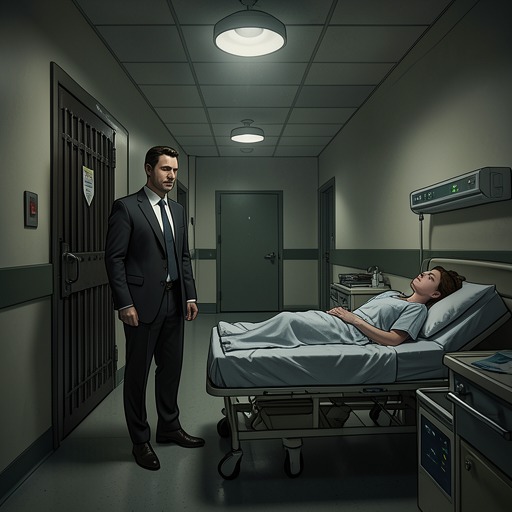
Jensen Donates a Kidney to Gloria
I'm Still Here- What didn't kill me made me stronger and sharperJensen Brick McCall’s kidney donation to Gloria Simpson Picou reverses his earlier refusal to help the mother who abandoned him at birth. The transplant is both a life-saving act and a decisive change in their relationship: by the novel’s Christmas epilogue, Gloria is part of Jensen’s family, and he understands his survival as bound up with the family he has since built.
Background and Stakes
Jensen’s connection to Gloria begins with abandonment, not care. In his account of his origins, he is the surviving baby born after a late-term abortion; the young mother refuses to take him home, and the nurse who later becomes his adoptive mother names him Jensen Brick McCall. That beginning gives the later transplant particular weight: the child whose life his birth mother rejected grows up to make a choice that helps preserve hers.
The immediate medical stakes emerge when Mama Pearl tells Jensen that Gloria needs a kidney transplant and that the bills are extremely high. She argues that helping is the right thing to do and suggests that doing good might help Gloria see Jensen. Her appeal places the choice at the intersection of medical need, family obligation, and a history of being denied recognition.
Refusal and Reversal
Jensen initially rejects Mama Pearl’s request. He points out that Gloria has not treated him as her son and would not acknowledge him when he was sitting in front of her. His refusal is rooted in a specific injury: donating to someone who has withheld the relationship itself seems to ask him to accept a one-sided version of family duty.
Mama Pearl does not erase that grievance. She acknowledges that the request is difficult and asks him to consider whether doing good might change how Gloria sees him. The later donation makes Jensen’s eventual decision a reversal, but not proof that the original abandonment did not matter. Rather, the contrast between his protest and his later action makes the donation an act of choice rather than an obligation he never questioned.
The Donation and Its Consequences
The epilogue confirms that Jensen gives Gloria his kidney. He explains the practical consequence in terms of the family’s future: the transplant allows her to watch his younger brother and sister grow up. The account does not describe the operation itself; it presents the donation through what it makes possible, shifting attention from the medical procedure to the life and relationships it helps sustain.
The transplant also changes the place Gloria occupies in Jensen’s life. At a Christmas gathering one year later, he calls her his mother and reflects that the person who tried to take his life now understands why he survived. In the same scene, he sits at the head of a family table and says that he has a family. The donation is thus followed by a visible, domestic form of inclusion rather than an isolated medical resolution.
Family and Narrative Significance
Jensen’s decision does not stand alone as a reconciliation scene. It belongs to an ending in which he is also a husband and father: on Christmas Day, Janae Morrison gives birth to their daughter, Grace Pearl McCall, while Jensen describes the family gathered around him. Gloria holds her great-granddaughter and places a small piece of crystal around the baby’s neck, continuing a tradition for each grandchild. These concrete acts show Gloria participating in the family she once denied Jensen.
The donation recasts the novel’s opening survival as an ongoing responsibility without making Jensen’s past disappear. He was once the abandoned infant whom another person chose to keep alive; now he chooses to help keep Gloria alive. The movement from refusal to donation, and from rejected son to acknowledged son, gives the transplant its decisive significance: it connects survival to forgiveness, while leaving the history that made forgiveness difficult in view.