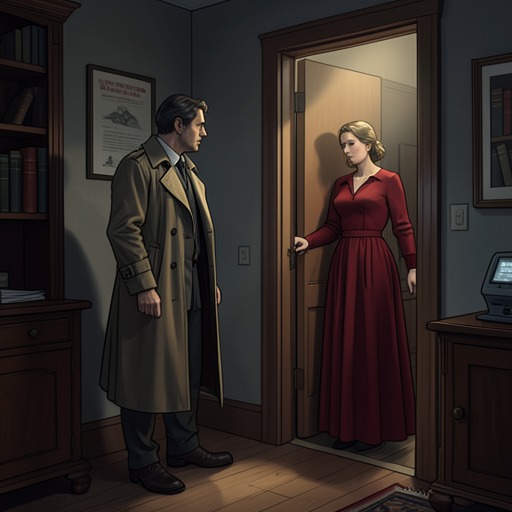
Jensen's Assassination Contract Revealed
I'm Still Here- What didn't kill me made me stronger and sharperJensen's Assassination Contract Revealed recasts Jensen and Janae's relationship as both a rescue and a betrayal: he entered her life under a paid assignment to destroy her, yet says that from the first moment he saw her he knew he could not harm her. The revelation forces Janae to confront the possibility that the man who protected her first approached her as a target, while Jensen must explain how he took the money, abandoned the intended violence, and came to love the woman he had been hired to ruin.
The Assignment and Its Context
The contract grew out of the affair between Janae and Robert Walters. Elizabeth Mourning-Walters, Robert's wife, approached Jensen through people he associated with and had worked for. She arrived with a brown envelope, a photograph of Janae, conspicuous signs of wealth, and a $25,000 transfer to Jensen's bank account. Her instruction was to get rid of Janae; when Jensen asked what form the attack should take, Elizabeth demanded that Janae be destroyed as completely as possible, but specified that she must never return to Buffalo. The order was not framed as a request to kill her alone: its stated object was to devastate her and expel her from the city.
Jensen recognized the contrast between the employer's apparent respectability and the violence she was commissioning. He knew that Elizabeth's husband had cheated on her too, and challenged the logic of the payment even as he examined the envelope and the picture. His response showed that he understood the transaction as a contract for harm, not an ordinary job. Yet he did accept the money. The account later makes clear that this choice did not mean he carried out the assignment: he says he took the payment because he knew Elizabeth would be caught.
Janae was already in danger before she knew that Jensen had been hired. The news had circulated her story of betrayal, and Jensen saw her as she traveled by bus after the events that had made her notorious in the media. He thought she was supposed to be dead before she even reached the bus steps. At that point, however, he did not reduce her to the picture or the headlines: he considered whether she was someone he could help. The contract therefore precedes their intimacy, but the narrative places his hesitation inside their first encounter, making the later disclosure a reinterpretation of that beginning rather than a wholly separate episode.
A Target Becomes a Person
Jensen explains his refusal through the deaths that already shaped his sense of responsibility. He had promised himself that he would not let another woman die without trying to save her, a promise he connects to Grace and Chyna. His account of Chyna is not abstract: she had become his closest friend after they entered the same foster home, and their bond took on the character of a sibling relationship. She had told him it was safer to remain his best friend than to become his lover. When gang members killed her and her son, Jensen blamed himself for failing to protect them; his silence and fear became part of the guilt he carried afterward.
Grace's death also belongs to the history Jensen invokes. She had saved him as a newborn after a botched abortion, when his birth mother had ordered that he be left to die. Later, Jensen's fear of losing Grace led him to tolerate her buying drugs from his friends. In retrospect, he describes his silence as a grave failure. These losses help explain why the assignment against Janae meets an existing moral limit: to act on Elizabeth's demand would mean knowingly repeating the kind of abandonment and preventable death Jensen believes he has already failed to stop.
That history does not erase the breach of trust. Jensen had accepted money to harm Janae and withheld that fact while becoming emotionally involved with her. His reasons for sparing her are therefore inseparable from the secret itself. He presents the promise as a commitment to protect someone in danger, but Janae has to reckon with the fact that this protection began in the shadow of a paid threat.
The Disclosure and Janae's Response
The truth comes out when Janae reads instructions from Doctor Walter-Mourning and looks at the accompanying business card while Jensen is speaking with his mother. The sight of the embroidered letters and the words on the paper unsettles her; she smooths the page, wipes her eyes, and hands Jensen the paper and card. The scene's decisive turn is not a new attack but the conversion of suspicion into a direct question: “You wanted to kill me?” Jensen denies that he did, but when she presses him, he admits that he could not.
Jensen ties that refusal to his feelings for her and to his promise about Grace and Chyna. Janae does not immediately accept this as an adequate account. She calls attention to the fact that she had been a target at all, insisting that she had been only a hit. Jensen answers that she would not be alive if that were all she had been to him. The exchange puts two truths into conflict: he did take the money, and he also chose not to carry out the violence for which it was paid.
Jensen then gives a more specific account of how he came to spare her. The first time he saw her, he says, he knew he could not harm her. He had heard the news report about how a man had played her and harmed other women, and felt sorry for her. Although their relationship began badly, he says he felt connected to her. He also acknowledges that he should have told her the truth. Janae asks how Elizabeth found him; Jensen replies that the employer approached him through people he knew and had done work for. By naming the route through which the assignment reached him, he confirms that this was not a misunderstanding or an invented accusation.
His clearest admission is that he knew Elizabeth would be caught and took her money. The explanation establishes that he accepted the payment despite expecting the employer's exposure, but it does not turn his conduct into an uncomplicated act of rescue. For Janae, the revelation revives the pattern of betrayal she fears: she tells him that whenever she falls for a man, he deceives her. Her heartbreak is the immediate cost of learning that protection and manipulation have occupied the same relationship.
Consequences for Their Relationship
Jensen tries to make the disclosure a point of departure rather than its final word. He tells Janae that she matters to him and that, from the moment he looked into her eyes, he was drawn toward saving her instead of harming her. He proposes that they begin their lives again, leave their mistakes behind, and build a future together. His imagined future includes a family, children, a home, and an end to the drama of their past. The proposal does not undo the contract; it makes the question of trust unavoidable, because a promise of shared life must now answer for the concealed assignment.
The scene also reverses the meaning of Jensen's original decision. At first, sparing Janae might appear to be only the failure of a hired killer to complete his work. In his account, it becomes a choice shaped by recognition, attachment, and memory of people he failed to save. Yet the ethical weight of that choice depends on what Janae knows: after the secret is spoken, she can judge both the violence he was paid to commit and the life he chose not to take. The revelation gives her information Jensen should have disclosed earlier, while leaving the hurt of his silence intact.
Narrative Significance
The event joins the novel's recurring concerns with honesty, guilt, and the possibility of repair. Jensen's promise to prevent another woman's death does not originate in the contract; it grows from the losses he carries, especially Chyna and Grace. The assignment brings that private vow into direct conflict with paid violence. His refusal is consequential because it changes Janae from a designated victim into someone he loves, but his concealment makes the same act of protection difficult for her to trust.
The disclosure therefore marks a sharp shift in the relationship: the apparent rescuer is revealed as a person who was commissioned to destroy Janae, and the apparent romance must withstand the fact that it began under false pretenses. Jensen offers love and a future as an answer, not a way to make the past disappear. Janae's pain keeps the event from resolving into a simple redemption story. What changes is that the contract is no longer hidden; what remains unsettled is whether Jensen's decision to spare her, and his subsequent confession, can support a relationship built on the honesty he failed to practice at the beginning.