Orphanhood and Abandonment
I'm Still Here- What didn't kill me made me stronger and sharperOrphanhood and abandonment are not a single event in Jensen Brick McCall’s life but an enduring condition: rejected at birth, raised by Grace McCall, and repeatedly made to feel like a temporary guest in foster homes and other would-be families. The contrast between his birth mother’s rejection and Grace’s decision to keep him gives the condition its defining tension. Jensen survives, but survival does not settle the questions of belonging, purpose, or whether anyone will stay.
Identity and Early Abandonment
Jensen’s beginning is narrated through a stark choice. His birth mother refuses to take him home and says that she wants him to die and to forget that he was born. After the call ends, Grace holds the baby; his fingers close around her thumb, and his smile turns the decision into an intimate encounter rather than an abstraction. Grace cannot watch him die. She decides to take him home and names him Jensen Brick McCall, understanding his survival as a reason to care for him and, eventually, as a sign that he has a purpose.
The infant’s survival is later described as improbable: Grace reminds him that babies do not ordinarily survive a botched abortion and remain healthy. She tells him that he has no major birth complications, apart from the color of his eyes, and insists that God chose him for something. Her words give his survival meaning, but they also leave him with a question that outlasts her: what purpose can justify a life marked by suffering? Grace’s last words return to him as both comfort and demand, especially when he measures them against the fact that his biological mother had wanted him to be left to die.
Foster Care, Displacement, and the Search for Home
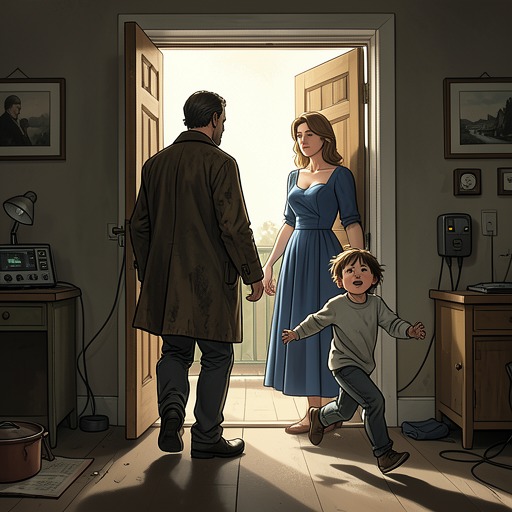
Grace’s care gives Jensen a genuine experience of being raised as her own. She takes in a Black child in a white world despite the objections of her husband, family, and friends. Yet her love cannot shield him from the wider instability of his childhood. Jensen says that he lived in ten foster homes, where he was abused mentally, physically, and emotionally. He also describes rape, sleeping on library steps, and living in conditions he calls uninhabitable. In many homes, he was treated as an unwelcome guest; at family reunions, he was introduced as the foster child who had been taken in.
That repeated designation makes the absence of a secure home more than a question of where he sleeps. Jensen wants a mother, a father, and a place he can call home, while the images on other families’ walls remind him that none resemble him. Libraries and streets become places to spend time away from the painful evidence of not belonging. His account of being “the foster kid” describes a social identity imposed on him: he is present in a household or family gathering, but not recognized as fully part of it.
The instability continues into adolescence and adulthood through relationships that offer protection but cannot guarantee permanence. Jensen joins the .357 Murder Mafia Swift because he wants the security of a family that will have his back and will not abandon him. The gang offers belonging on terms that require violence and adaptation. Jensen says those terms conflict with what he actually wants: not reputation or control of a block, but parents and a home. Even within the group, he comes to feel that he is still a guest. The gang’s promise of loyalty therefore repeats, rather than resolves, the distinction between being included and being securely loved.
Chosen Family, Grief, and Repetition
Jensen’s bond with Chyna grows out of shared placement in the same foster home. He looks out for her in a household with four other boys and understands their closeness as sibling-like, even though he also admits that he loved her romantically while she saw him as a big brother. Her death leaves him grieving and guilty, including because he feels that she had covered for him. He describes her as the family he believed he had. The loss reopens the older injury: someone who had felt like kin is gone, and the people left behind cannot make that bond permanent by naming it family.
Other friends briefly provide a contrasting experience of care. After the Byrds expel Jensen because he refuses to clean up a dog’s diarrhea, he is wet and without shelter. Five dollars, Maine, and Drew invite him in, give him dry clothes and food, and treat him like a human being. Their shared games, basketball, and memories of running up hills become a recollection of ordinary companionship. Jensen says that they are all gone, and recalls warning them to leave Brick town alone. Their absence turns a moment of welcome into another experience of loss; care is real, but it has not kept the people who offered it alive or near him.
These repetitions shape how Jensen responds to Janae Morrison. He recognizes in her hurt and difficulty fitting in a familiar longing for acceptance, and he explains that Grace’s care taught him to see worth in people whom others regard as lost or broken. His understanding is not that another person’s pain can be instantly repaired. Rather, he offers the kind of recognition he lacked in most foster homes: care that does not depend on someone appearing easy, respectable, or free of problems. Their relationship becomes another possible bond, but it remains vulnerable to the old fears and injuries they each bring to it.
Consequences and Meaning
Janae’s experience makes abandonment visible in a different form. She says that she uses cocaine to forget that her mother does not love her, along with her mistakes, and that she does not know how to stop. Jensen understands the feeling behind her addiction, but sympathy cannot erase the consequences of dishonesty. When he discovers her relapse and her lies, he says that he cannot remain in the relationship as it is and steps away. The separation shows that shared wounds can create recognition without guaranteeing recovery or trust; his own history does not make him able to prevent another person’s abandonment of herself, as he sees it.
For Jensen, the condition also drives the structure of his self-understanding. He looks back from a painful confrontation with his birth mother and insists that his story must reach into the past to explain the man he has become. He has lived through circumstances in which he expected to die, and he describes himself as an orphan three times over, linking lost family, foster-care displacement, and repeated bereavement. The phrase conveys accumulated disconnection rather than a simple legal status. His search for his birth mother is an attempt to investigate the source of his rejection and his purpose, but finding her does not restore the childhood he did not have.
The book therefore holds two truths together without making them cancel each other out: Jensen was unwanted by the woman who gave birth to him, and he was deliberately chosen by Grace McCall. The first fact fuels anger, grief, and the fear of being left; the second becomes the model for the care he tries to extend to others. Orphanhood remains a wound rather than a condition magically undone by adoption, friendship, or romance. Yet Jensen’s account also presents it as the ground from which he learns to recognize another person’s need for belonging—and to understand his survival not as proof that the suffering was deserved, but as a life he can still direct toward care and purpose.