
Learning to Name Whiteness
I'm Still HereThis flow follows Austin's growing ability to recognize whiteness not merely as individual prejudice but as a cultural and institutional norm.
increasing Bearing strength in each event
 decreasing
Bearing strength in each eventdecreasingThe Hidden Expectation

The Hidden Expectation
A name misread
The librarian's disbelief teaches Austin that other people attach race and gender expectations to a name. A white man's name on a Black girl's card is treated as an error rather than an ordinary fact.
A larger pattern
Karen's explanation reveals that the name was meant to navigate employers' bias. The incident opens Austin's understanding of whiteness as an expectation built into everyday judgments, not only an openly hostile act.
Colorblind Promises
Colorblind Promises
The public assurance
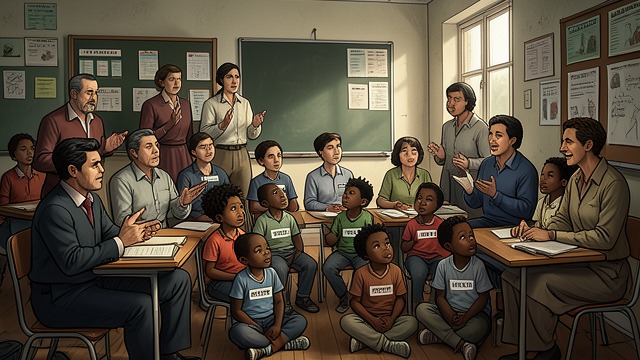
In school and church, adults sing that children of every color are precious and say they do not see color. The message promises that racial difference will not matter and that racism can therefore be absent.
Experience contradicts the promise
Austin learns that her name, body, and daily treatment remain legible as racial difference. The gap between reassuring language and lived experience makes racial color blindness seem less like protection than a refusal to notice unequal conditions.
A Seat Chart Confession

A Seat Chart Confession
The admission
Ms. Phillips tells her class that she has separated Black students because she assumed they would disrupt lessons together. She acknowledges that she did not make the same assumption about white students.
Awareness without repair
Her candor matters, but Austin is left wondering how many teachers have silently judged her through the same stereotype. The scene shows how apparent racial harmony can coexist with bias in the decisions of people who hold authority.
Curriculum as a Choice

Curriculum as a Choice
Correcting the lesson
When assignments invite a simplified account of history, Austin weighs the grade against the chance to affirm Black history. She sometimes challenges a textbook directly and sometimes marks its claims as the textbook's own.
The cost of truth
Her academic choices reveal that a supposedly shared curriculum can require students of color to do extra work simply to see themselves represented accurately. Education becomes a series of decisions about whether to accommodate or question a white-centered account.
From Individuals to Systems

From Individuals to Systems
A repeated pattern
Austin initially tries to identify particular people who make racist comments, hoping that naming an individual will prompt correction. Organizations often respond by denying intent or asking her to show more patience.
A structural diagnosis
She comes to describe the deeper pattern: white leadership, hiring habits, and institutional culture reproduce exclusion even when specific offenders disappear. Her analysis shifts from isolated misconduct toward whiteness as an organizing system.
At age seven, at the public library
During Austin's late-eighties and early-nineties childhood
During Austin's Catholic high-school years
During high school
By the opening years of Austin's professional life
