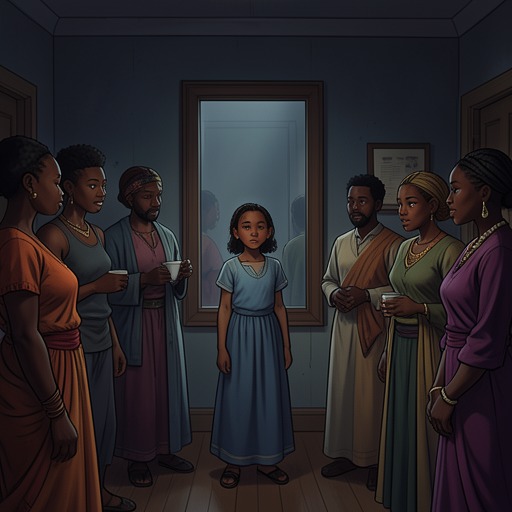
Austin and Tiffani's friendship
I'm Still HereAustin and Tiffani’s friendship takes shape during the summers Austin spends in Cleveland after her parents divorce. In a neighborhood where Austin is newly surrounded by Black people, she first feels conspicuous and out of place; Tiffani’s companionship turns that disorientation into belonging. As a friend and informal teacher, Tiffani helps Austin discover that Blackness is not one prescribed way of speaking, dressing, or spending time, and that she can belong without becoming someone else.
A Friendship Formed Between Two Worlds
When Austin is ten, her parents divorce, and she and her younger brother begin spending summers with their mother in Cleveland. Their home in Toledo is only two hours away, but the move from a mostly white setting into a neighborhood that is all Black feels like entering another world. It is Austin’s first experience of a public space where most people look like her. She experiences the change as both exhilarating and frightening: the environment offers a kind of racial familiarity she has not known, but its customs are unfamiliar.
Austin has little preparation for the neighborhood’s social rhythms. She encounters dance competitions, talent shows, line dances, and a liveliness she has not experienced before. On the bus to the community pool, the other children sing along to SWV’s “Weak”; Austin, who has never heard it, tries to lip-synch so that no one will notice. She spends the rest of the summer listening to Black radio to catch up, yet popular music and references still elude her. The effort to learn the culture is real, but so is her fear of being exposed as someone who does not know it.
Difference and the Risk of Not Belonging
Other Black children call Austin an Oreo and ask why she talks white. She can trace that way of speaking to growing up in Toledo, attending a school with mostly white classmates, and having white teachers. But those explanations do not make the question painless. Austin is already trying to hide the influence of whiteness in herself; the children’s comments make her feel that the effort has failed and that her difference is audible.
The strain reaches beyond a single teasing remark. At times, Austin pretends to be sick, sits far from the other children, and tells a counselor that she does not feel well. Her distress comes from a double fear: she believes she will never fit into whiteness, but she does not know how to bear the possibility of losing a place among Black people either. She feels too white for Black people and too Black for white people. Tiffani enters this uncertainty not as someone identical to Austin, but as a friend who makes room for her without requiring sameness.
Tiffani as Friend, Teacher, and Advocate
Tiffani lives four houses from Austin’s mother. The girls are the same age, but Austin describes little else in common between them. Tiffani is short, spunky, self-confident, playful, loud, and at ease in ways Austin is not. Austin is tall and quiet, working hard to blend in. The contrast is central to what the friendship offers: Tiffani does not mirror Austin’s personality; she brings her into experiences Austin would struggle to enter alone.
Tiffani teaches Austin about music and dances, Ebonics and pop culture, and the ordinary pleasures of playing outside with neighborhood children until the streetlights come on. They dance and play together, and Tiffani vouches for Austin. That support matters because Austin is not only learning cultural references; she is trying to find out whether she can be recognized as Black while still being visibly different from the children around her. Tiffani’s belief in Austin’s Blackness gives Austin room to believe it herself.
The friendship also carries Austin into specific experiences she had not known before. She learns the Butterfly and nearly wins a dance contest. She becomes more comfortable with Ebonics, though the most popular slang still sounds funny when she tries it. She learns about neighborhood games and music, while remaining someone who may prefer to read when the other children play kickball. Tiffani’s friendship does not make Austin proficient in every custom, nor does it erase the differences between them. It lets Austin participate without treating incomplete knowledge as disqualification.
Belonging Without Imitation
What Austin learns from Tiffani is larger than a list of dances, songs, or expressions. She realizes that she can embrace unfamiliar parts of Black culture without surrendering her own identity. She need not become as loud or socially confident as Tiffani, and she need not abandon reading or force slang that does not feel natural. The friendship makes difference inside Black life easier to see: Austin can be awkward in one setting and still belong to it.
Tiffani thus becomes a bridge to an understanding of Blackness that includes both of them. Austin comes to see that Black people can be nerdy or cool, and that neither person has to set the standard for the other. Her formulation that Black is not monolithic follows from the friendship’s lived example: Tiffani’s confidence and Austin’s quietness do not cancel one another’s Black identities. Belonging is not a test that Austin passes by copying her friend; it is a space in which different ways of being can coexist.
Lasting Significance
The friendship also changes the measure Austin uses to assess herself. At first she is intensely aware of how she appears to others and how much she does not know. Tiffani’s welcome lets her experiment and learn, but it also releases her from the demand to become universally legible. Austin can enjoy the Butterfly without giving up reading, and she can value neighborhood culture without pretending that every expression comes naturally to her.
Austin describes the resulting freedom in contrast to the approval of whiteness: in the Cleveland neighborhood, no white audience is present to decide whether her Blackness is acceptable. The friendship therefore offers more than comfort during a difficult summer. It gives Austin an early experience of affirmation grounded in another Black person’s recognition, rather than in conformity to white expectations. The book presents Tiffani as the friend who helps Austin understand that Blackness is expansive—and that she can belong within it as herself.