Dalin Wants a Gun to Get His Sneakers Back After an Armed Robbery
I'm Still HereDalin Wants a Gun to Get His Sneakers Back After an Armed Robbery is a childhood scene recalled by Austin in which a stolen pair of bright white sneakers leads her sixteen-year-old cousin to say he will find a gun. The episode’s decisive turn is not a recovery of the shoes but Austin’s recognition that Dalin faces a world in which violence, danger, and the possibility of seeking a weapon feel close at hand, while she has scarcely known how to imagine them. His anger frightens her; her belief in his account, and her wish that he live, remain with her long after that Christmas night.
A Christmas Gathering in Akron
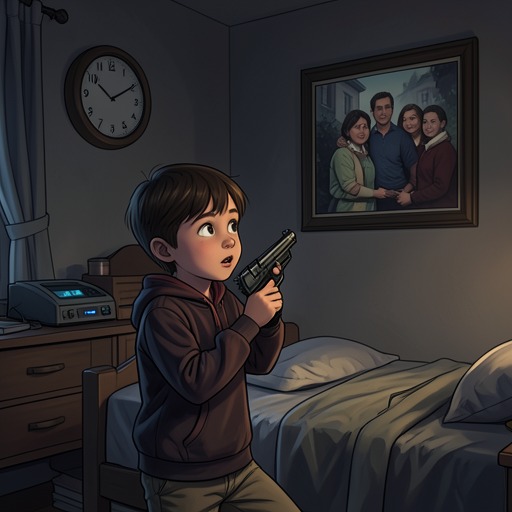
During Christmas break, Austin’s extended family and friends fill the warm, creaky house in Akron where her father grew up. The adults are gathered in the kitchen. Eight-year-old Austin slips upstairs to her grandmother’s room, glad to have the company to herself. Her grandmother lies beneath warm blankets, watching a twenty-inch television with an antenna and a wavering picture. The two talk about the commercials and laugh at the characters on the screen. The small, ordinary scene establishes the contrast that makes the interruption so sharp: upstairs, a child and her grandmother share a quiet moment, while a crisis is building below them.
Dalin has seemed distant to Austin even though he is her first cousin. He is a confident sixteen-year-old boy; she is a shy, self-conscious eight-year-old girl. His family lives in Akron, hers in Toledo, and their lives usually meet only occasionally. The gap between them is therefore not just a matter of age. Before this night, Dalin’s world has largely remained beyond Austin’s direct experience.
The Robbery and the Threat of a Gun
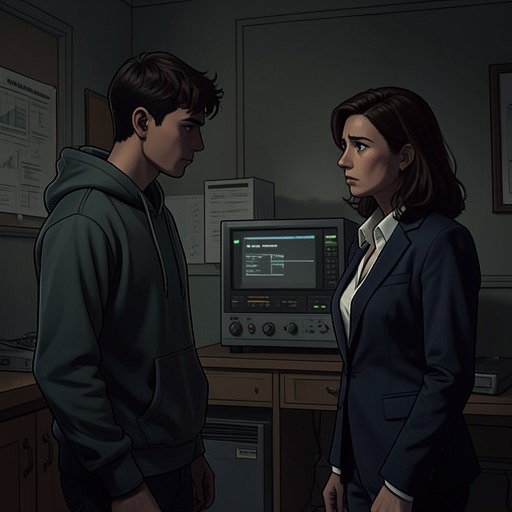
A slammed front door and a burst of shouting break the calm. Dalin’s voice sounds unusually high and frantic; his mother answers at the same heightened pitch. From upstairs, Austin and her grandmother catch only fragments of the argument, but one word is unmistakable: gun. They exchange raised eyebrows and stay where they are. When the yelling stops, footsteps pound up the stairs. Her grandmother turns toward the door before Dalin reaches it and asks what is happening.
The cousin who enters is not the cool, confident teenager Austin expects. Lit by the television, he appears shaken. He cracks his knuckles and says that he was out with friends when someone took his shoes. His grandmother echoes the detail in confusion, asking whether his shoes were taken. Dalin explains that he had just bought a new pair of sneakers. After he and his friends left the store, they were held up at gunpoint. His group carried no weapons, so he had to surrender the bright white shoes. The loss leaves him furious.
His grandmother asks what he plans to do. Dalin answers without hesitation: “I’m looking for a gun to go get my shoes back.” He cracks his knuckles again. The repeated gesture accompanies a response that turns the robbery into a new, immediate danger. The shoes are a concrete loss, and Dalin wants them back; yet Austin understands that the stakes reach beyond the purchase. To her, the desire behind his words is also a wish to restore dignity, safety, and control after a stranger treated his life as less valuable than his possessions.
Austin’s Recognition and Fear
Austin and her grandmother stare at Dalin in horror. She fears that he will go back outside and never come home. His anger and sadness remain together in her memory, as does the possibility that he does not even register her presence in the room. The scene does not say that Dalin obtains a gun or returns for the sneakers; its turning point is Austin’s frightened understanding of what his intention reveals about the conditions around him.
She recognizes that the rules governing Dalin’s life differ from those governing hers. She believes that going to the police is not a viable option for him. In her own world, she would not know where to get a gun or whom she could ask. Dalin’s circumstances have previously been as distant to her as headlines; now she has heard him describe them in person. Austin believes him, fears for him, and wants him to live. The difference between their worlds is made intimate not by an abstract explanation but by the same family room in which a child watches her cousin contemplate an armed response to an armed robbery.
The Scene’s Lasting Echo
Austin later identifies the fear she felt that night as one she came to know well. She connects it to the possibility that her father might not return from work travel through white rural Ohio, that her intellectually gifted brother might be mistaken for a criminal, or that her husband might be mistaken for someone else. As a mother, she fears being unable to protect her little boy once he is no longer hidden within her body, and she fears that the state may violate her own body. These are not further events in the Christmas gathering; they show how the fear first crystallized there broadens across her life.
That fear remains active in the present of her account. As she writes, her husband is visiting his parents and must drive two hours across Michigan in each direction. Austin tries not to imagine him being pulled over and frisked, or his anger rising until his tongue gets the better of him. She also tries not to pass her anxiety to him. The childhood scene thus opens onto a continuing burden: the impulse to anticipate danger for the people she loves, and the effort to keep that anticipation from becoming theirs. Dalin’s threatened search for a gun is never presented as a simple wish for revenge or as an accomplished act. It is the moment Austin sees the unequal exposure to danger that separates their lives—and begins to understand why she is afraid for him.