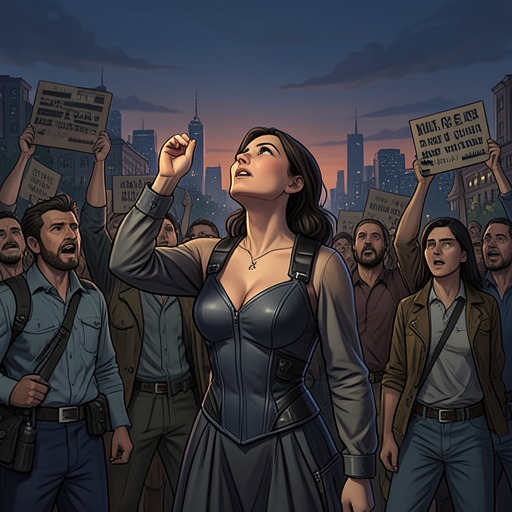
Ferguson Protests and Police Standoff
I'm Still HereFerguson Protests and Police Standoff marks the moment when Austin sees the distance between the history she has studied and the racial present collapse into a scene on her living-room television. Black residents demand accountability for the shooting of an unarmed teenager; police meet them in riot gear, with dogs, tear gas, and tanks. For Austin, the confrontation is not evidence that the past has simply returned unchanged, but a devastating challenge to claims that the United States has moved beyond the structures that made such violence possible.
Historical Expectations and Rupture
Before Ferguson, Austin had already resisted the idea that Barack Obama’s election had ushered in a postracial society. She expected racist signs and offensive caricatures from some white citizens; what she did not expect was the force of the images from Ferguson. The distinction matters: the election could be treated as proof of progress, but it had not dissolved racism or guaranteed safety. Ferguson made that gap visible in a way that abstract assurances could not.
The realization arrives through watching, not through a retrospective lesson in a classroom. Austin recalls an earlier visit to a lynching museum, where the distance between historical atrocity and the present had also narrowed. Ferguson repeats that rupture in a domestic setting: the television brings the confrontation into her home, while the scenes themselves refuse to remain safely confined to a past chapter of American history. What she had learned as history becomes something unfolding before her.
The Standoff on Television
Mainstream media takes time to recognize that news is being made in the suburb of St. Louis. Once cable news begins carrying images nightly, viewers see police facing Black residents as if preparing for war. Officers wear riot gear, hold dogs on leashes, deploy tear gas, and position tanks in front of a McDonald’s. The details sharpen the dissonance: familiar public life and ordinary clothing stand against equipment and tactics associated with military confrontation.
The widened camera view changes the meaning of the scene. If the frame showed only the officers, Austin writes, the images might seem to come from another country, or to depict a force confronting people armed with rifles and body armor. Instead, the people facing police are recognizable as parents, aunts and uncles, cousins, and children, dressed in shorts and T-shirts. They are demanding that an officer be held accountable for shooting an unarmed teenager. The contrast between the residents’ appearance and the force arrayed against them exposes the gulf between the public’s demand and the state’s response.
History Reappearing in the Present
Austin cannot ignore the parallels between the televised confrontation and photographs in her history book. The comparison does not depend on the events being identical. It rests on the visible continuity between racialized state force in the past and the spectacle of Black residents treated as enemies in the present. The scene makes a simple story of national progress inadequate: changes in equipment do not, by themselves, demonstrate a change in the underlying treatment of Black people.
By the time of the rise of the Black Lives Matter movement, Austin already knows the argument that racism did not disappear but evolved. Yet, watching Ferguson, she finds even that formulation insufficient. The images seem less like a wholly transformed racism than a familiar confrontation carried out with newer weapons: where Black people were once confronted on horseback with nightsticks, police now arrive in tanks with automatic rifles strapped to their backs. The comparison makes technological change an unsettling measure of continuity, not proof that the historical pattern has ended.
Personal Recognition and Structural Critique
Austin describes herself as frustrated and sad, but also as struck by how familiar the scene feels. She imagines not only her own recognition but her parents’ and grandparents’ as well: the confrontation appears to belong to an experience repeated across generations. That sense of recurrence makes Ferguson more than a shocking television report. It becomes a present-tense encounter with a history that many Americans would prefer to regard as completed.
Elsewhere, Austin explains why accounts of individual incidents must be connected to systems. In workplaces, she describes how organizations may invite reports of racism and then minimize them, redirecting attention from patterns in white leadership and culture toward supposedly isolated bad actors. Her account of Ferguson belongs to the same broader insistence on looking beyond an individual explanation. In her analysis of American history, telling the truth means tracing white supremacy through institutions, including housing, education, health, and criminal justice, rather than treating racism as a collection of disconnected episodes.
Significance and Unresolved Demand
Ferguson also clarifies why Austin distrusts the demand that Black people express gratitude for how far the country has come. In trainings about American history, she sees white participants seeking affirmation of progress; the images from Ferguson make that reassuring placement of hope untenable for her. The standoff does not settle every question about the nation’s history, but it gives her a concrete reason not to mistake a celebratory narrative for justice.
Her later argument about racial reconciliation distinguishes conversation from action. Dialogue can help only when it leads to action, changes the distribution of power, and pursues justice for marginalized people; listening to pain cannot be the endpoint. Read alongside that argument, the residents’ demand for accountability is not merely a striking image for television. It names a claim that requires a response. Austin’s account leaves the scene unresolved, preserving the pressure of the question the images raise: whether the country will confront the structures they expose, or continue to call the distance between past and present progress.