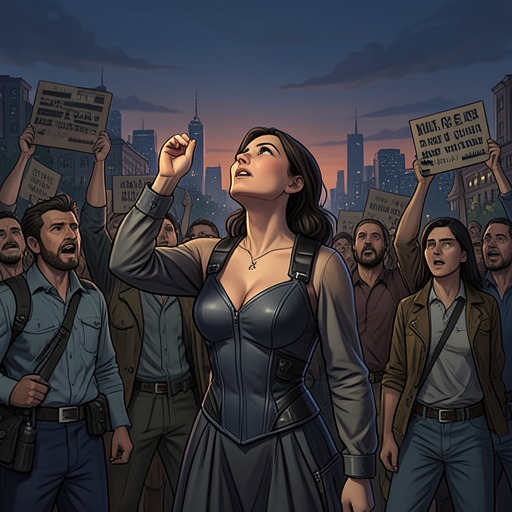
The rise of the Black Lives Matter movement
I'm Still HereThe rise of the Black Lives Matter movement marks a period when the persistence of anti-Black violence became newly visible to Austin through both public events and her own family history. The movement, launched by three Black women to address the needs of Black America, gives the era its public language; Austin’s account insists that its urgency also lies in the lives of people whose names do not become national symbols. She sees contemporary racism not as a vanished past returning, but as power repeatedly reorganized around Black life.
A public movement and a personal question
Austin recalls that many people came to know the names Trayvon Martin, Eric Garner, and Michael Brown through the movement. For her, however, the question of whether every Black life mattered had already been made personal by her cousin Dalin. His death became a distinct point of entry into the larger crisis: the public names could represent a movement, but they did not exhaust the particular grief and family ties through which Austin understood its stakes.
The contrast shapes how she locates herself in the era. The movement gives public force to demands for justice, while Dalin’s place in her life makes those demands intimate. Austin’s account therefore resists treating the movement only as a sequence of widely reported cases. Its meaning is also measured in the relatives, neighbors, and children whom Black communities recognize in the people exposed to violence.
Ferguson and the appearance of continuity
Ferguson sharpened this historical understanding. By the time the era had begun, Austin was familiar with the argument that racism had not disappeared but evolved. Watching Black residents confronted by police, however, she felt that evolution did not adequately describe what she saw. Police appeared in tanks, with automatic rifles, facing residents protesting the shooting of an unarmed teenager. When the images reached television, the militarized confrontation seemed less like a wholly new form of power than a present-day version of violence already documented in the nation’s past.
The lag between the events and their national visibility mattered: Ferguson residents knew that news was unfolding before the mainstream media caught up and cable coverage brought the scenes into homes. Austin recognized the people facing police as parents, aunts and uncles, cousins, and children. That recognition unsettled the distance a viewer might otherwise keep from the confrontation. The images recalled history-book photographs, and Austin felt that she, her parents, and her grandparents had encountered versions of this history before.
The historical record beneath the present
Austin places contemporary events against a longer account of slavery, racial segregation, and mass incarceration. She argues that these systems were purposeful, while familiar national narratives soften their origins with comforting myths and incomplete timelines. Her account calls attention to the Middle Passage, the wealth created through enslaved labor in both the South and the North, and generations who were born enslaved and died without freedom on American soil.
She also rejects accounts of the Civil War that substitute states’ rights for slavery, and accounts of the rise of Jim Crow that reduce it to segregated signs and water fountains. Jim Crow meant economic deprivation, the loss of property, limited legal recourse, mob violence, burned homes, bombed churches and businesses, and lynching. The era’s violence shaped ordinary life by forcing Black families to measure their steps under threat.
The same demand for a fuller record extends to the U.S. Civil Rights Movement. Austin describes victories as inseparable from the opposition they faced: assaults, threats, clubs, dogs, bombs, guns, arrests, and the efforts to deny Black Americans access to lunch counters, integrated classrooms, and the vote. She challenges the comforting story that white opposition simply disappeared after celebrated speeches or that segregation’s defenders were all transformed. For her, the rise of the Black Lives Matter movement belongs to this history of struggle, not to a clean break from it.
Race, voice, and the burden of being believed
The period also clarifies how racial power works beyond highly visible confrontations. In predominantly white classrooms, Austin had to decide whether to reproduce a textbook’s account of Christopher Columbus or qualify it by noting that the land he supposedly discovered was already inhabited. She sometimes gave the answer a teacher expected with a disclaimer, and sometimes chose to affirm Black history even when doing so could cost her part of a letter grade. These choices show that historical interpretation is not abstract: it can place a student’s grade and sense of self on opposing sides.
The same unequal burden appears when Austin reads Paul Laurence Dunbar’s poem about a mask in an all-white class. She folds herself into her chair, unwilling to be made the classroom’s representative for Black experience. Her silence is a choice about access to a vulnerable part of herself, not evidence that she has nothing to say. Her teacher does not call on her; instead, he guides the white students through the discussion and earns her trust by not making her responsible for teaching the room.
Later, Austin describes professional settings in which Black women’s accounts of racism are questioned, minimized, or denied. After an interview where colleagues had expected a white man, she recognizes that the unstated test is whether she will fit a white organizational culture. When she reports biased treatment, she may be urged to assume good intentions, show patience, or focus on individual offenders rather than structures. In response, Black women share practical protections: helping one another draft scrutinized emails, keeping praise as a record of their work, finding trusted colleagues, and using private online groups to process microaggressions. These strategies do not eliminate the pressure, but they make mutual support part of surviving it.
Hope as continued work
For Austin, the movement’s historical setting does not promise that change will arrive soon. She doubts that she, her children, or her grandchildren will live in an America that has achieved racial equality. She points to present-day police violence and racial disparities, backlash against political correctness, hostility toward the country’s first Black president, the weakening of voting protections, and a chief executive who stoked racial animosity. These conditions make hope neither an easy confidence in progress nor a reason to withdraw.
Austin calls the alternative a shadow of hope: continuing to show up without knowing whether the work will succeed. It means speaking, writing, loving, and returning to the work after disappointment, even when words seem too small to change the whole structure. In this account, the rise of the Black Lives Matter movement names a period of public resistance, but its significance rests just as much on the persistence that continues beyond any single protest or lifetime: the insistence that Black lives matter, and that work toward a world not yet seen remains worth doing.