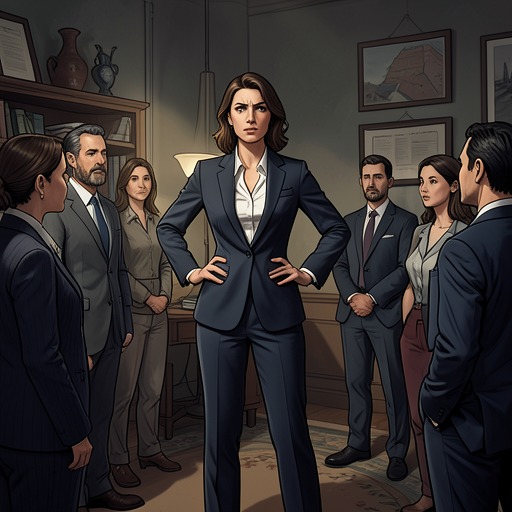
Zach Racially Insults Austin
I'm Still HereZach’s racial insult of Austin is a childhood encounter in which an apparently ordinary school line becomes a site of racial hostility. When Zach turns and directs a slur at her, Austin’s confusion gives way to anger; she answers rather than remaining silent. The scene becomes an early point of recognition: racism is not confined to the distant history taught at school, and her response to it does not need to be excused.
Setting and Immediate Provocation
The incident takes place when Austin is in fourth grade, as classmates line up to leave for gym, art, or music. She stands toward the back. Zach, a short white boy in front of her, mumbles something about monkeys and bananas without looking at anyone in particular. Austin does not immediately understand the reference. She asks what he means and scans the classroom bulletin boards, looking for a reason he might be talking about monkeys.
Zach then turns all the way around and looks directly up into Austin’s eyes before using a racial slur. The change from an oblique remark to direct address makes the target unmistakable. In Austin’s recollection, the line stops being an ordinary transition between classes: the twelve children ahead of Zach disappear from her awareness as her attention fixes on him.
Austin’s Response
Austin describes a physical jolt: her eyes narrow and her stomach lurches. She had thought of herself as a nice child who got along with her classmates, but the encounter brings her close to surprising herself. She does not remember the exact words she used in reply. She does remember that she was not silent, and that her response was harsh enough that Zach never tried the same thing again.
The account preserves a limit in what Austin can recall while remaining clear about the consequence. The precise retort is lost, but her refusal to let the insult pass is not. The scene does not present her anger as a failure of civility; it marks that anger as a response to being deliberately demeaned. Her memory of the event centers less on a polished comeback than on the fact that she answered and the behavior stopped.
What Austin Knew—and Did Not Know
Austin’s parents had not sat her down to explain what she should do if a white person called her that word, and she was too young at the time to know its history. She distinguishes that missing explanation from a broader absence of preparation: although she never received a specific lesson about the slur, her parents had given her many other examples of ways a white person might challenge or mistreat her. The encounter therefore arrives before Austin can fully name the word’s historical weight, but not in a life untouched by parental warnings about race.
That distinction gives the memory its force. Austin does not claim that a fourth grader already possessed a complete analysis of racism. She recalls knowing something more immediate: her anger was justified. Her later reflections repeatedly connect personal incidents to systems that make racial harm seem exceptional or debatable. In one later account of workplace racism, she describes people redirecting attention from institutional patterns to isolated “bad apples,” and treating her reports as evidence that she is divisive, negative, or toxic. The childhood scene offers an early contrast: Austin’s response is not silence, even when she does not yet have the vocabulary to explain the structures behind the insult.
From the Classroom to a Wider History
Austin places the incident against the teaching she encountered in her predominantly white school. There, students were expected to learn the names of Rosa Parks and Martin Luther King Jr., feel grateful for integrated classrooms, and move on. That rehearsed account of racial progress left little room for what it meant to be a Black student among white classmates. The insult punctures the distance between the school’s history lessons and the racism present in its own daily life.
Later, Austin describes having to assert her agency over an education organized around a white worldview. For reports and book assignments, she chose Black history and Black authors; when a textbook presented Christopher Columbus as having discovered America, she sometimes added that the land was already inhabited or attributed the claim specifically to the textbook. These later choices do not establish that the fourth-grade encounter alone caused her resistance. They do show a recurring pattern in her account: she faces pressure to accept the version of events preferred by white institutions, and chooses, at times at the cost of a better grade, to state what she believes is true.
The book eventually makes that pattern an argument about history and power. Austin writes that an honest account of the nation would have to name white supremacy and its control of Black lives, rather than treating racism as a closed chapter or a collection of individual mistakes. She also argues that conversations about racial harm matter only when they lead to action and justice, rather than ending with the act of listening. Zach’s insult is a small, sharply bounded scene, not a complete account of that history. Its significance lies in how plainly it exposes the gap between a school’s story of racial harmony and the lived experience that story leaves out.