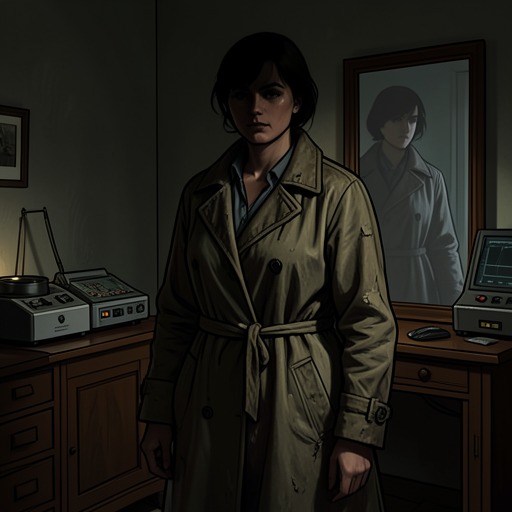
Childhood Photo in the Farmhouse
I'm Thinking of Ending ThingsThe Childhood Photo in the Farmhouse is a displayed black-and-white image whose identification unsettles both Jake and the narrator. Jake insists that the small child pictured is him; the narrator first rejects that claim, then looks more closely and recognizes a resemblance not to Jake but to herself. The photograph’s importance lies in this unresolved collision of testimony and perception: what appears to be a family image becomes a troubling question about who the child is and how either person can know.
Appearance and Setting
The photograph is already on display when Jake and the narrator discuss it. Its presence prompts a comment that the woman associated with it had problems that affected everyone, and that the story was sad; the speaker also questions why the photograph is still kept up. The narrator wants to ask more about the woman but does not. The image is therefore introduced amid an account of pain and reticence, though the excerpt does not establish the woman’s identity or explain her circumstances.
The child in the picture appears to be a toddler, perhaps three or four years old. The child is barefoot on a dirt road beside a tricycle, with long hair and a glare directed at the camera. These concrete details make the image seem particular and legible, but they do not settle who is pictured. Its black-and-white format becomes part of the disagreement: the narrator takes the photograph’s apparent age as evidence against Jake’s claim, while Jake attributes that impression to the image’s monochrome appearance.
The Disputed Identification
Asked who the child is, the narrator answers that she does not know and challenges how she could be expected to know. Jake responds, “It’s me.” The statement is direct, but it does not persuade the narrator. She leans closer, says the photograph is too old to show him, and rejects the identification as impossible. Jake repeats that the child is him, explaining that the photograph only seems so old because it is black-and-white.
The exchange places two incompatible readings of the same object side by side. Jake supplies a confident personal identification; the narrator brings visual comparison and doubt. Neither the exchange nor the photograph, as described here, provides an independent confirmation. The distinction matters: Jake’s assertion is a fact about what he claims, not proof that the pictured child is him. The narrator’s response likewise develops from disbelief into a perception that unsettles her, rather than resolving the image’s identity.
The Narrator’s Recognition
Looking more closely, the narrator notices the child’s appearance and feels a twinge in her stomach. She thinks the figure does not look like Jake at all. Her perception sharpens in stages: the child looks like a little girl, and, more precisely, looks like the narrator herself. The shift from rejecting Jake’s identification to recognizing her own likeness is the photograph’s decisive effect in the scene. Closer inspection does not clarify the image; it makes the discrepancy more intimate.
The description preserves the difference between what the narrator sees and what Jake says. The child’s long hair and small figure may inform her impression, but the account does not establish why she sees herself in the image or whether the resemblance is literal. Her bodily reaction registers the encounter as more than a casual mistake, while the carefully revised comparison—from not Jake, to a little girl, to herself—shows recognition forming in real time. The photograph remains both a physical record and a surface onto which the two characters arrive at sharply different identifications.
Narrative Significance
The photograph converts an ordinary act of looking into an unstable encounter with identity. It is not merely described from a distance: the narrator first asks who the child is, disputes Jake’s answer, then leans in and examines the details. That slowed sequence makes the reader follow her changing judgment rather than receive a settled explanation. The object’s familiar function as a record of childhood is consequently disturbed; here, it prompts competing claims instead of securing a shared memory.
The scene also leaves its central uncertainty intact. Jake does not withdraw his identification, and the narrator does not accept it; her final perception is that the child resembles her. No later clarification is supplied in this evidence. The photograph’s force therefore comes from the gap between what Jake recognizes and what the narrator sees, and from the possibility—kept unresolved—that an image may seem to return a person’s own likeness from someone else’s past.