Custodian's Room
I'm Thinking of Ending ThingsThe Custodian's Room is a cramped, utilitarian space in the school that turns the building’s ordinary back-room life into something intimate and uncanny. Its silver bucket, damp floor, table, photographs, and child’s shirt first make it a place of discovery; its coffin-like closet and wire hangers later frame the story’s final return. The room matters not only for what it contains, but for how its objects collapse the distance between the school, the custodian, and the narrator’s past.
Layout and Material Details
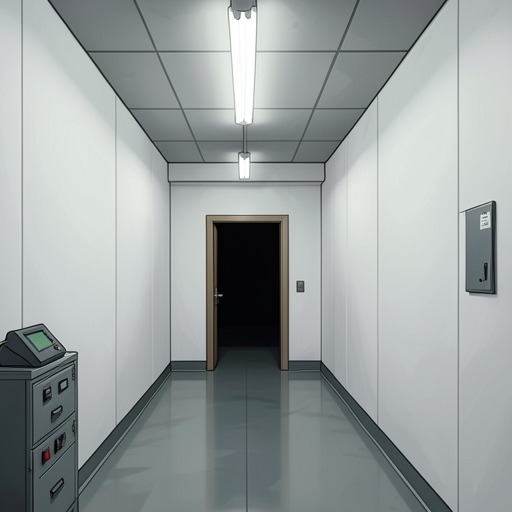
The narrator finds the room through an open, windowless wooden door in a hallway of lockers. It feels familiar before its contents are understood, as though the narrator already knows how it will look. The room is more like a large closet than a conventional office: dingy and mostly empty, with a calendar taped to the far wall and a drain set into the middle of the concrete floor. The floor looks wet. A silver bucket on four wheels holds grayish water, but there is no mop beside it.
At the back, a wooden table stands against the wall. Nearby is a tall, plain closet that strikes the narrator as a coffin standing upright. The table holds a dirty coffee cup, one set of silverware, a plate, and papers; a white microwave sits on a desk. These details suggest a space arranged for basic work and routine, but the sparse, almost makeshift domestic objects give it a different scale from the public school outside. The room is neither fully workplace nor fully home. Its drain, bucket, and table bind practical maintenance to an unexpectedly personal interior.
Photographs and the Childhood Shirt
Photographs on the wall deepen the room’s association with a private life. One shows a stiff, unsmiling older man and a gray-haired woman, so alike in appearance that the narrator wonders whether they might be siblings rather than a couple. Other pictures show a man who seems unaware of the camera, or reluctant to be photographed. In one he sits at a desk, leaning away and covering his face with his left hand; in the pictures, the top of his head is cut off. Their blotchy, faded quality makes them feel less like formal portraits than incomplete glimpses. The narrator recognizes the man as the figure Jake and the narrator have seen at the school, and finds his sad eyes familiar.
The most consequential object lies on the desk: a soft piece of cloth first mistaken for a rag. Unfolded, it proves to be a small light-blue shirt with white polka dots, a ripped sleeve, and a tiny paint stain down the back. The narrator recognizes it as the same kind of shirt worn in childhood and then insists that this very shirt was theirs, even while confronting the impossibility of finding it in the room. The detail changes the room from an unsettling custodian’s space into a point of contact with the narrator’s own history. A small video camera, wired to the back of a television, sits on the other side of the desk; the shirt and camera together make the room’s stored objects feel less like neutral equipment than evidence whose meaning remains troublingly uncertain.
The Room Within the School's Trap
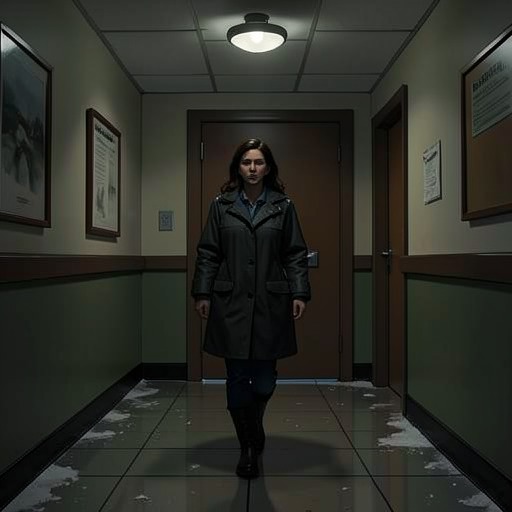
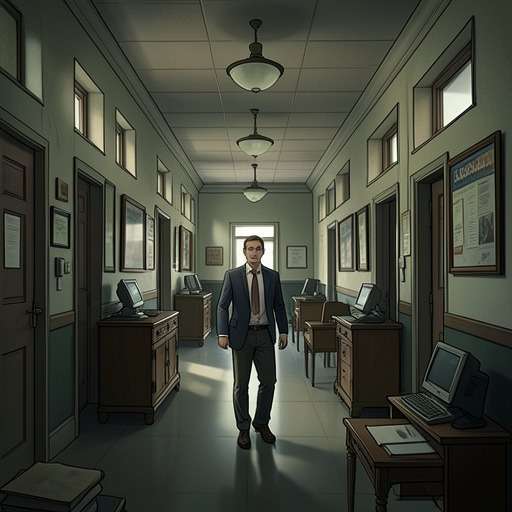
The narrator discovers the room while searching a school that has become a maze. The entrance that had been open is chained and locked from the inside; Jake’s pickup disappears, and slow footsteps in rubber boots send the narrator fleeing through the halls. Other doors are locked, and the repeated corridors frustrate any clear route out. Against that movement through a building that offers no reliable escape, the Custodian's Room is a place where the narrator can pause and examine things—but what it reveals increases rather than relieves the danger.
The school’s change from a place associated with learning and a future to something that feels like a prison gives the room a particular force. It is not itself described as the point where the narrator is first trapped, but its workaday furnishings belong to the same building whose doors, corridors, and sounds now govern movement. Later, music begins again during the narrator’s flight through the school. The country song “Hey, Good Lookin’” has already played on the drive with Jake, and, in the school, it repeats after a brief pause until the narrator begins to cry. When the story returns to the Custodian's Room, music again starts from the beginning, louder. Repetition makes sound, like the room’s objects, part of a pattern that leads back rather than forward.
Return and Final Significance
At the end, the narration returns to the Custodian's Room as if arrival there were inevitable. The voice shifts into the plural, describing a passage past school spaces such as the woodworking and auto classrooms, the Dance Studio, Student Council, and the drama department. None of those doors is tried. After years of passing them, the speakers say, even the dust is familiar; the Custodian's Room, by contrast, is theirs and where they are meant to be. The return turns the room into more than a location on a route: it becomes the place where the narration confronts the limits of imagined escape and the weight of what has already happened.
The closet that earlier looked like an upright coffin returns as a place of action. The empty wire hangers are pushed aside, and the speakers step inside, saying that it is hard to breathe and that they will stay there until the time comes. Later, Jake puts a metal hanger into the narrator’s hand and says, “I’m thinking of ending things.” The narrator straightens it and bends it in half so that both pointed ends face the same direction, then apologizes. The room’s ordinary object has become part of a decisive, dangerous act, while the closet concentrates the story’s images of confinement and return. Its significance rests in that unsettling transformation: the space first exposes a personal past through a child’s shirt, then becomes the place where the characters’ identities and endings converge.