Dinner and the Imitation Game at Jake's House
I'm Thinking of Ending ThingsDinner at Jake's Parents' Farm turns a family welcome into an unsettling test of how well two people can reproduce one another. Jake's mother invites The narrator to imitate Jake; Jake then answers by imitating The narrator with exact gestures as well as voice. What begins as a game for passing time becomes a scene about intimacy, observation, and the unease of seeing one person's mannerisms taken up by another.
Arrival and the family table
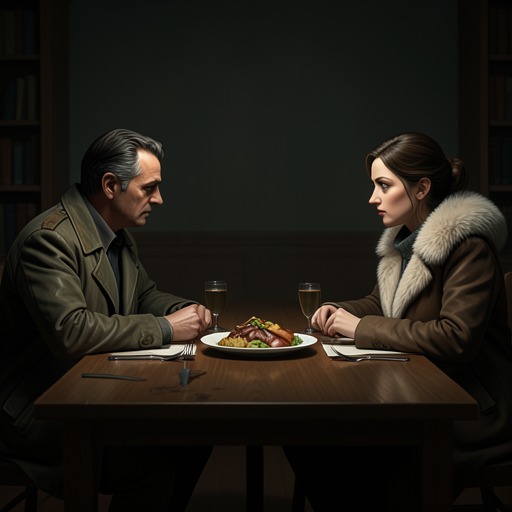
The narrator has arrived expecting to meet Jake's mother and Jake's father, but the meal is already set before they appear. After noticing shuffling in another room, The narrator serves a warm dinner roll and catches herself as the only person who has begun eating: Jake is sitting quietly, while she is ravenous after skipping lunch in preparation. Her attention is also divided by a headache and a metallic taste that has been troubling her for several days, especially when she eats fruit and vegetables. The bodily discomfort and hunger make the table feel immediate, even as the expected introductions are delayed.
Jake's mother and Jake's father enter together, one behind the other. The narrator stands to greet them, but Jake's father gestures for her to sit and welcomes her. Jake's mother says she hopes The narrator is hungry and that they are glad she is there. The introductions are brief and informal: there are no handshakes or extended courtesies, and the four of them are suddenly seated together. Jake's father strikes The narrator as reserved, almost standoffish, while Jake's mother smiles continuously. Neither seems physically like Jake to The narrator.
The narrator's close attention to Jake's mother gives the welcome a more complicated texture. She wears heavy makeup, inky-black dyed hair, powdered-white skin, and varnished red lips; her appearance unsettles The narrator, who would not say so to Jake. Her short-sleeved blue velvet dress, edged with frilly white lace, looks both outdated and too formal for a simple winter dinner. She is barefoot. When The narrator catches a glimpse under the table, she notices that Jake's mother's right big toe is missing its nail, while her other toenails are painted red. These precise details sit beside the mother's repeated assurances of welcome, making the warmth of the meal coexist with The narrator's watchful discomfort.
The game is proposed
The narrator's appetite fades as she turns back to her plate. Jake has already finished his meal; she is still working through rare meat, pink and oozy inside, with traces of juice and blood on the plate, while the jellied salad remains untouched. Against this intimate, slightly disquieting dinner, Jake's mother tells The narrator that Jake rarely brings girlfriends around and says it is good to have her there. Jake's father agrees that the house is too quiet when the family is alone, then trails off before Jake's mother takes over the conversation with an idea.
She explains that the family used to play games to pass the time, and proposes a favorite: The narrator should do Jake. The narrator checks that she means impersonating him. Jake's mother confirms that the performance should include his voice and the way he talks, and says it will be fun. Jake's father endorses the idea, while Jake looks at The narrator and then down at his empty plate, holding his fork above it. The invitation is presented as recreation and welcome, but its terms put The narrator on display before Jake's family.
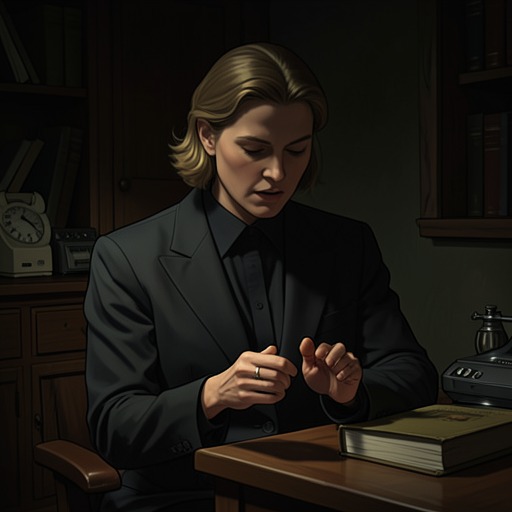
The narrator does not feel comfortable imitating Jake in front of his mother and father. She also does not want to disappoint them, so she stalls and then goes along. As they wait and stare at her, she clears her throat and deepens her voice. Her imitation begins with a line about Jake's interests: “Hello, I’m Jake,” followed by “Biochemistry has many virtues; so, too, do literature and philosophy.” Jake's father smiles and nods; Jake's mother grins. The narrator is embarrassed and does not want to continue the game, though Jake's father compliments the attempt and Jake's mother says she knew The narrator would be good because she knows Jake “inside and out.”
Jake imitates The narrator
Jake then says he will take a turn. The decision stands out because he has been quiet and, as The narrator notes, does not like games. His participation changes the direction of the scene: the person who was being imitated becomes the imitator, and The narrator becomes the subject of his performance. The exchange makes the game reciprocal, but not equally comfortable. The narrator's imitation was hesitant and prompted by the family's attention; Jake's is delivered with a precision that makes the room's entertainment feel different.
Jake uses a voice slightly higher than his own, without pushing it into comic exaggeration. More strikingly, he reproduces small gestures and facial expressions, including brushing invisible hair behind an ear. The narrator describes the result as accurate, startling, and off-putting: Jake is not making a gag out of her, but taking the imitation seriously. The performance seems less like a joke than an exact demonstration of how closely he has watched her. Where the family had praised The narrator for knowing Jake, Jake's enactment makes that claim reciprocal in a way that unsettles her.
Jake's mother and Jake's father watch wide-eyed and enjoy the performance. When Jake finishes, a pause gives way to his father's laughter, and Jake's mother doubles over laughing too. Jake himself does not laugh. The difference between the family's amusement and Jake's seriousness leaves the scene unresolved: his imitation has succeeded as entertainment for them, but The narrator experiences it as unpleasant, and Jake offers no matching laugh to soften its precision.
Interruption and significance
A phone rings from another room. It is not The narrator's phone this time but the farm's landline, sounding sharply during the aftermath of the performance. Jake's mother waits until the third ring, then says she had better answer it and leaves the table chuckling. The call breaks up the gathering without explaining what the game or Jake's imitation means to him. Instead, the scene ends with a contrast: laughter continues as Jake's mother departs, while Jake has not laughed and The narrator has just witnessed herself reproduced in gestures she recognizes as her own.
The imitation game condenses the dinner's central tension between being welcomed and being scrutinized. Jake's mother frames the activity as a familiar way to pass the time and as proof of closeness; The narrator's discomfort and Jake's unsettling accuracy complicate that easy framing. Their performances make knowledge visible, but not uncomplicated: to know someone well enough to mimic them can be affectionate, comic, or unnerving, depending on how the imitation is carried out and received. The interruption supplies no resolution, leaving the mismatch between the family's delight and the performers' different degrees of ease hanging over the table.