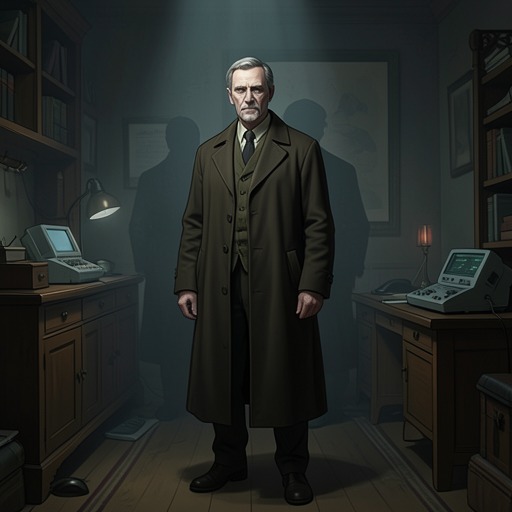
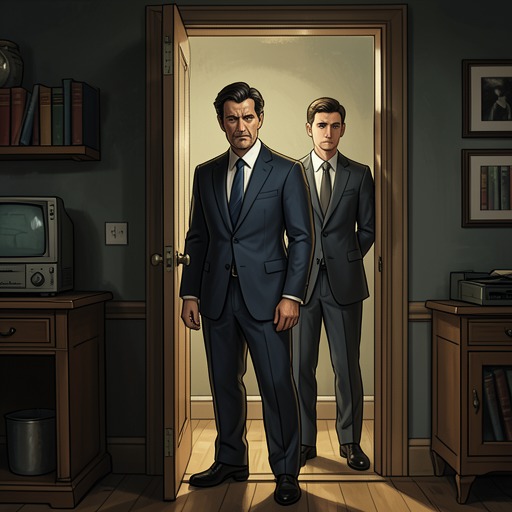
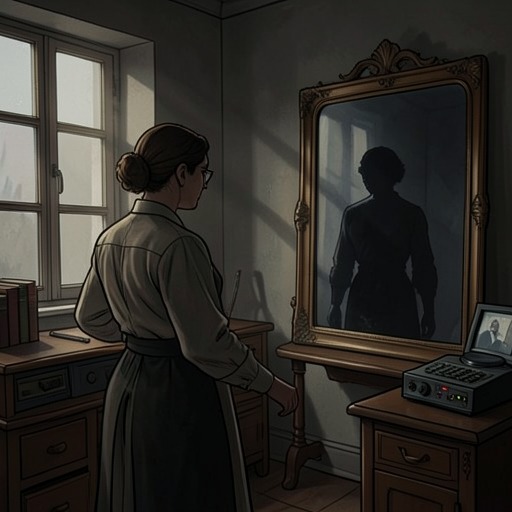
Jake’s older brother’s mental health crisis
I'm Thinking of Ending ThingsJake's account of Jake's brother's mental health crisis first presents it as a family struggle with an isolated, gifted man; the ending reveals that the brother never existed and that Jake was the troubled person. The account's reversal changes the meaning of its details: what seemed like a disclosure about a relative becomes a displaced description of Jake's own crisis, and a story about being cut off from others becomes part of the narrator's belated recognition of his loneliness.
The Account Jake Gives
While driving with the narrator, Jake explains that Jake's brother began having problems several years earlier. The family initially thought little of them, in part because he had always been solitary and unable to relate to other people. They assumed he was depressed. His behavior became harder to dismiss when he began following Jake. Jake says the following was not dangerous, but it was strange, and Jake's brother continued after being asked to stop. Jake describes himself as having had little recourse beyond cutting his brother out of his life and blocking him out.
Jake frames Jake's brother as capable of caring for himself and not, in his view, seriously or dangerously mentally ill. He also believes his brother could be rehabilitated. These qualifications sit uneasily beside the severity of the isolation he describes: Jake's brother was deeply unhappy, needed things Jake could not provide, and became very sad and lonely. Jake says the crisis changed the family dynamic, even as he insists that it is no longer a major issue and is over.
Work, Isolation, and Escalation
The account gives Jake's brother a professional life that makes his social difficulty concrete. He had been on track to become a full professor, but could not manage the workplace environment and had to leave his work. Jake distinguishes ability to do the job from the demands surrounding it: presentations and interaction with coworkers, including ordinary small talk, became too difficult. Jake's brother liked people, according to Jake, but faced a wave of anxiety at the prospect of speaking with them. The problem is therefore not described simply as dislike or lack of interest; the account stresses the gap between wanting connection and being unable to manage its everyday forms.
After leaving that work, Jake's brother needed a new job where he could avoid presentations and blend into the walls. Jake places this change in employment alongside a worsening period in his brother's life. During that time, Jake says, Jake's brother followed him, talked to him, and issued orders and ultimatums. Jake likens the presence to a voice in his head and describes it as a subtle sabotage of his life. The account does not specify the content of the orders or give a diagnosis; its emphasis falls on the persistent intrusion and the way it interferes with Jake's life.
A particularly striking detail is that Jake's brother began wearing Jake's clothes. Jake presents this as another sign of his brother's problems, then quickly qualifies it by saying the condition was not permanent and that his brother was better now. The clothes make the disturbance intimate and visible: the account's broader language of following and intrusion takes on a material form in the appropriation of Jake's own things. In the final revelation, that detail also acquires a different resonance, though the text does not separately explain it.
Family Strain and Claimed Recovery
Jake says he and Jake's brother had never been especially close, though they got along. Both were smart and competitive, qualities Jake describes as creating a bond between them. He had not anticipated his brother's illness, and the change makes him question whether anyone can truly know another person, even a sibling. The narrator responds with sympathy, and Jake agrees that the situation must have been difficult for everyone.
The conversation also links the supposed crisis to Jake's mother. Jake tells the narrator that she pulls out her hair, has lost most of her eyebrows and eyelashes, and has begun pulling hair from her head; he adds that Jake's brother had Trichotillomania too. Jake says his mother is fragile and that he had not realized the problem had become so serious. He regrets inviting the narrator without understanding how tense the evening would be, but says he wanted the narrator to see where he came from. The shared condition and the family's distress initially make the account seem to explain the strain of the visit. The ending, however, destabilizes the family history Jake has narrated, so these details cannot simply be treated as an independently verified medical record.
The Revelation That Reverses the Story
Near the end, the narrator recognizes that the school custodian was Jake, who had staged the pursuit to bring the narrator into the school. The narrator then recalls Jake's shoes in the locker room: he had taken them off and put on rubber boots. The apparent man following them was Jake himself. In the same passage of recognition, the narrator reconsiders the story about Jake's brother. It was made up; Jake, not a brother, was the troubled one. There was no brother, although, in the narrator's words, there should have been.
The revelation also overturns the family account. The narrator realizes that Jake's parents had died long ago, despite the earlier narrative of a visit and family dinner. The story had made the narrator feel newly able to understand Jake and his family, but that understanding rested on a history the ending exposes as fictional. The brother's reported illness is thus not a separate character arc confirmed by later events. It is a story Jake told, and the narrator's final reconstruction identifies Jake as the person at its center.
The narrator connects this disclosure to Jake's statement that a thought can be closer to truth than an action and cannot be faked. Jake knew that the narrator was considering ending things, although the narrator had not told him. The narrator understands Jake as knowing and fearing that decision, and as not wanting to be alone. The account of a brother who followed Jake and intruded on his life consequently returns in altered form: the person described as an unbearable presence is revealed as Jake, whose own isolation and need for company had been hidden behind the invented kinship.
Isolation and Narrative Significance
The crisis story gains force from the tension between connection and incapacity. Jake's brother, as first described, likes people but cannot bear ordinary conversation; he needs help but asks Jake for things Jake cannot give; and Jake responds by withdrawing from him. The ending transfers that pattern into the story of Jake and the narrator. It does not establish that every detail attributed to Jake's brother maps one-to-one onto Jake, but it makes the brother narrative a structure through which Jake's distress and isolation can be approached indirectly.
That structure also complicates any single explanation of the crisis. Jake calls his brother unhappy, lonely, and potentially rehabilitatable, while describing how difficult it was to remain involved with him. The narrator's final reflections widen the concern beyond one family's presumed illness: endurance, the narrator concludes, depends on closeness with others, and life becomes a struggle of mere endurance when a person is alone. In that light, the fabricated brother story is not just a concealed fact about Jake. It is part of the novel's larger examination of how isolation can make a person hard to reach, how a story can disguise as well as disclose suffering, and how the absence of help bears on the question of whether to continue.