Jake’s relationship with his younger brother
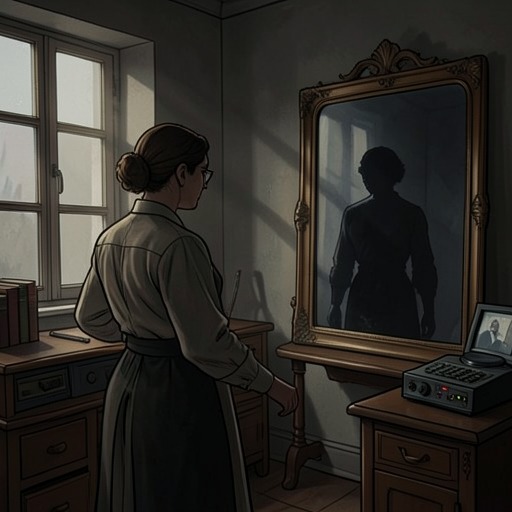
I'm Thinking of Ending ThingsJake’s relationship with his younger brother emerges as a history of ordinary sibling connection overtaken by estrangement, distress, and uncertainty. Jake describes a brother who was profoundly solitary and increasingly unable to manage social contact, then began following Jake and intruding on his life. Though Jake says he had to cut him off, he also insists that his brother is not dangerous and can recover. The account matters not only as family history: Jake’s final doubt that he ever truly knew his brother turns the story of their separation into a question about how much intimacy guarantees understanding.
Disclosure and Earlier Closeness
The relationship enters the conversation indirectly. Looking at photographs, the narrator notices a man in an image and cannot bring themself to ask about him. Jake eventually says that the man is probably his brother, whom he thinks he remembers appearing in one of the pictures. The revelation surprises the narrator, who had not known Jake had a brother. Their exchange makes the omission itself part of the relationship’s history: a major family connection has remained outside what Jake has told the narrator.
Asked whether the brothers are close, Jake does not claim affection or outright hostility. He says they were never especially close, but that they got along. Both were smart and competitive, qualities he thinks created a bond between them. That description preserves a distinction between compatibility and intimacy. The brothers shared traits and could live alongside one another, yet Jake’s account does not portray them as confidants. In retrospect, this limited closeness makes the later rupture harder to interpret: Jake says he never saw the crisis coming, despite being the person his brother would later follow.
The Brother’s Isolation and Crisis
Jake places the change a few years earlier. His brother had always been extremely solitary and struggled to relate to other people; the family initially thought he was depressed and did not believe the problems were serious. The brother later began following Jake. Jake says the behavior was odd rather than immediately dangerous, and that he asked his brother to stop without success. With no clear recourse, he felt he had to cut his brother out of his life and block him out. He stresses that his brother could take care of himself and that he did not consider him dangerously mentally ill, even while describing the situation as a serious disruption.
The brother’s difficulties also affected his work. He was on track to become a full professor, according to Jake, and could do the work itself; what he could not handle was the social environment around it. The prospect of interacting with coworkers brought on anxiety at the start of each day. Jake emphasizes the painful contradiction that his brother liked people but could not manage speaking with them, including the ordinary small talk expected in workplace life. His brother needed another way to earn a living, in a job without presentations where he could blend into the walls. Jake links this period of vulnerability to the brother’s pursuit of him, but does not explain precisely how one led to the other.
Intrusion and Separation
Jake describes the pursuit as more than physical proximity. His brother spoke to him, issued orders and ultimatums, and was always present in Jake’s mind like a voice. Jake characterizes the effect as sabotage: subtle interruptions to his life rather than a single dramatic act. One concrete boundary-crossing was that his brother began wearing Jake’s clothes. When the narrator asks about it, Jake repeats that his brother had issues, then shifts into insisting that they are past and that he is better now. The clothes make the brothers’ separation tangible: the brother’s intrusion reaches into Jake’s personal belongings, while Jake’s account repeatedly tries to establish distance between them.
As Jake recounts the episode, the car’s speed increases. The narrator notices that he seems not to realize how fast he is going; when the narrator continues asking about the brother, Jake turns up the radio slightly, although they are still talking. These details do not establish a new fact about the brother, but they show the difficulty of keeping the subject open between them. Jake supplies intimate information, then resists further probing, saying that his brother is no longer around and that the matter is over. The conversation’s movement between disclosure and deflection mirrors the relationship Jake describes: contact occurs, but sustained closeness remains difficult.
Family Consequences and Uncertainty
Jake says his brother’s needs changed the family dynamic. His brother became very sad and lonely, asked for things Jake could not provide, and was left, in Jake’s telling, without the kind of connection he needed. Jake recognizes the cost of prolonged isolation: a person can live alone for a while, but his account presents his brother’s loneliness as deepening rather than self-contained. At the same time, Jake maintains that the brother was not incapable of looking after himself and believes he can be rehabilitated. The account therefore holds distress and reassurance together without explaining what recovery would involve or confirming what changed afterward.
The relationship’s unresolved center is Jake’s admission that, although the brothers got along, he never anticipated the crisis and wonders whether he ever really knew his brother. The question unsettles the apparent simplicity of their shared qualities: intelligence and competitiveness had provided a bond, but had not made the brother’s inner life legible to Jake. The narrator says that the disclosure changes their understanding of Jake and his parents, and presses for more information because it may bear on their own relationship with Jake. Yet Jake closes down the inquiry. His account leaves the brothers neither reconciled nor presented as permanently estranged; it records Jake’s claim that the crisis is over alongside the lasting uncertainty of whether he understood the person he calls his brother.